
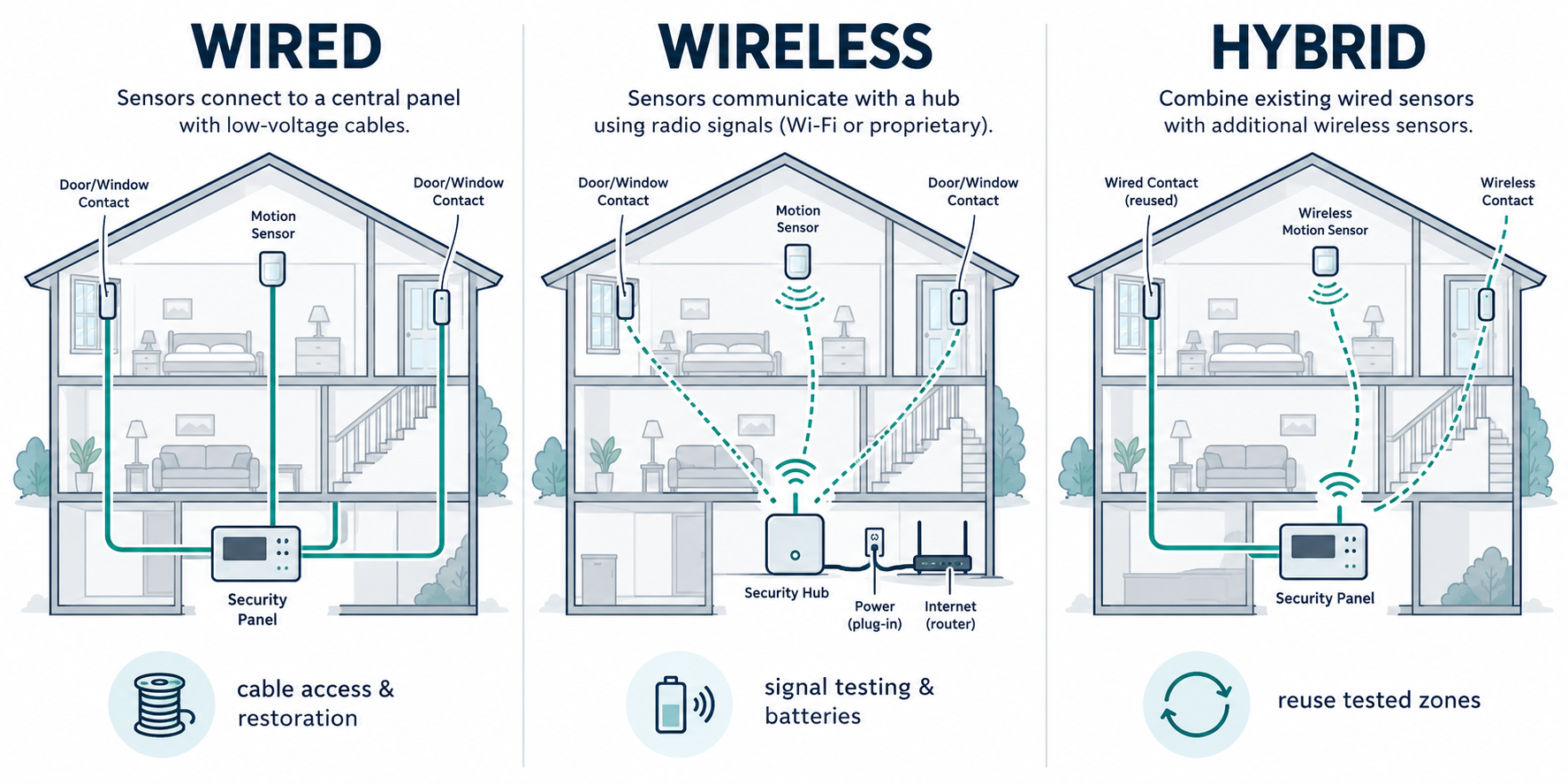
Wired and wireless alarms solve the same broad problem through different installation paths. A wireless system often costs less to install in a finished home because the installer can avoid pulling cable through walls. A wired system can make more economic sense during construction or when usable alarm cable already exists. A hybrid system sits between those choices.
For U.S. planning, a small wireless installation may fall around $400–$1,800, while a professionally installed wired or hybrid system may be roughly $1,000–$3,500. Larger systems, extensive access work, and integrated cameras can exceed those bands. These are U.S. examples, not Canadian prices.
What the labels actually mean
In a wired alarm, sensors communicate over cable to a panel or expansion module. The system may still use internet or cellular communication for app access or professional monitoring. In a wireless alarm, sensors use radio communication to a hub or panel; the hub still commonly needs line power, internet, cellular service, and backup power. “Wireless” does not mean independent of every wire or network.
Hybrid systems use both. They can be useful when a home has documented zones in accessible areas but difficult additions, masonry, detached spaces, or finished rooms where a new cable route would be expensive. The right comparison is therefore the installed and maintained system, not a choice between two device labels.
Cost difference at a glance
| Cost question | Wired or hybrid tendency | Wireless tendency |
|---|---|---|
| Equipment | Panel, wired expanders, cable, terminations, and sensors | Hub/panel, radio sensors, batteries, and possible repeaters |
| Finished-home labor | Cable fishing, drilling, access, and finish restoration can be substantial | Less wall access, but placement and signal testing remain |
| Open-wall work | Cable routes and central equipment can be efficient | May be economical for a small system |
| Maintenance | Fewer endpoint batteries, but panel and communications service remain | More battery planning and radio troubleshooting |
| Future changes | Spare cable and panel capacity can help | Device compatibility, range, and battery access matter |
The table describes tendencies, not guarantees. A well-planned wireless system may be more serviceable than undocumented legacy wire. A wired system with poor terminations or an inaccessible panel can be more expensive to maintain than its initial label suggests.
Where wired installation costs appear
The cable is only one part of a wired installation. A technician may need to identify routes, open a wall or ceiling, work through an attic or crawlspace, drill masonry, seal an exterior penetration, label zones, and repair the finish. A multi-story home can require more access time even when the sensor count is modest.
New construction or a major renovation changes the calculation. When walls are open, the incremental work for additional low-voltage pathways can be lower, and the equipment location can be designed before the finish surfaces close. It is still worth budgeting for cable, terminations, labels, testing, panel capacity, and documentation instead of assuming that “prewire” includes a complete alarm.
In an existing home, compare a concealed wired installation with a selective wired installation using accessible routes or surface raceway. A visible raceway may be a better economic decision than opening and repainting several rooms. Ask the installer to price restoration separately so a low cable-pull number does not hide the finish work.
Where wireless installation costs appear
Wireless reduces some cable labor, but it does not remove design work. The installer must choose hub and sensor locations, test radio paths, consider building materials and interference, verify battery access, and configure alerts. Exterior doors, detached buildings, metal surfaces, concrete, and long distances can require different equipment or additional communication planning.
The hub or panel still needs reliable power and a communication path. Internet-only communication can have different outage behavior from a system with cellular backup. Ask which parts of the system continue to operate locally during a power or internet failure and which alerts depend on a provider or cloud service. Product-specific behavior should be confirmed in current manufacturer documentation.
Battery replacement is an ownership cost. Per-device batteries may be inexpensive, but service time grows with the number of sensors, high mounting locations, seasonal occupancy, and the consequences of a missed low-battery notice. Ask whether the system reports battery status, whether the homeowner can replace batteries safely, and whether a service plan includes the visit.
Reusing existing alarm wiring
Existing cable can be valuable, but its presence is not proof of compatibility. A technician may need to trace undocumented runs, identify the sensor type, inspect terminations, test continuity and performance, and determine whether the proposed panel or module accepts the wiring arrangement. Old sensors may have mechanical wear, contamination, or obsolete interfaces even when the cable remains usable.
Include an explicit assumption in the quote: which zones are expected to pass testing, what happens if a run fails, and how much additional labor is authorized before a change order. A hybrid conversion can preserve the zones that are sound while using wireless devices in areas where reuse is not economical.
Reliability and serviceability
Neither architecture is automatically more reliable. Performance depends on product quality, installation, power, communications, radio conditions, cable condition, maintenance, and configuration. Wired equipment can fail at a panel, power supply, switch, or termination. Wireless equipment can fail because of battery, range, interference, account, or hub issues.
Serviceability is often the more useful homeowner question. Ask whether the system has a documented zone map, standard or proprietary devices, a supported replacement path, accessible batteries, and a clear owner account. A less expensive installation that cannot be diagnosed without opening walls or calling one provider may have a higher long-term cost.
The communication path deserves its own line item. A wired sensor system may still depend on cellular or internet services for remote notifications. A wireless sensor system may have local alarm functions but lose remote access when the hub cannot reach its service. The proposal should identify those dependencies without making a blanket reliability promise.
When hybrid is the sensible middle ground
Hybrid is often appropriate when the property has useful existing cable but a complete rewire would disturb too much finished surface. It can also fit a remodel where some rooms are accessible and others are not, or where a homeowner wants to preserve fixed perimeter zones while adding wireless environmental sensors.
Hybrid is not automatically the average of wired and wireless prices. It may require a panel or expansion modules that support both technologies, separate labor for each device type, additional programming, and more complicated documentation. Price the panel capacity, communication method, batteries, and future support rather than treating the architecture as a simple compromise.
Choosing by project condition
A primarily wired design tends to fit a new build, open-wall renovation, documented existing system, or large property where fixed cable pathways and service access have real value. Wireless tends to fit a modest finished home where the radio environment is suitable and power is available at the hub. Hybrid tends to fit a property with valuable existing zones plus expensive or inaccessible new routes.
The decision can also change over time. If the system is likely to grow, ask about spare panel capacity, supported devices, additional cable routes, and network capacity. If the property may be sold or transferred, documentation and account ownership matter. If the property is seasonal or remote, battery and communication alerts deserve more weight than a small initial labor saving.
How to compare quotes
Request the same scope from each bidder:
- number and type of protected openings and motion zones;
- panel, hub, keypad, siren, and communication path;
- wired, wireless, or hybrid device count;
- cable access, surface raceway, drilling, and restoration assumptions;
- battery and backup-power responsibilities;
- programming, testing, training, and documentation;
- monitoring, cellular, cloud, warranty, and service charges;
- treatment of failed existing zones and future additions.
If one quote assumes existing cable and another assumes wireless, ask both to describe the same coverage objective. If an installer has not tested wireless coverage or existing wire, the price is provisional. A useful quote explains what would cause the price to change.
U.S. and Canadian budgeting
For a Canadian project, request a quote from an installer serving the property’s area using the same scope: the device list, wiring route, panel compatibility, setup, and monitoring features. Ask the quote to separate equipment and labor, applicable site or restoration work, configuration or testing, recurring terms, taxes, and exclusions. Do not derive a Canadian amount by converting a U.S. band.
The most economical architecture is the one that delivers usable coverage, a workable communication path, manageable maintenance, and a supportable future—not necessarily the one with the lowest first invoice.
Key points
- Wireless often saves finished-wall labor, while wired can be economical during construction or with documented usable cable.
- Wireless still needs power, communications, signal planning, and battery maintenance.
- Wired still needs panel, communications, and service planning.
- Existing cable must be traced and tested before its reuse value is counted.
- Hybrid can be practical, but its panel, programming, and documentation costs should be quoted explicitly.