
In U.S. planning examples, adding concealed low-voltage wiring after construction may cost about $300–$900 per run. A small project may total $800–$3,000, while a multi-room retrofit with difficult walls, multi-story routes, patching, paint, and central equipment can reach $4,000–$15,000 or more.
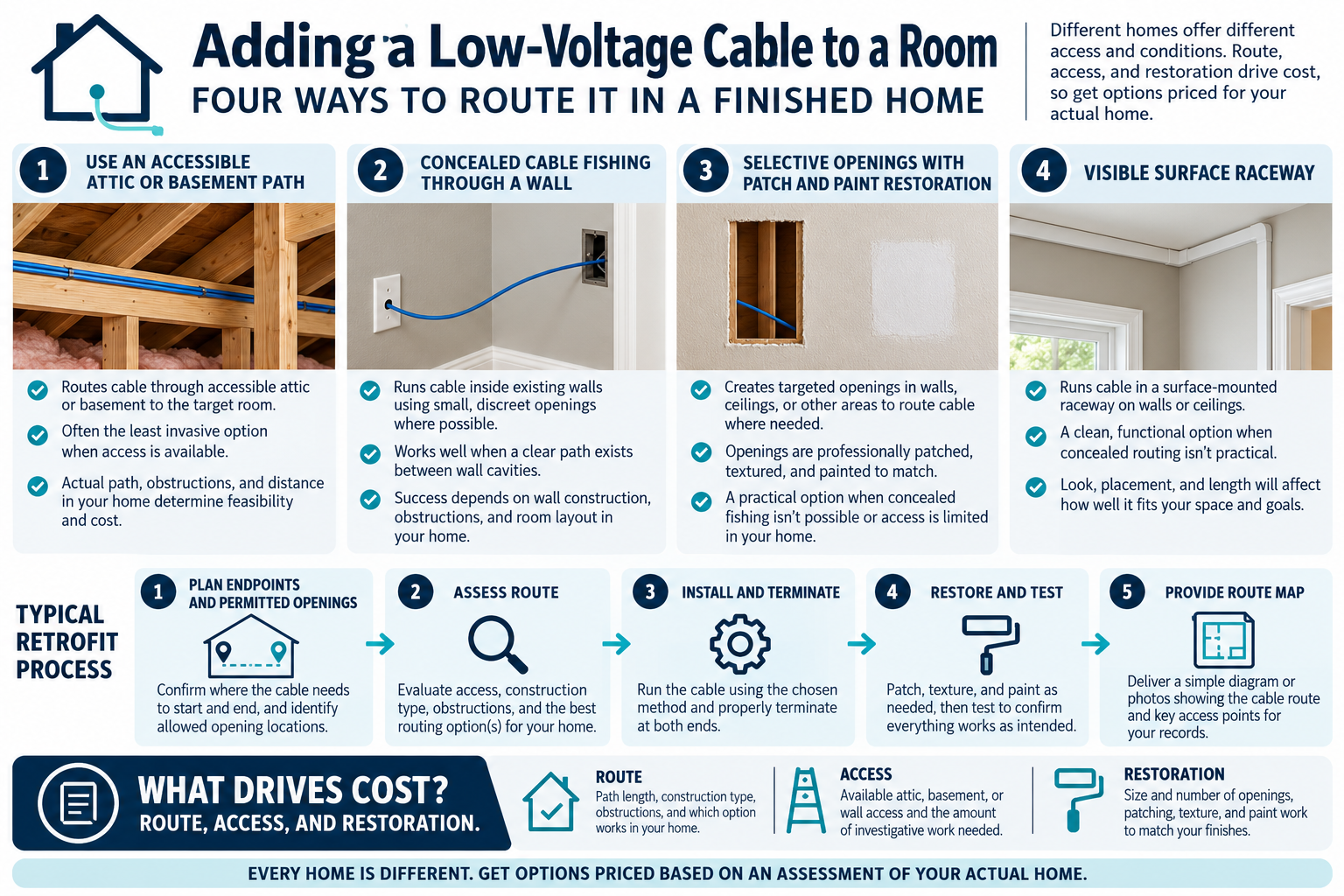
Retrofit cost is driven by access and restoration, not only cable. The same Ethernet, camera, alarm, intercom, or access-point run can be inexpensive along an unfinished basement and expensive through plaster, tile, masonry, finished ceilings, or several floors.
Why retrofit costs more than open-wall work
In a new build, cable can be routed before drywall and the central location can be planned. In a finished home, the installer may need to fish cable through concealed cavities, use attic or crawlspace routes, drill and patch small openings, work around insulation and fire blocking, or install visible raceway.
The work may also require a second trade for patching and painting. Ask whether restoration is included and to what finish standard. A “no visible wiring” requirement can be a major cost assumption.
Access-route options
The route determines the balance between installation labor, visible finish, future serviceability, and wall restoration. Ask the installer to price realistic alternatives when the preferred concealed path is uncertain.
Attic or crawlspace route
Accessible unfinished areas can reduce wall openings, but the route may still require drilling plates, crossing fire blocking, supporting cable, and working in cramped or hot conditions. Seasonal weather and insulation can affect labor.
Basement or utility chase
An unfinished basement, closet, or existing chase may offer a practical route. The installer still needs to reach the destination, terminate the cable, and protect or label it.
Selective openings
Small access openings can make a concealed route possible. They are not free: patching, texture matching, paint, trim, and cleanup add cost.
Surface raceway
Raceway can reduce destructive access and make future service easier. It may be acceptable in a garage, utility room, closet, or along a less visible wall. Compare its appearance and serviceability with the cost of concealed work.
Wireless or coax alternative
For a modest need, verified Wi-Fi, a wireless camera, or coax-to-Ethernet adapters may avoid wall work. Those alternatives introduce their own coverage, power, topology, and maintenance conditions.
Main labor drivers
Price changes with:
- wall and ceiling material;
- number of floors and route length;
- attic, crawlspace, basement, and chase access;
- masonry, tile, insulation, and fire-blocking conditions;
- cable endpoint and central equipment locations;
- exterior or weather-exposed routing;
- surface raceway versus concealed work;
- patching, painting, and finish expectations;
- number of runs bundled during the same visit.
Cable material can be a small share of the total. Ask for a route plan and access assumptions rather than a generic per-foot price.
Bundling several low-voltage projects
If a homeowner needs Ethernet, cameras, access points, alarm zones, a doorbell, or an intercom, bundling routes can reduce repeated openings and travel. The paths may not be interchangeable, and each system still needs its own termination, testing, power, and documentation.
Coordinate the central panel or rack before work begins. A cable retrofit that leaves equipment scattered in multiple closets may solve one connection while increasing future service cost.
Restoration and hidden conditions
Patch and paint are often separate in low-voltage quotes. Ask who moves furniture, removes trim, repairs openings, matches texture, and cleans up. Hidden insulation, fire blocking, masonry, asbestos-containing materials, water damage, or inaccessible cavities can change the route.
Do not approve a “concealed wiring” price without a change-order rule. The installer should identify what happens when the proposed route cannot be fished or when a wall opening needs more extensive repair.
Choosing between retrofit and alternatives
Concealed new cable may be worthwhile when the connection is important, expected to last, and difficult to replace later. Raceway may be better where service access and price matter more than invisibility. Coax reuse may make sense where the cable topology and condition are suitable. Wireless may suit a small, accessible device when coverage and power are reliable.
The decision is not simply wired equals good and wireless equals cheap. Compare performance objective, future service, equipment lifecycle, appearance, access, and five-year ownership cost. The separate Ethernet, mesh, access-point, and coax guides provide more focused comparisons.
U.S. and Canadian budgeting
For a Canadian project, request a quote from an installer serving the property’s area using the same scope: run count, wall and ceiling access, patching and paint, restoration, equipment, and test records. Ask the quote to separate equipment and labor, applicable site or restoration work, configuration or testing, recurring terms, taxes, and exclusions. Do not derive a Canadian amount by converting a U.S. band.
Low-voltage licensing and permit rules vary. This guide does not establish a universal requirement; verify the applicable local rule with the qualified contractor or authority.
What a retrofit quote should include
Ask for:
- endpoint list and intended system;
- proposed routes and access assumptions;
- wall openings, raceway, drilling, firestopping, and exterior sealing;
- cable, terminations, panels, switches, and power boundaries;
- patching, painting, trim, and cleanup;
- testing, labels, maps, photos, and documentation;
- bundled-work savings and change-order rules;
- wireless or coax alternatives if access is disproportionate.
Planning the access decision
Before work begins, walk the proposed route with the installer and identify which surfaces are allowed to open, which rooms must remain untouched, and what finish standard is expected afterward. A route that is economical from the attic may be impractical if it crosses fire blocking or ends behind built-in cabinetry. Conversely, a short surface raceway in a utility room may avoid a large restoration allowance. Ask for a good, better, and least-disruptive option when the route is uncertain.
It is also useful to separate the cost of getting a cable to a location from the cost of the device that will use it. A camera, access point, alarm, or intercom can be selected later if the pathway is documented. If the project is already opening ceilings or walls for another renovation, the incremental cost of adding several low-voltage runs may be lower than a later one-device visit. Have the installer label every run and record inaccessible cavities so future work does not repeat the same investigation.
Deciding whether to open the wall
The retrofit decision should compare disruption with the value of the connection. A wired path may be worthwhile for an access point, camera recorder, home office, alarm panel, or other endpoint that needs predictable service and will remain in place for years. It may be unnecessary for a temporary device or a room that already has reliable Wi-Fi. Coax reuse, a surface raceway, or a carefully tested wireless link can preserve value without treating every concealed route as mandatory.
Ask for the least-destructive route and the most durable route as separate options. Include the cost of moving furniture, removing trim, patching, painting, and cleaning. If a contractor says a run is “easy,” ask whether that assumes open access, a particular wall cavity, or no restoration. The price should identify those assumptions before work starts.
When several systems need wiring, schedule them together. Camera, Ethernet, access-point, alarm, doorbell, and intercom runs may share some access work, but they still need separate endpoints and tests. A single coordinated visit can save repeated disturbance and produce a more useful central map.
How to compare disruption with permanence
Ask whether the connection is likely to remain useful through a sale, remodel, or equipment change. A concealed run can be worthwhile when it supports a central network, camera, or access point for many years. A raceway or wireless alternative may be better when the device is temporary or the route is likely to change. Include future removal, access, and service in the comparison.
Before approving a retrofit
Ask how the finished result will be inspected before furniture and trim are returned. Confirm that cables are labeled, openings are closed, and the owner receives the route and test records. If the installer cannot use the proposed route, pause for a revised price rather than accepting an unbounded change order.
Setting a useful stopping point
The retrofit is complete when the intended endpoint works, the route and restoration are documented, and the owner understands future service. Further cable work should be justified by another concrete device or coverage need rather than added simply because access has already begun.
Key points
- Finished-home access and restoration often cost more than cable.
- Attics, crawlspaces, basements, chases, raceway, and selective openings create different price paths.
- Bundling several low-voltage runs can reduce repeated access, but each system still needs testing and documentation.
- Wireless or coax reuse can be economical alternatives when their limitations are acceptable.
- Require a route plan and explicit restoration and change-order assumptions.
Final quote checkpoint
Before work begins, agree which surfaces may be opened, the finish standard, who handles furniture and restoration, and the change-order trigger if the assumed route fails. For bundled systems, share access work but list each endpoint and test separately. Require closeout records for labels, route limits, test results, and photos before openings are restored.