
An older hardwired alarm does not automatically need a complete rewire. Existing cable, door contacts, motion sensors, and sirens may be reusable, while the panel, keypad, communicator, backup battery, or software may be obsolete. The economic question is how much of the installed system can be identified, tested, supported, and carried into a modern design.
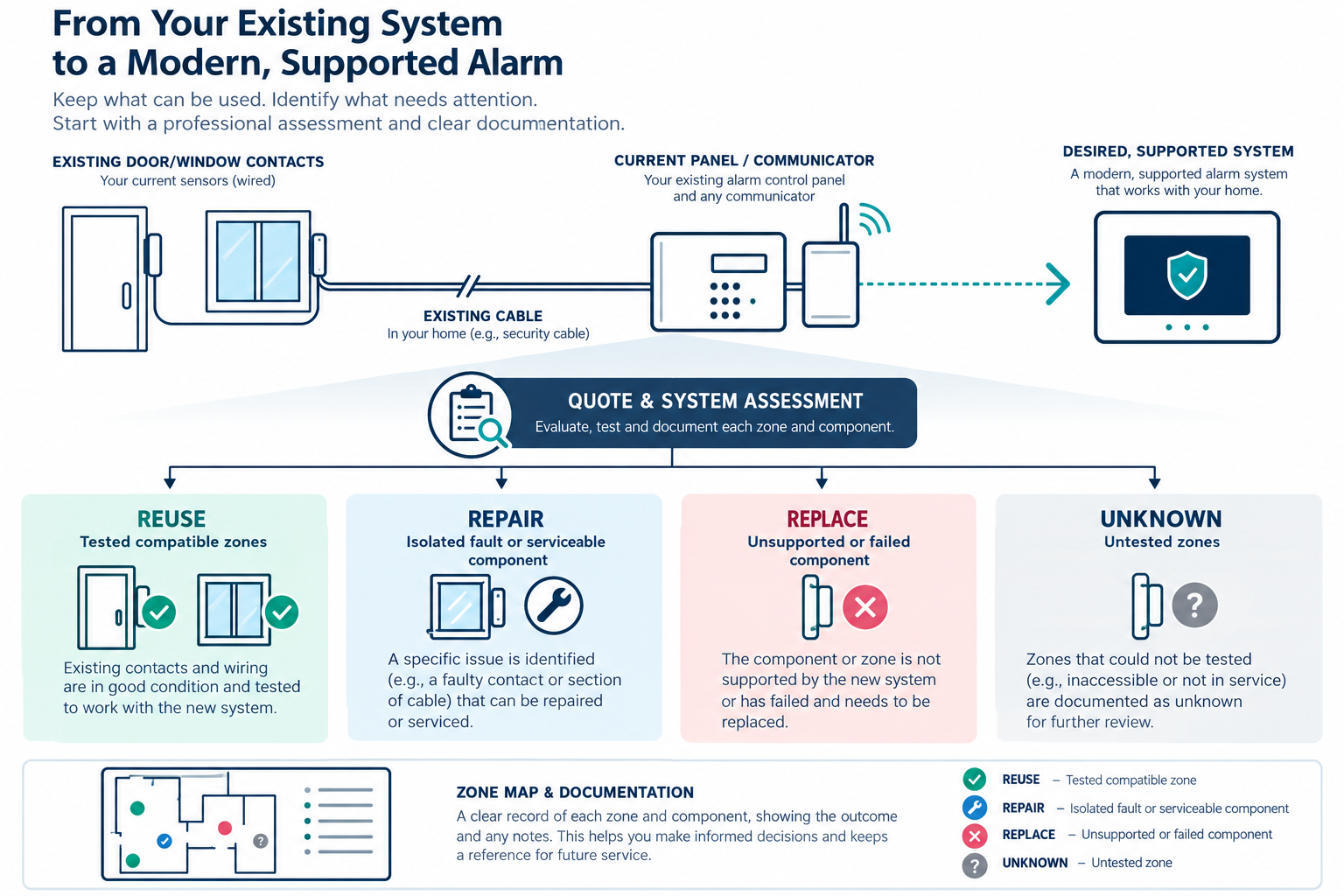
U.S. planning examples put a targeted panel or communicator upgrade around $600–$2,000 when existing zones are accessible and compatible. A larger hybrid conversion or replacement may reach $2,000–$6,000, especially when wiring is undocumented, sensors fail, or the system is integrated with cameras and access control. These are broad U.S. ranges, not compatibility guarantees.
Why an old alarm can still have value
Alarm cable is often concealed and expensive to replace in a finished home. If the routes are sound, reusing them can avoid wall access, patching, painting, and repeated disturbance. A documented zone map can also make future repair faster.
Reuse is not the same as keeping every old component. The original system may have a functioning cable path but a panel that no longer supports the desired communication method. Some sensors may be standard enough to reuse; others may use a proprietary interface or have reached the end of their useful service life. The installer must assess the complete chain from sensor to panel to communication service.
What may be reusable
An installer may evaluate:
- cable routes and conductor condition;
- door and window contacts;
- motion or glass-break sensors;
- sirens and auxiliary devices;
- keypads and enclosures;
- zone labels and existing documentation;
- power paths and accessible equipment locations.
The test should be specific. Ask whether the quote includes tracing, continuity, resistance or device testing, inspection of terminations, and confirmation that the proposed panel recognizes the existing zone type. A cable that shows continuity is not necessarily proof that every device on it is reliable or compatible.
Existing wiring can also be valuable because residential low-voltage infrastructure may support several functions, but do not repurpose a cable without confirming its design, condition, and the requirements of the new equipment. The technical decision belongs in the installer’s scope.
What commonly requires replacement
The panel or main controller is often the first candidate because it determines supported sensors, communication, programming, and future expansion. A communicator may need modernization if the old system relies on a service no longer provided or lacks the desired backup path. Keypads may be replaced when they are incompatible, damaged, difficult to read, or unable to support the new user interface.
Backup batteries, power supplies, sirens, and motion sensors may be service items rather than automatic replacement items. A professional should explain why each is retained or replaced. The homeowner should receive a clear list rather than a vague “upgrade package.”
Upgrade paths
The least expensive path is not always the one with the fewest new devices. Compare the amount of reusable wiring, compatibility testing, programming, and future support in each option.
Panel and communicator replacement
This is the narrowest path. It can work when existing zones are documented, testable, and supported by the new equipment. The price includes the controller, communicator, battery, programming, testing, and any keypad or module changes. Compatibility must be confirmed for the actual products; general statements about “universal” reuse are unsafe.
Hybrid conversion
A hybrid system keeps selected wired zones and uses wireless devices for additions or failed areas. It can reduce wall work while avoiding the cost of maintaining every legacy component. It may require a compatible receiver or expansion module, new batteries, and additional programming.
Full system replacement using old routes
In some homes the cable is usable but the devices are too old, damaged, or poorly documented. A new panel and sensors can use the old pathways, but this still involves more device labor than a panel-only upgrade. Include testing and zone labeling.
Abandonment and wireless replacement
If tracing the cable is unusually difficult or the routes are inaccessible, a wireless system may be cheaper than proving each zone. That decision should account for signal testing, battery service, communication, and future support. Abandoned cable should be documented so a future owner or technician is not misled.
Cost drivers
The biggest factors are:
- Documentation. Missing zone maps increase tracing and identification time.
- Access. A panel in a finished closet is different from equipment in an accessible utility room.
- Zone count. More endpoints mean more tests, labels, programming, and potential failures.
- Compatibility. Specific panel, sensor, keypad, communicator, and account requirements must align.
- Condition. Corrosion, damaged cable, loose terminations, and old batteries can turn an upgrade into repair.
- Communication. Internet, cellular, or dual-path service changes equipment and recurring fees.
- Integration. Cameras, locks, intercoms, water sensors, and automation add programming and network work.
- Ownership. A provider-locked system may have different transfer and service economics from an owner-controlled design.
Ask for a price for assessment before approving a large replacement. A paid diagnostic visit can prevent paying for a complete system when the real issue is a single zone, battery, or communicator.
When undocumented wiring raises the budget
An installer may need to locate both ends of a cable, determine which endpoint is connected, test it, identify the sensor type, and create a new map. If several cables converge in a panel with no labels, the labor is not just “connecting a new panel.” The deliverable should include labels, a zone schedule, and a record of any abandoned or inaccessible run.
Do not approve a proposal that assumes all existing zones will work without a stated change-order rule. Ask how failed runs are priced, whether a wireless substitute is available, and whether the technician will stop for authorization when the scope expands.
Repair, upgrade, or replacement?
Repair makes sense when the equipment is supported, the fault is isolated, the cable and devices test well, and the system still meets the homeowner’s desired communication and coverage needs.
An upgrade tends to make sense when the cable is sound but the controller, communicator, keypad, or software is outdated. A hybrid design can be a reasonable middle path when only some zones are difficult.
Full replacement is more attractive when the equipment is proprietary or unsupported, multiple zones fail, documentation is absent, replacement parts are unavailable, the desired features cannot be added, or the assessment labor approaches the cost of a new supported system. Compare future service and recurring fees, not only the initial invoice.
Safe scope boundaries
This is a planning guide, not a procedure for disconnecting a panel, bypassing a sensor, or disabling an alarm. A homeowner should not rely on trial-and-error wiring changes to test a security system. Ask the qualified installer how the system will be placed in service, tested, and handed over.
If the system is connected to life-safety devices or controlled access, product compatibility and applicable requirements deserve more careful verification. Do not generalize an alarm panel’s ability to handle smoke detectors, locks, or door releases from a different product family.
Questions for an alarm contractor
Ask:
- Which existing zones and sensors were actually tested?
- Which components are being reused, and why?
- What exact products replace the panel and communicator?
- Is the system owner-controlled or tied to a service provider?
- What happens if a cable or sensor fails during installation?
- Is a hybrid path priced as an alternative?
- Will the quote include labels, zone documentation, user setup, and testing?
- What are monitoring, cellular, warranty, and future service charges?
- What equipment, accounts, and credentials will the homeowner own?
Use a written assessment to separate known facts from assumptions. A clear “reuse,” “replace,” or “unknown” status for each zone is more useful than a single percentage allowance.
U.S. and Canadian cost boundaries
For a Canadian project, request a quote from an installer serving the property’s area using the same scope: the panel and communicator, preserved zones, troubleshooting allowance, replacement sensors, programming, and service terms. Ask the quote to separate equipment and labor, applicable site or restoration work, configuration or testing, recurring terms, taxes, and exclusions. Do not derive a Canadian amount by converting a U.S. band.
The best upgrade is the one that preserves useful infrastructure without leaving the homeowner with unsupported hardware, undocumented zones, or a service model they cannot change.
Key points
- Existing cable may save substantial access labor, but it must be traced and tested.
- Panel, communicator, keypad, sensors, batteries, and programming are separate decisions.
- A hybrid conversion can avoid both a full rewire and a wholesale wireless replacement.
- Undocumented or proprietary systems can make assessment labor the dominant cost.
- Ask for zone-by-zone reuse decisions and a change-order rule before approving work.
Final quote checkpoint
Before approving an upgrade, request a zone-by-zone survey that records cable condition, sensor type, end-of-line components, panel compatibility, communicator path, keypad behavior, and any unknown. Ask the installer to price reuse, replacement, and hybrid options separately, including programming, batteries, monitoring takeover, labels, user setup, and final testing. Confirm who owns the panel configuration and account credentials after the work. If a legacy product is proprietary or unsupported, the lowest immediate upgrade price may leave the homeowner with another difficult transition. Keep local permit, false-alarm, dispatch, and insurance questions with the applicable authority or provider. A complete handoff includes the final zone list, tested signals, equipment models, and documented limitations.