
In U.S. planning examples, tracing and documenting inherited low-voltage wiring may cost about $300–$1,200 for a modest visit covering accessible cables and basic testing. A large home with dozens of runs, multiple cable types, inaccessible routes, cable certification, retermination, diagrams, and repair recommendations can cost $1,200–$4,000.
This is an infrastructure condition assessment, not automatically a statutory electrical or building inspection. Its value is identifying what exists, what works, how it is connected, and what should be repaired before a homeowner buys, remodels, or installs new equipment.
When an inspection is useful
Homeowners often need this service when:
- a house has unlabeled Ethernet, coax, alarm, camera, speaker, or control cable;
- a previous owner removed equipment but left wiring;
- a remodel exposed or damaged low-voltage paths;
- an alarm or network upgrade depends on existing cable;
- a central panel or rack is full of unknown terminations;
- a home purchase includes undocumented technology;
- an installer needs a map before adding new systems.
A clear inventory can prevent duplicate cable pulls, unnecessary replacement, and wasted troubleshooting. It can also reveal that a seemingly valuable cable is damaged, inaccessible, or unsuitable for the intended system.
What technicians can trace and test
The scope may include:
- identifying both ends of a cable;
- continuity, pinout, or basic link testing;
- cable qualification or certification where appropriate;
- inspecting jacks, connectors, patch panels, and splices;
- labeling outlets, runs, and central ports;
- mapping the central panel or rack;
- identifying abandoned or inaccessible cables;
- testing Wi-Fi coverage or network endpoints;
- recommending retermination, replacement, or new routes.
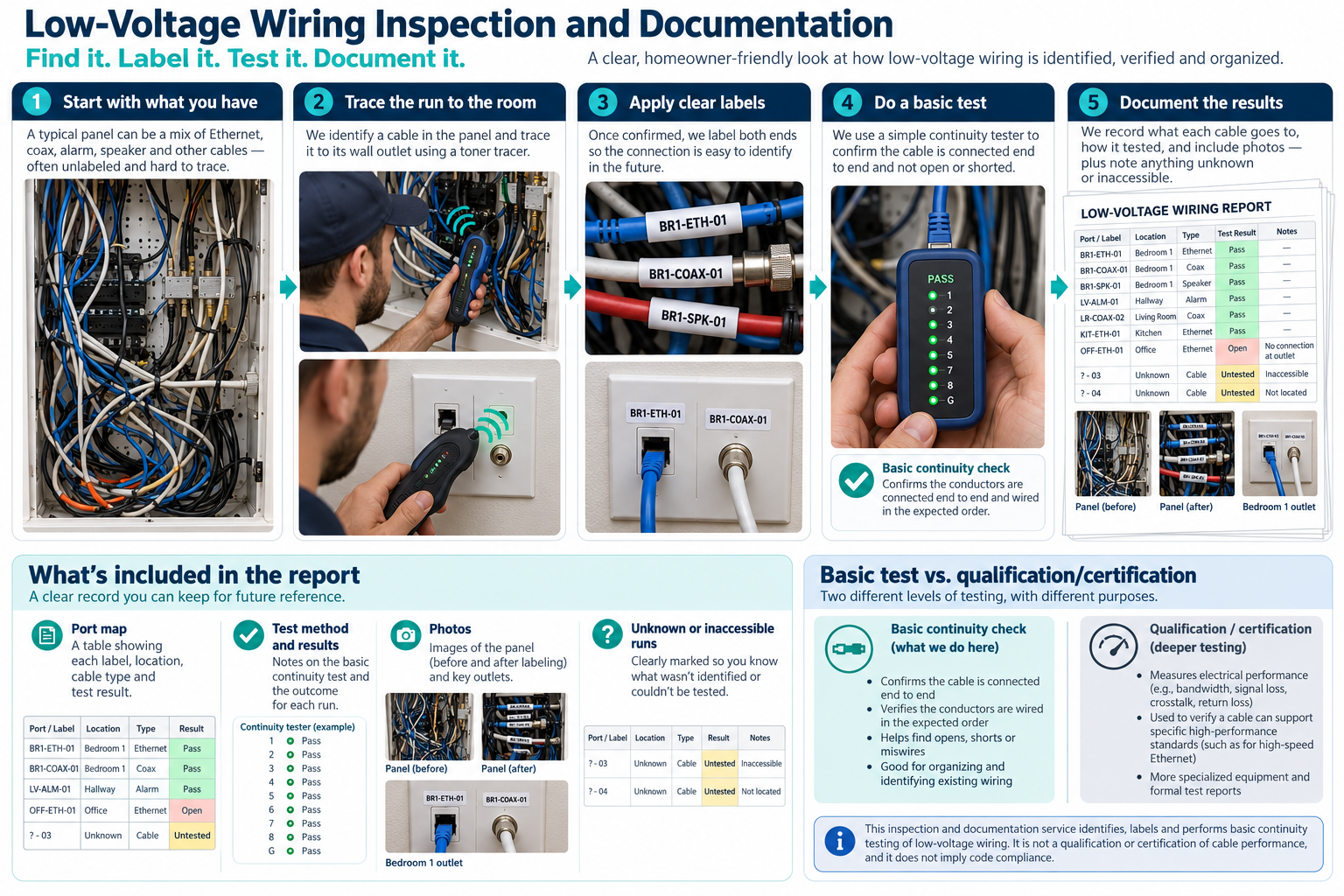
The test level matters. A tone tracer can help locate a cable. A continuity test can identify a basic conductor problem. A network link test can show that a port negotiates. A deeper cable qualification or certification answers a different question. Ask for the method and deliverable.
Labor and number-of-run cost drivers
Pricing is usually labor-based. It changes with:
- number and type of runs;
- access to the central location and room endpoints;
- cable congestion and missing labels;
- attic, crawlspace, basement, or finished-wall conditions;
- height, masonry, or exterior locations;
- test depth and equipment required;
- retermination or repair;
- drawing, photography, and documentation expectations;
- travel and specialist availability.
Twenty accessible labeled network runs are a different job from twenty unknown cables in a crowded panel with no room to work. Ask for an included run count and a price for additional runs.
Basic verification versus deeper qualification
A basic inventory can answer where a cable seems to go and whether it is continuous. A deeper service may identify cable type, inspect terminations, test network performance, verify a cable against a selected standard, and produce a formal report.
The right level depends on the decision. A homeowner choosing whether to reuse alarm cable may need zone and sensor testing. A homeowner installing a wired access-point system may need cable qualification and a port map. A home buyer may first need an inventory and risk assessment before paying for every run.
Do not purchase a formal certification report when a simple map answers the immediate question, but do not call a visual check a certification.
Labeling and documentation
Useful deliverables include:
- room and outlet labels;
- central panel or rack port map;
- cable type and endpoint inventory;
- test method and result;
- photos of concealed routes before finishes close;
- diagram of switches, patch panels, hubs, and controllers;
- list of failed, abandoned, or inaccessible runs;
- repair and future-installation recommendations.
Documentation has long-term value. It can reduce the cost of a future network, camera, alarm, intercom, or automation project. Make sure the homeowner receives the files and not only a technician’s private record.
Common follow-on repairs
Inspection often finds loose jacks, poor terminations, short cables, damaged coax, missing labels, obsolete equipment, inaccessible routes, or a central location that lacks space or ventilation. These should be priced separately when possible.
A technician may recommend new Ethernet, a wireless system, coax adapters, a rack, a panel, or an alarm upgrade. The inspection should distinguish observed condition from the proposed improvement. A finding that a cable is unknown is not proof that it must be discarded.
Boundaries and safety
This service is not an automatic code or statutory electrical inspection. Low-voltage wiring can still interact with line-voltage systems, fire-rated assemblies, access-control egress, security devices, or other consequential infrastructure. Use qualified professionals for those questions and keep the report within its actual test scope.
Do not infer that a cable is safe, code-compliant, or suitable for a new function merely because it is present or passes a basic continuity test.
U.S. and Canadian budgeting
For a Canadian project, request a quote from an installer serving the property’s area using the same scope: run count, cable types, access, certification, retermination, diagrams, and repair recommendations. Ask the quote to separate equipment and labor, applicable site or restoration work, configuration or testing, recurring terms, taxes, and exclusions. Do not derive a Canadian amount by converting a U.S. band.
What the quote should state
Ask:
- Which cable types and how many runs are included?
- Is the work tracing, basic testing, qualification, certification, or all four?
- Are outlets, jacks, patch panels, alarm zones, cameras, and control wires included?
- What access and restoration assumptions apply?
- Are reterminations and repairs included or separate?
- What labels, maps, photos, test results, and report format will be delivered?
- Is this separate from a statutory electrical or building inspection?
- What follow-on work is optional?
Choosing the right inspection depth
Start with the decision that the report needs to support. A buyer may need an inventory of central equipment and unknown runs. An alarm upgrade may need zone-by-zone sensor and cable testing. A network installation may need cable qualification, port mapping, and access-point survey. A formal certification is valuable only when its test question and deliverable are understood.
Ask the technician to separate observed facts from recommendations. An inaccessible cable is not automatically failed, and a basic link is not automatically a certified installation. A clear report allows the homeowner to budget follow-on repairs without paying for work that the inspection did not establish.
A useful report for a future project
The report should be written for the next person who has to use the infrastructure. It should identify each room endpoint, central termination, cable type when known, test method, result, and confidence or limitation. Use a consistent label at both ends. If a run could not be traced, mark it unknown rather than assigning a guessed destination.
For an alarm, include the zone name, sensor, panel terminal or module, and whether the device was tested. For Ethernet, include the jack, patch-panel position, switch port, and test result. For coax, identify splitters and any service that shares the path. For camera or control wiring, record the endpoint and power or network assumptions.
Ask for digital copies of diagrams, photos, and test results. Keep them with the property records and update them when equipment moves. A report that only says “wiring checked” is unlikely to prevent another diagnostic visit.
How the result supports a later decision
Use the report to separate usable infrastructure from infrastructure that is merely present. A cable can be retained, repaired, rerouted, or left unused, and each choice has a different later cost. The technician should state what the test established and what it did not establish. That prevents a future installer from treating an unknown run as a guaranteed network, alarm, or control path.
Before approving follow-on work
Ask for separate prices for retermination, new cable, equipment replacement, and documentation updates. The inspection should not turn every unknown into an automatic replacement recommendation. A staged plan can preserve useful infrastructure while resolving the highest-value uncertainty first.
Setting a useful stopping point
Stop when the report answers the immediate decision and records the remaining uncertainty. Repeated testing of a cable that cannot be accessed may add cost without adding useful evidence; a new route or a different system may be the better next step.
Key points
- Inspection and documentation are paid infrastructure services, usually priced by labor and run count.
- Basic continuity, cable qualification, and formal certification answer different questions.
- Labels, maps, test results, and photos can lower future installation and troubleshooting cost.
- Unknown wiring should be assessed rather than automatically discarded.
- Keep infrastructure assessment separate from statutory inspections and consequential safety work.
Final quote checkpoint
State the decision the report must support and the test level required; continuity does not establish every network or PoE use. Have the installer identify cable types, endpoints, test method, and certification standard where applicable, and mark inaccessible or untested runs as unknown. Provide any authority or buyer requirement before the visit. Require a port-identified report another technician can interpret.