
A connected smoke and carbon-monoxide monitoring upgrade may cost about $300–$1,500 in U.S. planning examples for replacement devices, compatible communication, setup, and basic monitoring. A larger home with many interconnected alarms, hubs, professional installation, replacement wiring, integration, or a service plan can cost $1,500–$4,000.
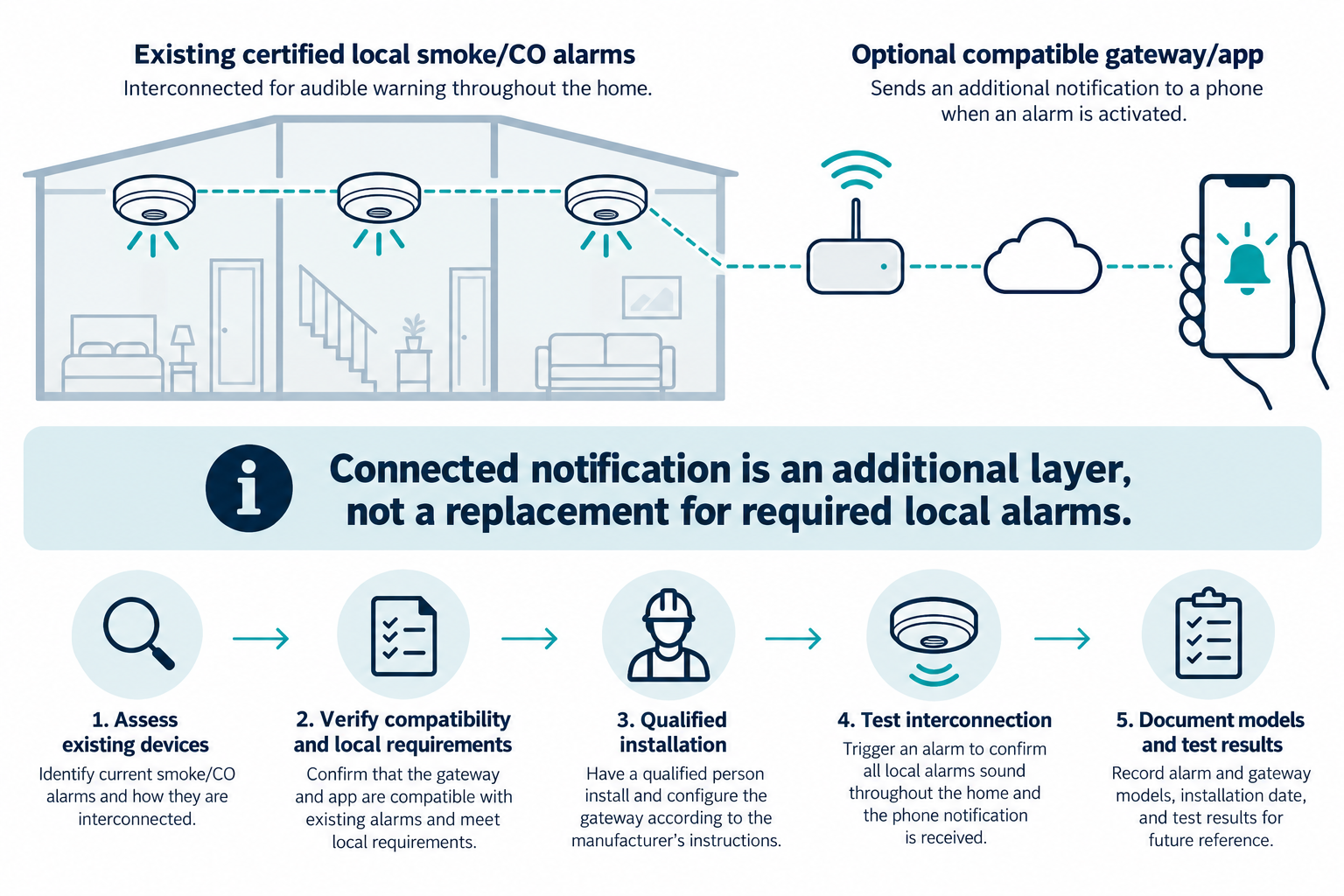
This is a life-safety project. The cost guide can explain equipment and labor categories, but it is not a substitute for the applicable jurisdiction’s requirements, the manufacturer’s interconnection instructions, or qualified assessment. A connected feature does not automatically make a product compliant for every location.
What “smart monitoring” adds
A conventional alarm provides local warning. A connected upgrade may add remote notifications, app status, battery alerts, device health, interconnection through a compatible platform, professional monitoring, or automation. It may also require replacing otherwise functional detectors because the new device uses a different system or certification.
The project may include:
- smoke alarms, CO alarms, or combination units;
- interconnected devices and compatible wiring or wireless interconnect;
- hubs, gateways, controllers, or a security panel;
- power, batteries, mounting, and removal of old units;
- app, account, notification, or professional monitoring setup;
- testing, documentation, and owner handoff.
Avoid comparing only the smart alarm’s retail price. The number and type of existing units, access, interconnection, compatibility, and required professional work can dominate.
Device and installation cost categories
| Cost category | What changes it |
|---|---|
| Devices | Smoke-only, CO-only, combination, connected, battery, hardwired, and listed product type |
| Existing system | Number of alarms, interconnect method, age, wiring, and compatible replacement path |
| Access | Ceiling height, finished surfaces, attic routes, and removal or repair |
| Connectivity | Hub, gateway, panel, Wi-Fi, app, cellular, or professional service |
| Commissioning | Device enrollment, interconnection test, notification test, documentation, and training |
| Recurring cost | Monitoring, cloud status, support, batteries, and future replacements |
The quote should identify whether the installer is replacing all units, adding a connected bridge, or integrating with an existing alarm. “Smart” is not a sufficient specification.
Existing interconnected systems
An existing home may have hardwired alarms connected to one another, wireless interconnect, battery units, or a mixture. A new device must be compatible with the system’s interconnection method and the manufacturer’s instructions. A device that communicates with an app may not interconnect locally with a different alarm family.
The installer should identify which units are being retained, which are replaced, how the interconnection will be tested, and whether the system remains within the selected product’s supported configuration. Do not infer compatibility from a shared brand, app, or protocol name.
The Connectivity Standards Alliance describes Matter as an open protocol using Bluetooth Low Energy for setup and Wi-Fi, Thread, or Ethernet for connectivity, and lists safety and security sensors among device categories. It also says support for categories and implementation are evolving. Matter compatibility therefore does not prove that a particular smoke or CO product satisfies the property’s life-safety or interconnection requirements.
Certification and code boundaries
UL identifies UL 217 for smoke alarms and UL 2034 for CO alarms, with combination units meeting both in the cited certification context. Device certification, placement, interconnection, power, replacement timing, and installation requirements still need to be checked for the actual product, building, and jurisdiction.
U.S. and Canadian requirements can differ, and local rules can differ within each country. This article does not provide detector-placement instructions, a universal replacement interval, or a code conclusion. When the upgrade affects required alarms, a rental, a shared building, a renovation, or a life-safety system, consult the applicable authority and a qualified professional.
Connectivity and monitoring
Remote notification may use Wi-Fi, a hub, a security panel, cellular service, or a cloud account. Ask what happens during power, internet, hub, or subscription failure. A local alarm should not be treated as replaced by a phone notification. If professional monitoring is added, price it as a separate service with its own response agreement.
Account ownership and notification recipients matter. Keep the homeowner’s administrator account and recovery method, and document which family members or caregivers receive alerts. Remove old users when the property or system changes hands.
Replacement and end-of-life costs
Connected alarms still need batteries or eventual device replacement. Replacing a single unit may be difficult if the system depends on matched devices or a shared interconnect. A whole-home upgrade may be more economical when the existing alarms are near replacement, unsupported, or incompatible with the desired platform.
Ask how future devices will be added, whether the current controller is supported, what happens if the cloud service changes, and how the system is tested after replacement. Do not assume that a longer support life or a permanent subscription is guaranteed without current manufacturer terms.
When professional assessment is appropriate
Professional assessment is especially important when the home has hardwired or interconnected alarms, unusual ceiling or wiring conditions, a rental or shared-property arrangement, a renovation, a monitored alarm, or a question about required devices. The professional should document the equipment, interconnection, test result, and any limits.
This guide does not provide instructions for removing or disabling alarms. Do not leave a home without required working warning devices while waiting for a connected upgrade.
U.S. and Canadian budgeting
For a Canadian project, request a quote from an installer serving the property’s area using the same scope: device count, compatibility and interconnection, installation, monitoring terms, and required qualified work. Ask the quote to separate equipment and labor, applicable site or restoration work, configuration or testing, recurring terms, taxes, and exclusions. Do not derive a Canadian amount by converting a U.S. band.
The cost range should be treated as a project-planning band. Higher-consequence claims about certification, code, placement, interconnection, or monitoring must come from the applicable authoritative source, not from a general cost guide.
Questions before approving
Ask:
- What exact smoke, CO, or combination products are proposed?
- Are the products certified and supported for the intended use?
- How will existing hardwired or wireless interconnection be handled?
- Are all existing units replaced or only selected units?
- What hub, network, panel, app, cellular, or subscription is required?
- What happens during power or network failure?
- Who owns the account and receives notifications?
- What local requirements or professional assessment apply?
- What testing, documentation, and future replacement plan are included?
Making the upgrade decision
First determine whether the existing alarms are approaching replacement, whether they are interconnected, and whether the desired remote notification is available through a compatible panel or product. Replacing all devices can cost more than adding a bridge, but a partial change may create an unsupported mix. The proposed configuration should be written down and checked against the actual manufacturer instructions.
Treat life-safety work differently from ordinary smart-home setup. Test the final local alarms and interconnection, keep required devices in service, and do not assume that an app alert replaces an audible alarm. If a professional cannot establish compatibility, the responsible decision may be to narrow the connected scope while preserving properly supported alarm coverage.
The quote should also state what happens to old devices, batteries, wiring, and monitoring accounts. Removal and disposal can be part of the labor. A connected upgrade may require a whole set of matching devices even when only one alarm is being replaced. Ask for a temporary protection plan if work cannot be completed in one visit, and keep a record of the final models, interconnection method, test date, and owner account.
Keeping the scope honest
Separate the cost of required alarm replacement from optional app, cloud, or professional monitoring features. A homeowner may choose connected notifications after confirming that the local alarm system remains supported and compliant for the actual property. Price the connected layer as an addition, not as a reason to defer a needed alarm replacement or to treat a phone alert as the only warning.
Key points
- Connected smoke and CO upgrades cost more when they replace an interconnected system or require professional commissioning.
- Certification and product compatibility are not the same as universal code compliance.
- U.S. and Canadian requirements must be checked separately and locally.
- A smart notification is not a substitute for a required local alarm or an emergency response plan.
- Use qualified professionals for consequential installation, interconnection, and life-safety questions.
Final quote checkpoint
Before approving, record the age, model, location, interconnection method, power source, and replacement status of every affected alarm. Ask which units remain active during installation, whether the proposed device is listed and compatible for its intended use, whether all units must match, and what local requirements apply. Separate required replacement from optional app, cloud, or monitoring costs. Confirm that local audible warnings work through internet, power, or account failure and who performs the final test. Keep model records, interconnection results, account ownership, and battery information with the property file; include a temporary protection plan if work spans visits. Remote notification remains an additional layer, not the sole life-safety measure.