
A basic temperature or freeze-monitoring setup may cost about $100–$500 in U.S. examples for one or more sensors, a gateway, setup, and basic alerts. A remote or seasonal property with cellular communication, backup power, multiple zones, professional notification, or leak and shutoff integration can reach $500–$2,000.
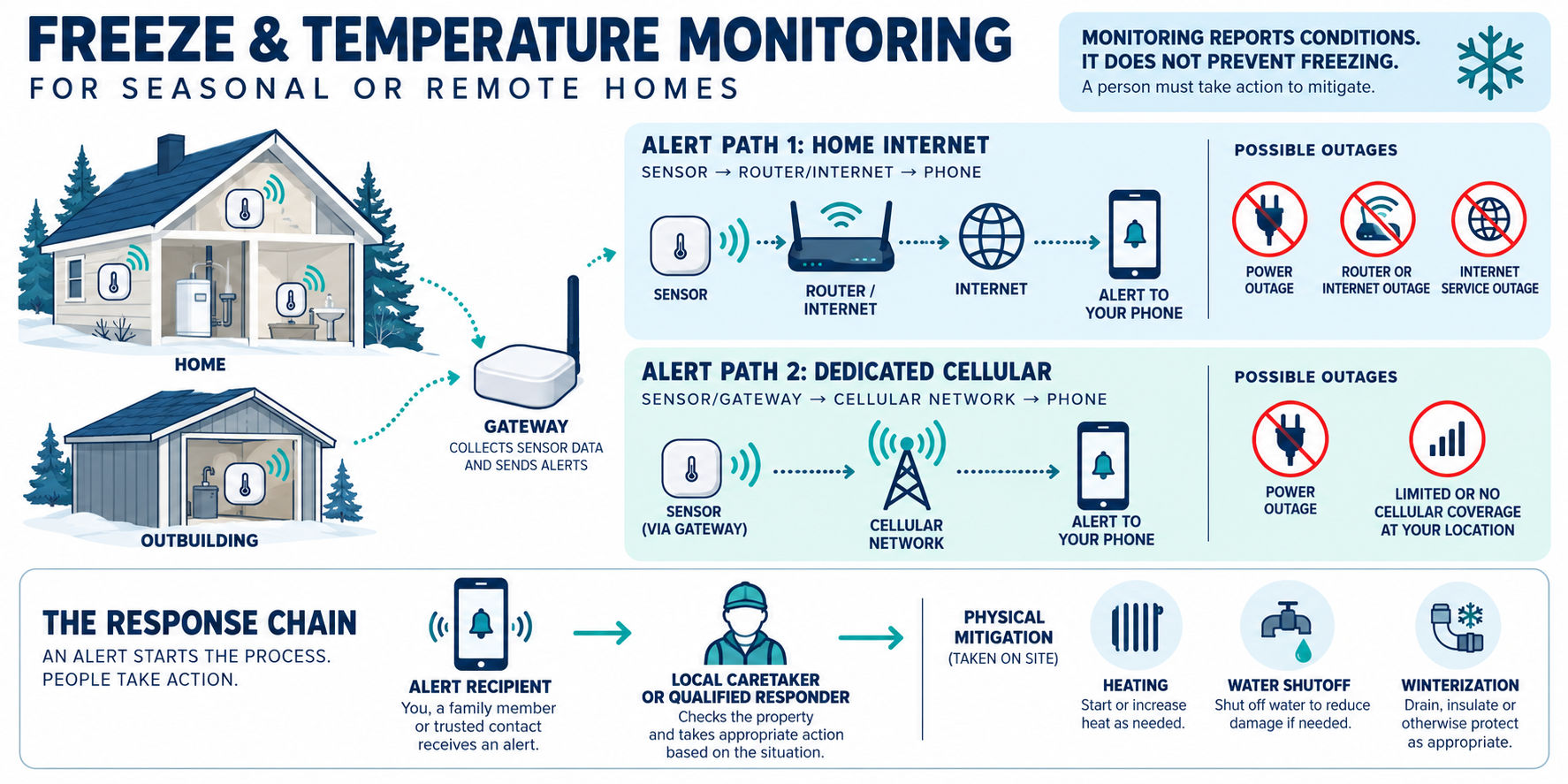
Monitoring sends information about conditions. It does not heat the property, insulate pipes, repair a failure, or guarantee that an alert will arrive. The value is greatest when the homeowner has a realistic response or mitigation plan.
What freeze monitoring includes
A complete system may include:
- temperature sensors in selected rooms or risk zones;
- a hub, gateway, or cellular communicator;
- internet or cellular service;
- battery or backup power;
- local audible alerts and remote notifications;
- a cloud account or professional notification service;
- optional leak sensors, automatic shutoff, or automation;
- setup, testing, documentation, and ongoing service.
Sensor placement depends on the risk rather than simply room count. A mechanical room, crawlspace, basement, utility area, well house, or vulnerable pipe location may need a sensor even if the room is small.
Internet versus cellular
Internet-connected sensors can be economical where a reliable network already reaches the property. A remote or seasonal home may need cellular communication when the local internet is unavailable or when the homeowner wants the monitoring path to be independent of the ordinary router. Cellular plans add recurring cost and depend on compatible coverage.
Ask what happens when the router, internet, cellular service, gateway, or power fails. Some products may buffer or retry events; others may simply become unreachable. Operating-temperature and communication limits are manufacturer-specific. Verify them for the actual product instead of assuming a sensor remains reliable in every cold location.
Power and outage planning
A monitoring system that loses power when the property does may fail at the moment it is needed. Include the gateway, router, modem, access point, and sensor power arrangements in the outage plan. A small uninterruptible supply or battery may keep equipment online for a period, but the duration and load must be calculated for the selected devices.
Backup power is not the same as heat or pipe protection. If the property can freeze, the owner still needs a response plan that may involve a caretaker, remote heating control, safe access, water shutoff, or broader resilience work. Those physical mitigation projects may belong in another category.
Multiple zones and remote properties
One sensor can show a condition at one point. Multiple zones improve visibility but add equipment, batteries, setup, labels, and future checks. A large home may have different temperatures in a basement, attic, crawlspace, garage, utility room, or outbuilding.
Remote travel and seasonal occupancy can add communication and service cost. Ask who receives alerts, who can physically inspect the property, and what happens when a sensor reports low battery or a gateway is offline. An alert without a reachable person may not justify the full system cost.
Rural and remote properties can also face travel, weather, cellular, and power limitations. Keep the monitoring system separate from the broader rural or off-grid infrastructure decision, but price any shared gateway, network, or backup power assumptions.
Subscriptions and ownership cost
Recurring fees may include cellular connectivity, cloud history, professional notification, device support, or automation service. A lower equipment price can be outweighed by years of subscription. Model first-year and five-year cost separately.
Ask whether the service plan can change, whether the device works locally without it, how the account transfers, and what happens after cancellation. Keep the homeowner’s administrator account and recovery method. Canadian consumer guidance recommends considering privacy, security, expected service life, offline operation, updates, unique passwords, and factory reset at transfer or disposal. U.S. guidance similarly emphasizes router security, updates, unused features, and obsolete-device management.
Integration with leak and shutoff systems
Freeze monitoring can be paired with leak sensors or an automatic water shutoff. Integration may provide a richer response path, but it adds compatibility, programming, and testing. A temperature alert does not establish that the water is frozen or that a shutoff should operate. The actual automation rule should be documented and checked against the selected products.
An automatic shutoff is still a plumbing intervention. Do not treat a monitoring hub as evidence that a valve is compatible with the main line or with other plumbing equipment. Use the separate installation decision and qualified contractor for that scope.
Cost scenarios
Monitoring cost is shaped by the property’s occupancy, communications, power, and response plan—not just by the number of temperature sensors. Price the alert path and the action after an alert as part of the same decision.
Occupied home with reliable internet
A few sensors and a hub may be relatively inexpensive when the network and power are already suitable. The main cost is setup, notification configuration, and future battery service.
Seasonal or vacant home
Cellular communication, backup power, wider sensor coverage, professional notification, and a local caretaker can make the recurring cost more significant than the sensor price.
Remote property with outbuildings
The system may need a separate network link, weather-protected gateway, or additional power and service. A connection to an outbuilding can become a separate infrastructure project.
U.S. and Canadian budgeting
For a Canadian project, request a quote from an installer serving the property’s area using the same scope: sensor zones, cellular service, backup power, alerts, and any response or monitoring service. Ask the quote to separate equipment and labor, applicable site or restoration work, configuration or testing, recurring terms, taxes, and exclusions. Do not derive a Canadian amount by converting a U.S. band.
Dedicated professional pricing is limited and product-level subscriptions change. Treat online ranges as scope examples and get a local quote for gateway, power, service, and response assumptions.
Questions before choosing
Ask:
- Which exact zones will be monitored?
- Does the gateway use internet, cellular, or both?
- What happens during power, network, and service outages?
- What operating-temperature and communication limits are documented?
- Who receives alerts and who can respond on site?
- Is backup power included, and for what duration?
- Are leak sensors, shutoff, and automation separately priced?
- What are the monthly, annual, support, and transfer terms?
Turning an alert into protection
Before paying for more sensors, define the response to each alert. Who can reach the property, how quickly, and what can that person do? A homeowner may need a caretaker, remote heat control, a water shutoff, generator or backup-power planning, or a different winterization project. Monitoring by itself only improves information.
Test the complete chain before the property is left unattended: sensor reading, gateway status, alert recipient, battery warning, power-outage notification, and the procedure for restoring service. Keep the account and device list with the property records so a future owner or caretaker can understand the system.
What to include in a remote-property quote
Ask the installer to state the normal temperature range, sensor location, gateway location, backup-power assumption, communication path, alert recipient, and service response. Include the cost of a site visit after a false alert or offline warning. A system that requires the homeowner to be physically present for every reset may not fit a remote property.
Temperature monitoring can also be a decision signal for other work. Repeated alerts may point to inadequate insulation, heating failure, air leakage, or a broader winterization problem. The monitoring system should report that condition without pretending to diagnose or repair the physical cause. Keep those mitigation projects separate and budget them if the property depends on the alert.
Testing and handoff before the property is unattended
Test a normal reading, threshold alert, low battery, gateway loss, power or network outage, and the intended recipient. Confirm the owner can distinguish a sensor or communication fault from a real cold condition, and that the local response contact has access and instructions. Record the normal range, threshold and delay, notification sequence, gateway-offline response, uncovered zones, and any spare-battery or service plan. A monitor can report conditions but cannot diagnose heating, insulation, or air-leakage problems; assess those separately if alerts persist.
Key points
- Freeze monitoring detects conditions; it does not prevent freezing or repair damage.
- Cellular, backup power, multiple zones, and response arrangements drive remote-property cost.
- Product-specific operating and outage behavior must be verified.
- Integrating sensors with a shutoff adds a separate plumbing and commissioning scope.
- Budget recurring service and an actual on-site response plan.
Final quote checkpoint
List the rooms and failure conditions that need coverage, including any vulnerable line or outbuilding. Confirm sensor range and placement, battery life, alert delay, communication path, backup duration, offline behavior, and whether a second notification path or annual test costs extra. Name a reachable local responder and any areas outside coverage. Monitoring cannot heat a room, close a valve, or guarantee that damage will be avoided, so price physical mitigation separately. Keep the threshold, response plan, and uncovered areas in the handoff.