
In U.S. planning examples, using existing coaxial cable with compatible adapters may cost about $200–$800 for a small two-endpoint setup. A larger home with several adapters, splitters or filters, cable tracing, service work, and network configuration may reach $800–$2,500. Straightforward new Ethernet cabling may cost roughly $150–$400 per drop and much more in a finished-home retrofit.
Coax reuse can avoid opening walls, but it is not a universal replacement for structured Ethernet. Its value depends on the cable route, condition, topology, connectors, existing services, adapter compatibility, and the homeowner’s future network goals.
What coax-to-Ethernet reuse means
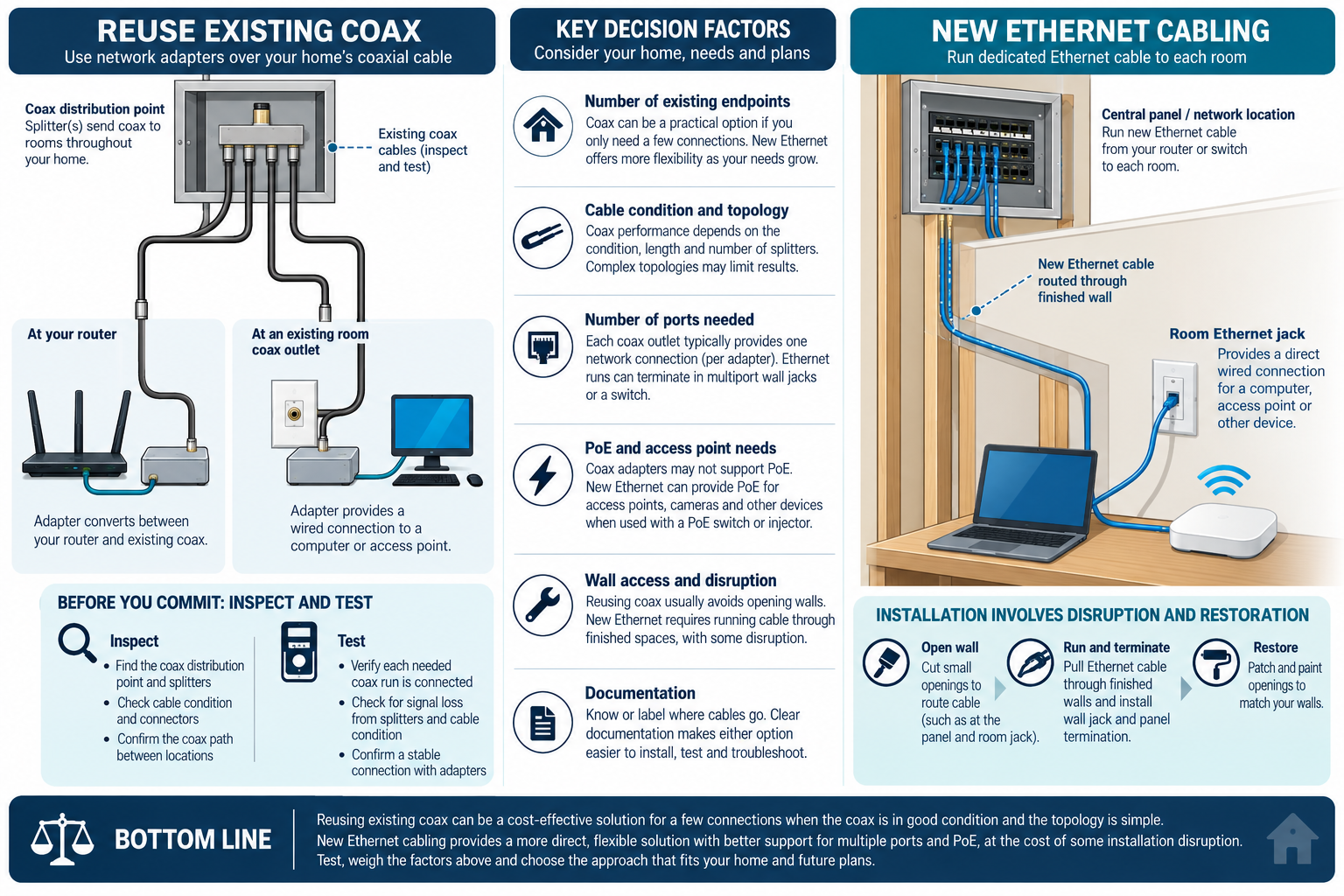
A compatible adapter at the network source and another at a room endpoint can use an existing coax path to carry network traffic. The adapter does not turn the coax into ordinary twisted-pair Ethernet; it creates a different transport that still needs compatible equipment and a suitable coax topology.
The exact technical behavior, supported speeds, frequencies, splitters, filters, and device limits are product-specific. The current research package identified the need for a primary MoCA technical source but did not establish a universal performance matrix. Do not publish or rely on a guaranteed speed from a marketing label alone.
Equipment and cost
A reuse project may include:
- two or more compatible adapters;
- power supplies and Ethernet patch cables;
- coax splitters, filters, connectors, or terminators;
- cable tracing and outlet identification;
- router, switch, access-point, or mesh configuration;
- testing and documentation;
- replacement of damaged coax outlets or connectors.
The adapters can be less expensive than opening walls, especially when one or two rooms already have coax near the desired network location. A whole-home deployment can become expensive as adapters multiply and the central topology requires cleanup.
Existing coax condition and topology
The installer should identify where each coax outlet goes, whether the cable is continuous, whether it passes through splitters, and whether connectors and wall plates are in good condition. Abandoned, damaged, stapled, water-exposed, or inaccessible cable may not be a good network path.
The path may share a splitter with television or other service. The selected adapter system may have requirements about topology, filters, or frequency. Do not assume that every coax distribution panel is ready for a network adapter.
Ask for a basic map and a test at each intended endpoint. A coax outlet that receives television signal is not automatically a suitable network endpoint.
Labor versus new cable
Coax reuse can be attractive in a finished house when the existing path reaches exactly where the homeowner needs connectivity. The labor may be limited to tracing, replacing connectors, installing adapters, configuring the network, and testing.
New Ethernet can be more economical when several rooms need connections, the coax path is undocumented, the outlet locations are wrong, or the homeowner wants a clean structured-cabling system. A new cable route can also support PoE cameras or wired access points more directly, depending on the design.
Compare the cost of adapters and future service with the access and restoration cost of new cable. Do not decide using only the first invoice.
Where coax reuse reduces wall work
Reuse is strongest when:
- the coax outlet is in the desired room;
- the cable is continuous and accessible at both ends;
- the central location has a suitable connection;
- adapters can be powered;
- the homeowner needs a limited number of endpoints;
- the performance objective fits the selected system.
It is weaker when the path requires new wall openings, several splitters, inaccessible connectors, or repeated service visits. An adapter can avoid cable fishing while still requiring network cleanup or an access point at the far end.
Limitations and future flexibility
Coax adapters add equipment, power, configuration, and another failure point. They may not support every network feature, PoE use, future speed, or desired topology. A homeowner adding cameras, wired access points, or a central rack should ask whether new Ethernet provides a more serviceable long-term path.
Do not assume that coax reuse is cheaper for a large system. Several adapters may approach the cost of new cable while leaving the original topology difficult to document. Conversely, a single adapter pair can be a sensible temporary or targeted solution when opening finished walls would provide little additional value.
Network configuration and testing
The installation may require a router or switch port, adapter pairing, firmware, addressing, access-point placement, and device migration. Ask whether the installer will test the connection under the actual use case and document adapter locations, coax labels, and network ports.
A connected link is not a guarantee of the homeowner’s desired performance. Test the rooms, cameras, calls, or work devices that matter. Record limitations and future expansion assumptions.
U.S. and Canadian budgeting
For a Canadian project, request a quote from an installer serving the property’s area using the same scope: existing coax and splitters, adapter pairs, any new Ethernet drops, testing, and network configuration. Ask the quote to separate equipment and labor, applicable site or restoration work, configuration or testing, recurring terms, taxes, and exclusions. Do not derive a Canadian amount by converting a U.S. band.
The current evidence supports the economic distinction between coax reuse and new cabling, but not a universal performance promise. Use manufacturer technical documentation for the selected adapter and obtain a local test or quote.
What to ask
Ask:
- Which coax outlets and central ends were identified and tested?
- What topology, splitters, filters, connectors, and services are present?
- Which exact adapters and power supplies are proposed?
- What performance and compatibility assumptions are documented?
- Will the system support cameras, PoE, access points, or only a room connection?
- What is the cost of replacing a bad connector or inaccessible run?
- What does new Ethernet cost for the same endpoints?
- What labels, map, and test results will be provided?
A decision rule for existing coax
Coax reuse is strongest when the outlet is in the right room, the route is continuous, the central end is known, the adapters are compatible, and only a few endpoints are needed. New Ethernet is stronger when the home needs many ports, PoE cameras, wired access points, a central rack, or a clean long-term map.
Ask the installer to price the adapter option and the new-cable option against the same rooms. Include tracing, connectors, splitters, configuration, testing, wall restoration, and future service. The goal is not to make every existing wire useful; it is to choose the path that delivers reliable, maintainable connectivity at a reasonable total cost.
Testing before committing
Have the technician identify the coax distribution point and trace the outlets that matter. Record splitters, filters, unused branches, damaged connectors, and any television or other service that must remain connected. The selected adapter manufacturer may specify a particular topology or frequency range, so a general claim that the coax is “good” is not enough.
Decide what the endpoint must do. A computer connection, a wired access point, a camera, and a network switch may have different power and performance requirements. Adapters may provide an Ethernet handoff without providing PoE to a remote device. If the goal includes a camera or access point, price the endpoint equipment separately.
Ask whether the adapter system can be removed later without damaging the original coax service. Keep labels and a topology map. If the homeowner later installs new Ethernet, the map will help decide which adapters can be retired and which routes remain useful.
How to compare future flexibility
An adapter solution can be economical today but add another box, power supply, and compatibility dependency at every endpoint. New Ethernet may cost more now while making future access points, cameras, and switches easier to connect. Ask which choice leaves the owner with the better map, fewer service dependencies, and a route that can be maintained after the current adapter or device is discontinued.
Setting a useful stopping point
If testing shows that one or two coax paths are suitable, use them for the immediate need and document the rest as unknown. Do not expand adapters throughout the house until the owner has a clear reason and has compared that cost with a structured retrofit.
Key points
- Coax reuse can avoid finished-wall access but requires a suitable, tested topology and compatible adapters.
- Adapter, power, splitter, connector, configuration, and future-service costs belong in the comparison.
- New Ethernet may be better for many endpoints, PoE devices, access points, or long-term flexibility.
- Do not treat a marketing speed or protocol label as a universal guarantee.
- Compare the installed and five-year ownership cost for the same endpoints.
Final quote checkpoint
Compare tested adapter and new-cable options for the same endpoints, including power, shared television service, wall access, and configuration. Use the selected manufacturer’s topology and performance limits; marketing speed is not a household guarantee. Confirm how the owner or next technician will identify a failed adapter, and document any coax branches left untested or unused.