
In U.S. planning examples, a residential fiber backbone may cost roughly $1,000–$4,000 for a moderate run with pathway, termination, transceivers, testing, and integration. A long or difficult route between floors or buildings, new conduit, multiple strands, specialized termination, and active equipment can push the project above $4,000–$10,000.
Fiber is a narrower infrastructure decision than ordinary room-to-room Ethernet. It may be considered where distance, electrical isolation, future capacity, building separation, or difficult copper conditions justify the additional hardware and specialist labor. Public residential pricing is sparse, so the range should be treated as a qualified planning model rather than a standard package price.
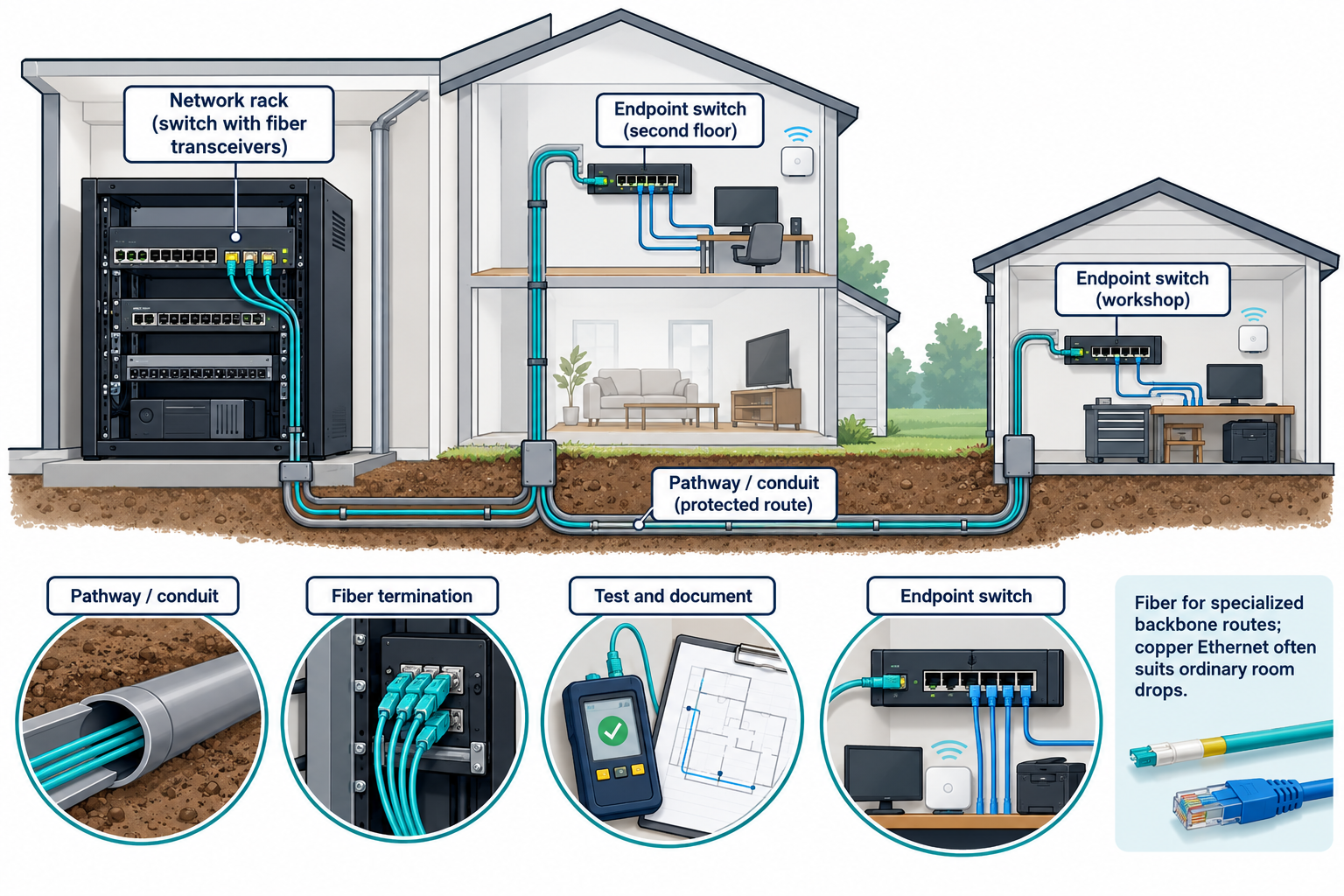
What a fiber backbone does
A backbone connects network distribution points, floors, buildings, or central equipment locations. It is not automatically needed for every room drop. Copper Ethernet may be the simpler choice for ordinary residential distances and devices when the pathway and equipment are suitable.
Fiber can be attractive when the homeowner wants a dedicated high-capacity path, a connection between electrically separate structures, or a route that is easier to manage with fiber than with copper. The decision depends on the actual property and network design, not on the fiber label alone.
Fiber versus copper
| Decision factor | Fiber backbone | Copper Ethernet backbone |
|---|---|---|
| Cable and termination | Specialized cable, connectors, trays, and termination or preterminated assemblies | Familiar cable, jacks, patch panels, and terminations |
| Active hardware | Transceivers, fiber ports, or media conversion may be needed | Copper switch ports or PoE equipment |
| Labor | Specialist routing, handling, termination, and testing | More common low-voltage labor and tools |
| Building separation | Can be useful where electrical isolation is a concern | Requires appropriate design and installation for inter-building paths |
| Room devices | Usually transitions to copper or Wi-Fi at distribution points | Can connect directly to room drops where appropriate |
| Future changes | May offer pathway capacity, but hardware compatibility still matters | Simple for many residential endpoints |
The comparison is economic, not a claim that one medium is always superior. A fiber backbone that requires expensive conversion hardware and specialist service may be poor value for a small home.
Cable, pathways, and termination
Cost includes the fiber type, strand count, jacket and route, conduit or pathway, support, bend protection, entry points, termination, patch hardware, and labels. A difficult attic, finished wall, masonry route, exterior run, or buried conduit can dominate.
Preterminated fiber can simplify field work in some installations, while field termination or splicing may be appropriate for a specialist project. Ask which approach is proposed and what test record will be delivered. Do not accept “fiber-ready” as a complete scope.
Conduit can add current cost but preserve a future replacement path. If a conduit is included, request accessible endpoints, a pull string, route documentation, bend assumptions, and a record of what is occupied.
Network hardware
The backbone may need fiber-capable switches, SFP or similar transceivers, media converters, patch panels, enclosures, and a central rack or structured panel. The exact modules must match the selected cable, connector, speed, and switch. Active hardware cost can exceed the cable cost.
If a distribution point also serves cameras or wired access points, the design may need copper switching and PoE at that location. The fiber backbone does not power ordinary remote devices by itself. Include local switch, power, enclosure, and network configuration.
New receptacles, branch circuits, UPS installation, and line-voltage changes are separate electrical work. The low-voltage quote should identify the equipment load and location without silently including a new circuit.
Testing and documentation
Testing is essential because a fiber fault can be difficult to find after finishes close. Ask whether the installer will provide a visual inspection, continuity or light-level test, loss measurement, certification or qualification result appropriate to the installation, labels, and a port map.
Documentation should identify the origin and destination, strand or port assignment, connector type, route, patch hardware, transceivers, switch ports, and any unused strands or conduit. A backbone with no map can increase future troubleshooting cost.
Long runs and outbuilding applications
A long run to a garage, workshop, gate, barn, or guesthouse may justify comparing fiber with a point-to-point wireless bridge or copper in conduit. Trenching, conduit, weather exposure, site access, and endpoint power often dominate the networking hardware. The outbuilding guide addresses the broader connection decision.
Fiber does not remove the need to coordinate with electrical and site contractors. Power, grounding, lightning, trench depth, and outdoor pathways are higher-consequence topics that require applicable local and technical guidance. This article does not prescribe an inter-building installation method.
When ordinary Ethernet is sufficient
Ordinary Ethernet is often simpler for room drops, a short path inside one dwelling, a few access points, or cameras near an existing rack. It may also be easier for a homeowner to service and expand. A fiber backbone should have a clear reason: distance, building separation, pathway, future capacity, or a property-specific technical constraint.
Ask the installer to compare a fiber option with a suitable copper option using the same endpoints, network capacity, pathway, testing, and five-year support assumptions.
Cost scenarios
The scenarios below separate the physical route from the active network equipment. Fiber may solve a pathway or distance problem, but the endpoints, testing, and any site work still determine the installed cost.
Short in-house backbone
A short route between a structured panel and an equipment location may still require transceivers and testing. Copper may be more economical if there is no meaningful distance or isolation reason.
Multi-floor or difficult route
Fiber can be attractive where the pathway is difficult to replace, but access and finishing remain major costs. Conduit and documentation may provide more value than premium cable alone.
Detached structure
Trenching, conduit, endpoint switching, weather, and power coordination can outweigh the fiber. Price the physical site work separately.
U.S. and Canadian budgeting
For a Canadian project, request a quote from an installer serving the property’s area using the same scope: distance and pathway, conduit, strand count, terminations, transceivers or switching, and test results. Ask the quote to separate equipment and labor, applicable site or restoration work, configuration or testing, recurring terms, taxes, and exclusions. Do not derive a Canadian amount by converting a U.S. band.
What the quote should include
Ask for:
- reason for fiber and comparison with copper or wireless;
- fiber type, strand count, route, pathway, and protection;
- termination or pretermination method;
- switches, transceivers, converters, patch hardware, and racks;
- testing, labels, maps, and documentation;
- endpoint power and separate electrical or site work;
- warranty, future support, and replacement assumptions.
Deciding whether fiber earns its premium
Ask what problem fiber solves on this property. A long route between buildings, a future backbone, electrical separation, or a pathway that would be difficult to replace may justify the extra hardware and specialist labor. If the need is a few room drops inside one home, ordinary Ethernet may be simpler and easier to service.
Request two designs with the same endpoints: fiber and suitable copper. Compare pathway, termination, transceivers, switches, testing, rack space, power, and future replacement. A transparent comparison often shows that conduit and documentation provide more long-term value than a premium medium chosen without a defined use.
What makes the estimate uncertain
Residential fiber is less often sold as a standard homeowner package than ordinary Ethernet. One installer may quote preterminated assemblies and a simple switch; another may include field termination, a larger rack, redundant strands, formal testing, and several active modules. Those scopes are not directly comparable.
Ask the bidder to identify the cable route, number of strands, connector and transceiver type, endpoint speed assumption, test method, and what happens if the pathway or termination fails. If the project serves a detached building, separate trenching, conduit, electrical, and landscape work from the fiber estimate. A transparent uncertainty statement is more useful than a false per-foot average.
Comparing the completed handoff
The owner should receive the origin and destination of the backbone, strand and port labels, connector and transceiver details, test results, route photos, and the active switch configuration. Ask what can be replaced by a homeowner or ordinary network technician and what requires specialist service. A fiber path is a long-term asset only when its endpoints and hardware remain identifiable.
Key points
- Fiber is usually a specialized backbone decision, not a default replacement for room Ethernet.
- Cable, pathway, termination, transceivers, switches, and testing all affect cost.
- Residential-specific pricing is sparse, so local scope-based quotes matter more than a single average.
- A detached-building run may be justified by distance or isolation but can be dominated by trenching and power.
- Compare fiber with suitable copper and wireless alternatives before approving the premium.
Final quote checkpoint
State the fiber type, strands, connectors, endpoint hardware, and test method, and distinguish an in-home route from an exposed or inter-building path. Price trenching, conduit, entry, electrical, and restoration work separately. Require strand labels, test results, and an active-module replacement plan. Compare compatible fiber electronics with a suitable copper pathway, including local service availability.