
Water is often the reason a rural access road deteriorates. A clogged inlet, undersized or collapsed culvert, eroding outlet, failed ditch, or uncontrolled runoff can turn a surface repair into a road closure or reconstruction project. The budget should identify the water path and the access consequence before anyone prices a pipe.
Cleaning, repair, replacement, and washout work
- Cleaning: remove debris, sediment, ice, or vegetation when the structure is otherwise suitable.
- Repair: correct an inlet, outlet, joint, end treatment, or localized erosion problem.
- Replacement: excavate, remove, install, backfill, compact, and restore the road over a failed or inadequate structure.
- Drainage correction: reshape ditches, add cross-drainage, stabilize outlets, or redirect runoff.
- Washout restoration: remove unstable material, rebuild the road section, and correct the cause before restoring the surface.
These scopes can require different equipment, material, access, and professional input. Culvert size, grade, alignment, and outlet treatment should be assessed for the actual contributing drainage area and expected flow; do not select a size from a generic online rule.
What drives the estimate
Ask the contractor to separate:
- assessment, survey, and locating the existing structure;
- traffic control, temporary crossing, or alternate access;
- excavation, dewatering, rock handling, and disposal;
- pipe, end treatments, bedding, backfill, and compaction;
- ditch, inlet, outlet, erosion, and vegetation work;
- road-base, aggregate, and surface restoration;
- engineering, permits, inspection, and post-work monitoring.
British Columbia guidance provides a jurisdiction-specific example in which property owners maintain driveway culverts, clear snow at the entrance, and replace undersized or collapsed culverts in the stated side-road context. It is not a general U.S. or Canadian allocation rule.
Ask about environmental limits early
Work affecting a stream, wetland, fish habitat, public highway, or drainage easement may need local environmental, transportation, or engineering review. The source research does not establish a universal permit trigger. Ask the authority or qualified designer before excavation, especially after a washout when the pressure to reopen access is high.
Compare prevention with emergency repair
Include an inspection and cleaning allowance in routine maintenance. Record where water crosses the road, where snow or ice blocks the entrance, where gravel leaves the road, and where outlets erode. Preventive work is not a guarantee against a storm, but it can reveal a small drainage scope before it becomes a failed road base and emergency mobilization.
The right quote is a water-control and access-restoration scope, not just a pipe price.
Describe the crossing before requesting bids
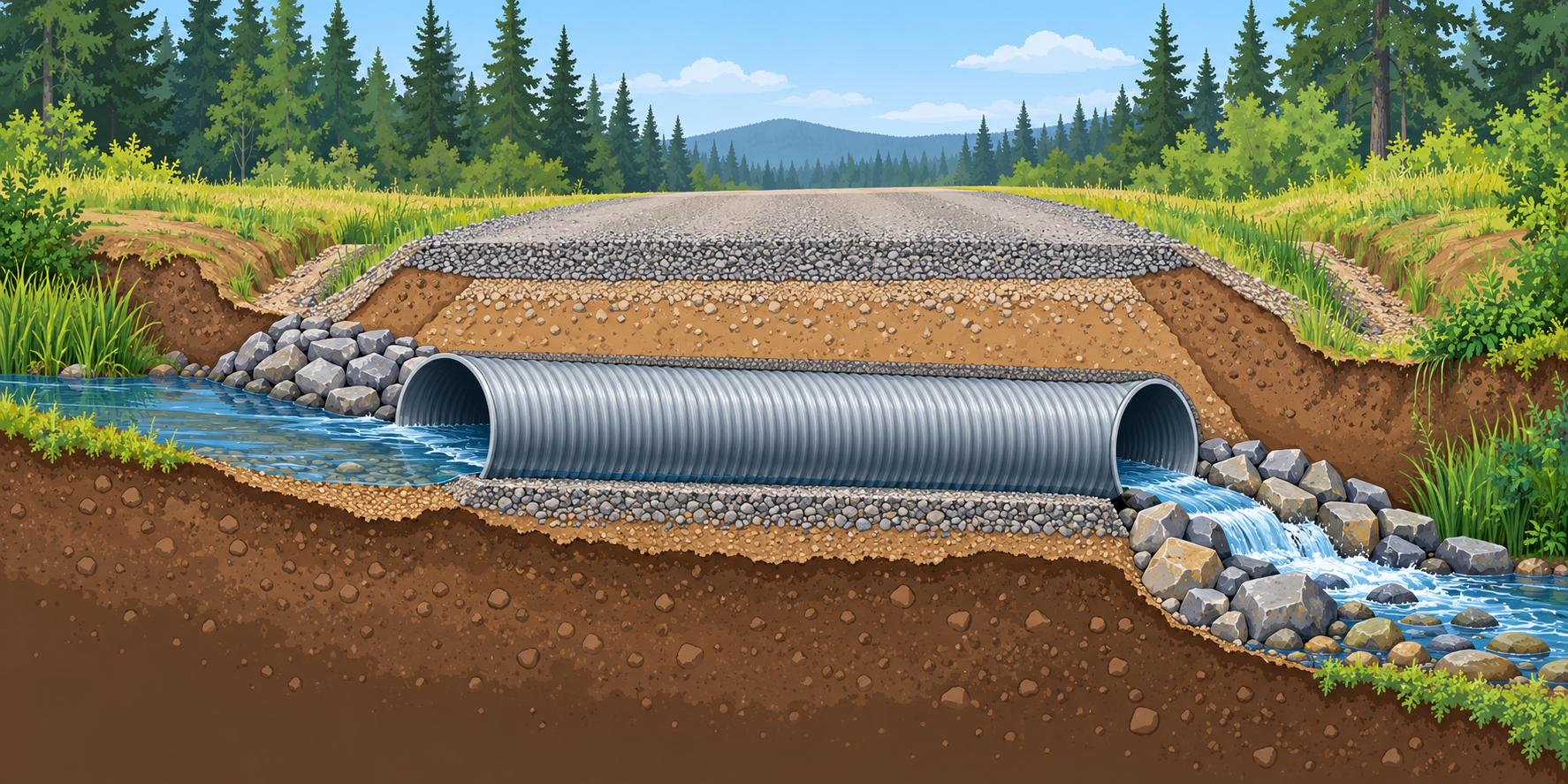
Map where runoff comes from, where it crosses the road, and where it leaves. Photograph the inlet, pipe, outlet, road surface, shoulders, nearby slopes, and any ponding or erosion. Note the approximate pipe material and diameter if visible, but do not enter a culvert or attempt to measure from an unsafe location. Record blockages, crushed sections, exposed joints, sinkholes, overtopping, and changes after heavy rain or snowmelt. A contractor or qualified designer can determine whether cleaning, repair, replacement, or a broader drainage redesign is appropriate.
Describe the access the crossing must support: ordinary cars, delivery trucks, fire or emergency access, equipment for road work, and seasonal loads. A design suitable for light traffic may not meet the property’s actual use. If the crossing affects a public road, stream, wetland, drainage easement, or neighboring land, identify that early. Ownership and maintenance responsibility may differ from the visible location of the pipe.
Compare the complete installed scope
For cleaning or repair, specify how sediment and debris will be handled, whether the pipe will be inspected, how outlets will be stabilized, and how disturbed road material will be restored. For replacement, ask the proposal to identify the design basis, pipe material and dimensions, excavation, bedding, backfill, compaction, headwalls or end treatment, traffic management, bypass pumping if required, disposal, and surface restoration. Each item may be unnecessary at a specific site; the point is to state what the bid includes and why.
Request separate pricing for survey, engineering, approvals, environmental review, utility locating, mobilization, road closure or detour, and temporary water management. Also separate excavation, removal and disposal, new pipe and bedding, backfill, compaction, inlet and outlet protection, ditch reshaping, erosion repair, gravel or paved surface restoration, inspection, and as-built records.
Ask how the contractor handles unknown ground conditions, buried utilities, groundwater, unsuitable material, and a longer-than-expected crossing. The estimate should state a unit price or written approval process for additional quantities. Confirm whether temporary access can carry fuel, water, septic, and emergency vehicles during construction and whether the property remains accessible overnight.
Check approvals and water impacts
Permit and review requirements depend on the crossing, land ownership, watercourse, environmental setting, and local authority. A published road-access guide for one jurisdiction can help identify questions, but it does not establish rules elsewhere. Ask the responsible road agency and environmental authority what approvals apply before altering a crossing or diverting water. A professional may need to assess flow, fish habitat, flood risk, sediment, erosion, or effects on adjoining land. Do not use a generic pipe diameter as a universal design or permit answer.
A structural vehicle bridge is a separate decision from a drainage culvert. The U.S. Army Corps of Engineers’ 2026 Nationwide Permit 14 covers qualifying road and driveway crossings in federally regulated waters, but it does not mean every private crossing needs Corps authorization or qualifies for that permit. In Canada, Fisheries and Oceans Canada’s clear-span code applies only when the work meets its conditions and protective measures; its notification is not a substitute for other approvals. Transport Canada separately assesses major bridge work where a crossing affects navigation. Establish the actual water, land, and work class before budgeting review or construction, and use the private bridge guide for structural scope.
Plan inspection and future maintenance
Include periodic visual checks in the road schedule, especially before the wet or freeze-thaw season. Check that the inlet is open, the outlet is not eroding, the pipe ends remain visible, and the road is not settling or overtopping. Keep safe distance from moving water, unstable banks, and confined spaces; qualified contractors should handle conditions that pose a hazard. Record the inspection date and photos from the same viewing points so changes are visible.
After replacement, save the plan, permits, pipe specifications, depth or alignment information where available, invoice, and contractor warranty. Mark the crossing on the property and association maps. The next maintenance provider should know what was installed and how to access it without damaging the structure. Budget cleaning and inspection as recurring work, and keep a separate reserve for replacement or emergency washout. A crossing that is treated as a drainage asset is easier to maintain than a buried pipe discovered only after the road fails.
Distinguish drainage work from road rebuilding
If a crossing fails during a storm, record when the road was closed, how access was restored, and which temporary repairs remain. Include a separate emergency mobilization allowance in the property or association plan, because urgent access work may have different equipment, travel, and approval requirements than a scheduled replacement.
Ask the contractor to identify the point at which a maintenance call becomes an emergency closure. Keep temporary barriers and owner notification arrangements in the response plan. A visibly undermined roadway may be unsafe even if cars have continued to pass, so a qualified assessment should guide reopening.
Do not assume that the lowest replacement quote includes the maintenance access needed later. Ask whether the contractor can leave a safe inspection point, whether inlet protection needs seasonal clearing, and who will be responsible for vegetation and debris. Include those recurring tasks in the road budget so the replacement does not create an unassigned maintenance obligation.
If water is repeatedly undermining a long section, the culvert may be only one part of the failure. Ask whether ditches, road crown, shoulder runoff, uphill drainage, and downstream outlets have been reviewed together. A replacement pipe that simply moves water faster toward an unstable outlet can shift erosion rather than solve it. The proposal should explain the intended water path and any stabilization at the entry and discharge points.
For a buyer, find out who owns the crossing and who must maintain it. It may be within a private-road easement, a public right-of-way, or land controlled by another owner. Confirm whether the road agreement assigns inspection and replacement costs to a group, an individual parcel, or another party. If the crossing is shared, include the affected owners before requesting bids and confirm who can approve access restrictions during construction.
When obtaining multiple bids, provide the same site photos, map, known drainage history, access conditions, and requested service outcome. Ask each contractor to identify work that requires a designer or agency review before pricing a fixed installation. Keep exploratory work and final construction as separate decisions if the existing structure is concealed. This prevents a preliminary inspection allowance from being mistaken for a complete replacement budget.
After a major storm, inspect from safe ground and record whether water overtopped the road, new sediment accumulated, the outlet changed, or the surface settled. A log of these events can help a professional identify design capacity issues and provide a better future scope. Do not enter fast water or a damaged pipe; restrict traffic and contact qualified help when the road or crossing appears unsafe.
Include downstream restoration in the estimate
Work at a crossing can disturb more than the road surface. Ask the bidder to describe how temporary water flow will be handled, how excavated material and debris will be contained, and what condition the outlet and adjacent ground should be in when the job is complete. Identify restoration of vegetation, ditch shape, road shoulder, and any affected fence or access point. Confirm who documents existing conditions and who will notify an authority if the site changes during excavation. These items may be outside a simple pipe replacement price. Naming them in advance gives the owner a clearer installed-cost comparison and reduces the risk that the final bill treats restoration as an unexpected extra.