
Rural winter-access pricing depends on more than snowfall. A long private road, steep grade, drifting, limited turnaround, low contractor density, fuel-truck requirements, and the need for loader work after a major storm can make a simple per-visit quote incomplete. Budget the service level the property needs, not just the number of snow events.
Common service structures
| Structure | What to clarify |
|---|---|
| Per visit or per push | Trigger depth, response window, route priority, and minimum charge |
| Seasonal contract | Included storms, hours, access standard, exclusions, and storm limits |
| Shared-road agreement | Road-wide trigger, individual driveways, allocation, and dispute process |
| Loader or storm recovery | Snowbank removal, drifting, turnaround clearing, and extraordinary equipment |
| Sanding or traction | Material, application trigger, environmental limits, and repeat visits |
Snow fences can reduce drifting on roads and paths in some situations, but the Government of Canada guidance does not establish their ownership, installation cost, or local approval. Treat them as a site-specific mitigation option rather than a guaranteed price reducer.
Describe the route to bidders
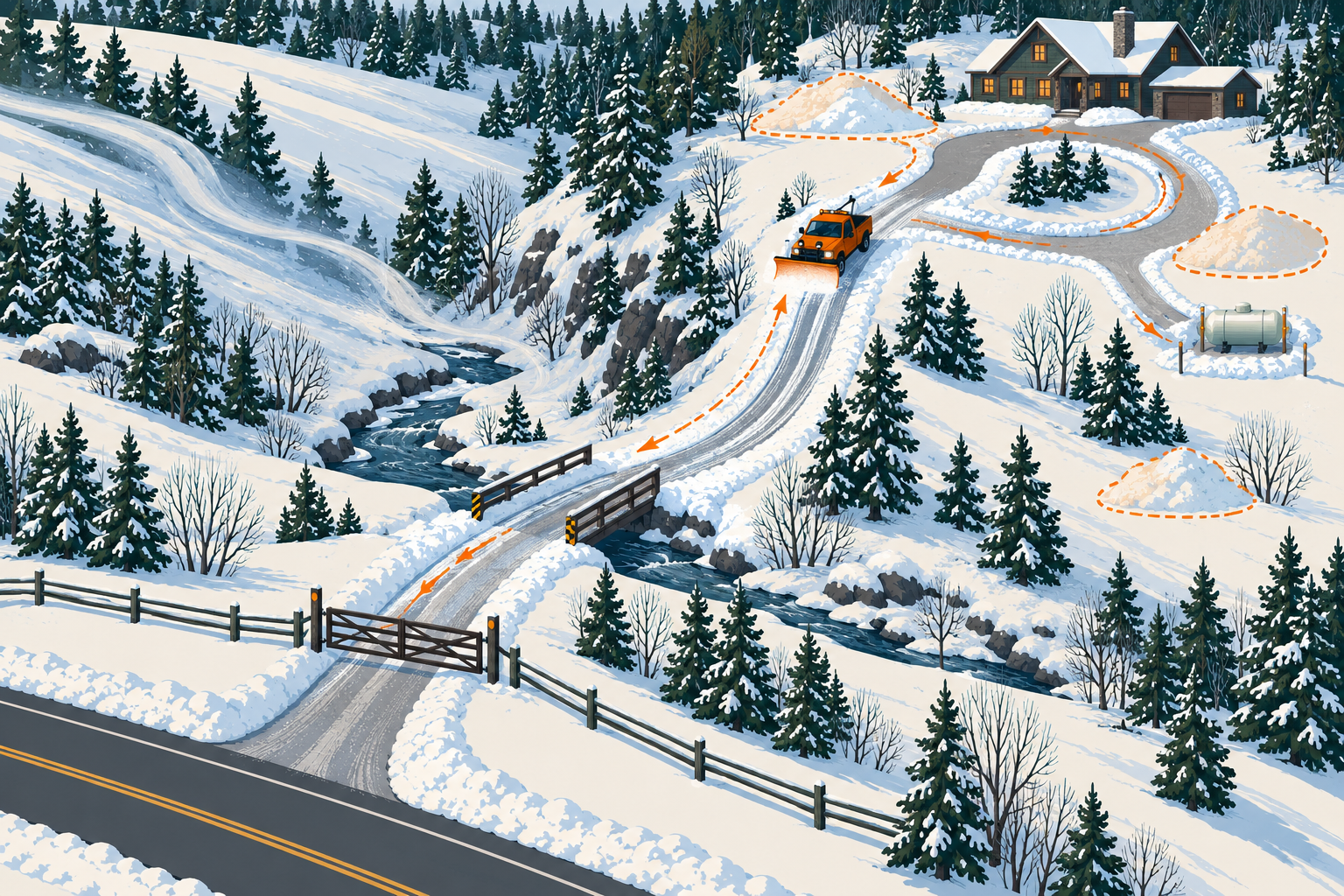
Provide road length, width, grades, culverts, bridges, turnarounds, gates, snow-storage areas, exposed sections, and the location of each driveway. Tell the contractor whether fuel, water, septic, medical, or construction vehicles must reach the property during storms. Ask who clears snow pushed into a driveway or entrance and who handles ice, sanding, and spring damage.
Include delivery and outage consequences
The Canadian Propane Association advises planning fuel deliveries before levels become low and keeping the tank and driveway accessible. A snow budget is therefore connected to heating continuity. A remote property may also need an alternate plan for an outage, blocked road, or storm cleanup; that plan can involve a caretaker, loader, backup heat, or a second fuel delivery.
Reserve for the severe winter
Keep ordinary contract cost separate from storm extras, emergency access, spring washout repair, and equipment mobilization. Ask what happens when snowfall exceeds the contractor’s stated service capacity or a road becomes blocked by a fallen tree, drift, or failed culvert.
There is no useful national snow-removal rate. Compare local proposals with the same road map and service standard, and keep U.S. and Canadian market quotes separate rather than converting currencies.
Check whether a public plow route actually serves the property and where the public road ends. Klickitat County, Washington, says some County roads do not receive year-round grading or snowplowing, private roads remain the users’ responsibility, and a County plow may leave a berm across the driveway entrance. Those are local examples, not a service promise for another route. Confirm the maintained-road map and clear the private spur, entrance, and bridge in the contractor’s written scope.
Define the winter service level
Decide what “cleared” means for this property. One owner may need a passable lane for occasional visits; another may need reliable access for daily travel, fuel delivery, medical needs, or emergency response. State the road segments, target width, turnarounds, entrance, parking area, and any steep or shaded sections. Identify gates, parked vehicles, low branches, narrow bridges, culverts, and places where plowed snow can be stored without blocking sightlines or drainage.
Ask how the contractor measures a storm trigger and when service begins. Clarify whether the agreement is seasonal, per visit, per event, by accumulation, or time and materials. Define treatment for drifting, compacted snow, freezing rain, ice, repeated storms, windrows, and a plow that returns after a vehicle has passed. Specify sanding or de-icing materials separately and ask how their use is authorized and recorded. Do not assume a standard residential driveway package includes several hundred feet of private road or a steep shared lane.
Normalize proposals and understand extras
Have each bidder price the same map and service standard. Ask for included visits or triggers, response window, equipment type, minimum charge, travel and mobilization, storm maximum, return-trip charges, sanding, loader work, drift removal, and exclusions. Confirm whether the equipment can turn and pass through the actual route. Ask where snow will be placed and who clears the area around fuel tanks, generators, hydrants, or other equipment without damaging them.
One western Washington provider lists snow-removal offers by driveway type, with event and seasonal packages. The page does not define enough about event severity and service limits to support a direct comparison, and it does not state an ISO currency code or a clear pricing date. Treat the listed offer only as an example of how service units differ, not as a local market rate or an annual cost forecast. Obtain written quotes from providers serving the property and compare the actual seasonal terms.
A seasonal contract can make ordinary access predictable but may exclude unusually large storms, drifting, ice, or remote mobilization. A per-event contract can appear lower until a severe winter produces many callouts. Model a mild, typical, and difficult season using the provider’s actual billing unit and your local history. Keep snow service separate from spring grading, culvert repair, tree removal, and washout restoration.
Plan for storms beyond the contract
Ask what the service can realistically deliver when snowfall exceeds the equipment or staffing capacity. Establish how the owner receives a delay notice, who can authorize extra equipment, and whether a second contractor is available. For shared roads, confirm whose approval is required and how emergency charges are allocated. Keep a contact list and road map available to the service provider before the first storm.
Winter access is part of the property’s operating plan. Check that snow storage does not cover a drainage outlet, push snow against a structure, or block the only turnaround. Identify where fuel and deliveries can safely stop if the whole road cannot be opened. A snow contract does not guarantee that emergency vehicles can reach the home, and owners should not describe it that way without confirmation from the relevant service.
After the season, compare invoices with the contract, note response time and unresolved trouble spots, and photograph damage before spring repairs. Use that record to adjust service frequency or road design. The useful annual figure is a local proposal tied to road geometry, expected service, and extras, with separate allowances for unusually severe weather and resulting repairs.
Add the details that cause surprise charges
Keep seasonal invoices and storm dates together; actual visit counts are the best local input for renewal planning.
Before agreeing to a contract, clarify how a seasonal price is adjusted if the service period changes or the property is sold. Ask whether there is an automatic renewal and what notice is needed to cancel. Keep a contact for a backup provider in case the primary contractor is unavailable.
For a seasonal home, coordinate snow work with opening and closing dates. A winter access request made before the contractor has the key, road map, and service authorization may be delayed. Confirm how the owner learns that a visit is complete and whether photos or a short condition report are available. Keep snow removal separate from any promise to inspect the building.
Before the first snowfall, walk the route with the contractor and mark the plow path, entrances, turnaround, snow-storage areas, low branches, drainage structures, and obstacles. Clarify how vehicles left on the road affect service and whether the provider will clear in front of a gate or only to the gate. Ask who marks hidden landscape features and how damage to a mailbox, fence, or surface is handled. A short route map can reduce repeated calls and prevent the operator from guessing where to push snow.
Ask whether the quote includes sanding, salt or other treatment, loader work, hand shoveling, roof work, and clearing access around equipment. These services may have different equipment and safety requirements and should not be assumed from a plowing price. Confirm whether the contractor’s insurance and contract cover the specific work being requested. For a long shared lane, list which segments receive priority and how a blocked branch is reported.
Create a seasonal cost scenario from your area’s typical number of service triggers, but keep that calculation separate from a guaranteed contract amount. For a seasonal price, identify the contract dates, early or late season visits, maximum storm condition, and renewal terms. For a per-event price, define what counts as one event and whether drifting or refreezing starts another charge. Keep the invoice log by event so the next renewal can be compared with actual weather and service.
When the road remains closed after a storm, have a separate plan for fuel, deliveries, and urgent access. The plow contractor may not be the right provider for tree removal, road stabilization, or emergency response. Name who evaluates the obstruction, what work can be approved, and how costs are shared. Clear responsibilities make a severe-weather reserve more useful than an unspecified contingency.
Review service after the first storms
At the beginning of the season, confirm that the contractor has current keys, contact details, route instructions, and any changes in parked vehicles or construction. After the first few service events, compare the actual cleared width and timing with the agreement and identify any unsafe drift, ice, or blocked turnaround. Adjust the scope with written approval before the most difficult part of the season. Keep records of service calls, storm conditions, extras, and areas the equipment could not reach. This gives the owner evidence for the next contract discussion and helps separate a snow-service shortfall from a road-design or drainage problem that requires a different contractor.