
A private bridge can make one rural home reachable, but it can also be a shared capital asset with responsibilities that outlast any one owner. Before budgeting repair or replacement, establish who owns and uses the crossing, what work is necessary, which vehicles must be supported, what approvals apply, and how access will continue during construction. The available examples help frame questions; they do not support a representative U.S. or Canadian installed-price range.
Confirm access, ownership, and maintenance responsibility
Begin with the deed, survey, access easement, bridge plans, permits, inspection history, repair invoices, and any road-association or maintenance agreement. Confirm whether the bridge and its approaches are on the property, shared land, public land, or another owner’s parcel. The right to cross may not automatically include authority to repair, replace, widen, or change the structure. A title or legal professional can interpret easements and recorded obligations; a qualified engineer can assess the physical structure.
For a shared route, identify every property and service that depends on it, who can authorize work, how routine costs and emergency repairs are allocated, and whether a reserve exists. In Clark County, Washington, the County says it does not maintain private bridges; local code requires a recorded maintenance covenant for certain Category A bridges serving more than three lots, including an annual assessment and a process for sharing repair or rebuilding costs. That is a local development rule, not a model that automatically governs another bridge. Check the property’s actual recorded documents and current local requirements.
A third party may have an operational reason to use a bridge, but do not count on a contribution before an agreement is signed. A 2023 Byron Bethany Irrigation District packet describes one proposed 50% share of a private bridge replacement estimate in exchange for a perpetual easement allowing district staff to cross for its work. The proposal is specific to that district and crossing; it does not establish a general grant or an actual completed project. Any offer should be compared with the value and duration of access rights, maintenance, insurance, and future obligations being granted.
Separate condition inspection from load assessment
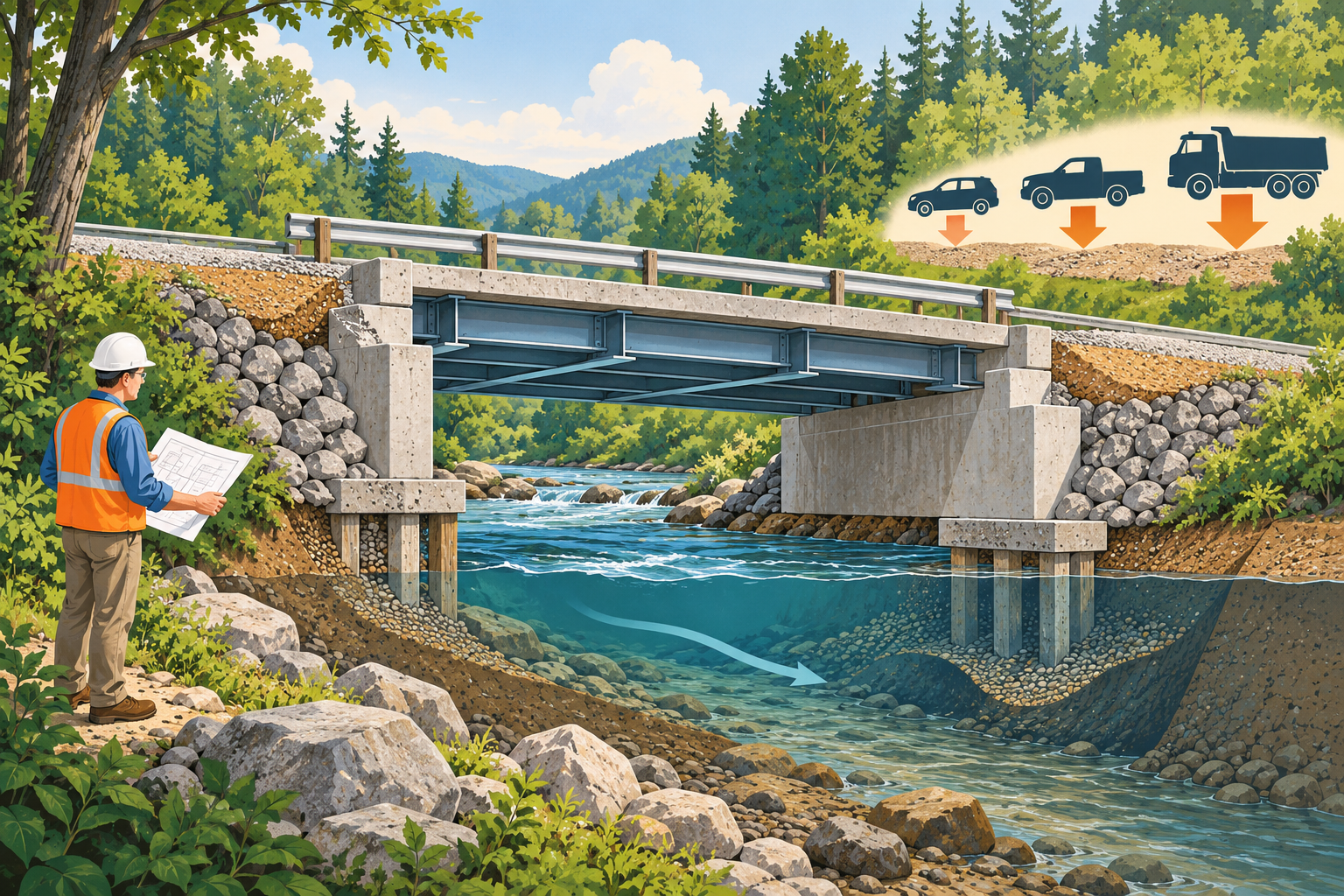
A visual inspection and a load assessment answer different questions. A qualified bridge engineer may inspect the deck, girders, connections, abutments, foundations, approaches, scour, corrosion, movement, and drainage to identify deterioration and needed work. A load-rating analysis uses records and structural information to assess capacity for defined vehicle loads. A crossing that looks serviceable is not thereby confirmed for a fire apparatus, fuel truck, water hauler, septic pumper, crane, or construction vehicle.
Ask what the professional will deliver: a condition report, load rating, posted restriction recommendation, repair detail, replacement concept, or some combination. Provide plans, prior reports, measured dimensions, materials, repair history, known flood or impact events, and the vehicle types expected. If drawings or as-built records are absent, investigation or measurement may be a separate cost. Ask the local fire or emergency service what access information it needs; Clark County warns that missing load documentation can make fire districts hesitate to send heavy vehicles across a private bridge. Its public page recommends qualified-engineer inspections every five years, but that interval is a Clark County recommendation, not a universal rule. Local law, bridge classification, development triggers, and the engineer’s advice control.
Do not test capacity by driving heavier equipment across the bridge. Obtain an engineer’s assessment before changing use or relying on a posted load limit. If the route cannot safely support a required vehicle, include the consequence—alternate response, delivery limits, temporary access, or a change in project plan—in the property decision.
Compare the work alternatives and complete scope
A recommendation should explain why the bridge needs work and what outcome each option would provide. The choices may include routine maintenance, localized repair, rehabilitation of several components, replacement, or a temporary crossing while permanent work is designed. A bridge problem may be concentrated in the deck, but failing abutments, foundations, approach settlement, scour, drainage, or a changed load requirement can change the solution. A culvert replacement or road resurfacing is a different scope; use the related culvert and drainage guide for that work.
Request a written estimate that separates design and construction. Ask the engineer or contractor to state quantities, materials, labor, assumptions, exclusions, and the basis for each alternative. The U.S. Fish and Wildlife Service’s bridge handbook tells its staff to itemize quantities, materials, and labor and adjust for location-specific costs; it notes remote mobilization and material transport can raise a project estimate. Its percentages and procedures apply to USFWS facilities, not a residential markup or contingency rate.
| Cost area | Ask the proposal to identify |
|---|---|
| Inspection and design | Condition inspection, load analysis, survey, structural/geotechnical/hydraulic design, testing, and review stages |
| Approvals and land | Permit applications, environmental review, access or water rights, easements, fees, and who obtains each decision |
| Structure and approaches | Deck, girders, bearings, abutments, foundations, approach roads, drainage, erosion or scour work, and utility conflicts |
| Construction access | Mobilization, equipment delivery, staging, temporary crossing or detour, traffic control, and whether residents and emergency services can pass |
| Removal and closeout | Demolition, hauling/disposal, water management, site restoration, inspection, acceptance, as-built records, and maintenance handover |
Compare at least two alternatives on the same vehicle, access, site, and completion assumptions. Separate investigation from construction where hidden conditions remain. Ask how weather, water levels, seasonal work windows, permits, material availability, and remote travel affect schedule and remobilization. A low bridge-product price can omit abutments, delivery, erection, demolition, temporary access, approaches, permitting, engineering, and restoration. No per-foot figure should be multiplied into a project total without a defined design and scope.
Read the published price examples without turning them into a range
The current evidence contains a small number of unlike observations, not comparable bids:
| Published observation | Stated amount | What remains unknown |
|---|---|---|
| Florida contractor’s FM-H20 steel-girder, timber-deck bridge offer | Starts at approximately $3,300 per linear foot | The page does not state an ISO currency code, price date, configuration behind the unit amount, or whether engineering, foundations, delivery, installation, permits, and site work are included. It is a provider’s starting offer, not an installed quote. |
| Contractor-described private acreage bridge in Southern Alberta | Source-displayed $110,000 project value | Currency code, project date, span, width, loading, itemized scope, taxes, approvals, and included approach or access work are not stated. The contractor describes one project, not a price schedule. |
| Byron Bethany Irrigation District replacement proposal, California, 2023 | $162,200 concrete-deck estimate; proposed district share $81,100 | The scanned packet does not establish dimensions, estimate inclusions, final agreement, as-built work, or amount paid. The contribution was proposed in exchange for a perpetual access easement. |
These observations differ by product, market, date, scope, and currency disclosure. Do not average them, convert the dollar symbols, extrapolate a general per-foot cost, or use the proposed cost share as a homeowner subsidy. Public bridge unit costs, agency estimate percentages, supplier-only products, and volunteer-rebuild materials describe still other cost classes. The practical next step is to collect property-specific inspection findings and comparable proposals with explicit inclusions.
Identify approvals and land constraints before construction
Approvals depend on the crossing’s location, water, land tenure, design, and activity. In the United States, the 2026 Corps Nationwide Permit 14 describes a conditional pathway for qualifying road and driveway crossings that affect federally regulated waters. It does not decide whether a particular private bridge is jurisdictional, qualifies, or requires a different permit. Ask the responsible Corps district and local authorities which reviews apply before work; include any required delineation, impact documents, mitigation, temporary-access restoration, and review time in the project scope. Boulder County, Colorado, separately requires a permit for private-crossing repair or replacement in its jurisdiction and links engineering and hydraulic submittal materials; that is a local example, not a general permit rule.
In Canada, Fisheries and Oceans Canada’s clear-span bridge code covers specified temporary and permanent freshwater crossings that meet its conditions and protection measures. Qualifying work still requires advance notification under that code, and other federal, provincial, territorial, and municipal requirements remain in force. Transport Canada separately says bridge works are a major-work class likely to substantially interfere with navigation; approval is required when a major work interferes with navigation, whether or not the water is on the scheduled list. This is not a finding that every private bridge needs approval. Establish whether the water is navigable and obtain the applicable authority’s direction.
Land tenure can add another layer. For example, Ontario’s public-lands occupation regulation has bridge agreement conditions for certain bridges on public lands; that is not a general rule for a bridge wholly on privately owned land. Confirm title or occupation authority, and keep structural design, fish habitat, navigation, land tenure, floodplain, local permits, and fire-access requirements as separate review questions. One approval does not establish that all others are satisfied.
Budget owner cash and future obligations
Show the gross project cost first. Then identify the owner’s agreed share, confirmed contributions, financing, and any conditional aid as separate lines with timing and repayment terms. Do not count a possible insurer payment, disaster program, grant, neighbor contribution, or utility share until the administrator or counterpart confirms the specific property, work, terms, and payment. A contribution tied to an easement or operational access also transfers a continuing right; value and record that obligation before comparing net cash.
If a bridge is shared, agree on the operating reserve and emergency decision process as well as the one-time capital share. Define who handles routine observations and engineer-recommended inspections, who can close or restrict the bridge, how owners are notified, and how urgent work is authorized. A local covenant can specify annual assessments and shared reconstruction obligations, but the amount must come from the actual condition report, agreement, and proposals. See the shared private-road guide for governance and allocation questions.
Plan temporary access and the handover
Ask at the start whether work will interrupt the only route. Price temporary access or a detour, deliveries that cannot cross, emergency response, construction staging, and the period when occupants may need to leave or shelter elsewhere. A contractor’s preferred sequence may not match the household’s access needs. If a temporary crossing is proposed, it also has to meet its own engineering, land, and environmental requirements.
At completion, request the final inspection or acceptance documents required for the project, as-built drawings, loading information, warranties, photographs, permit closeout, and a maintenance and inspection recommendation from the responsible engineer or authority. Keep those records with the access agreement and give them to future owners, the road association, and service providers who need the route information. Set reserves for routine maintenance and future capital work separately; there is no universal bridge inspection interval or replacement life that can be applied to every private crossing.
For a purchase, make unresolved access rights, missing load documents, unknown inspection status, and incomplete approval history explicit conditions of the budget or transaction. For a repair or replacement, proceed from a professional scope and local approvals rather than a product catalogue or public-road unit cost. A useful budget does not pretend the crossing has a standard price. It establishes what the bridge must support, what work is actually included, who is responsible, and which costs remain uncertain until the site is assessed.