
When grading no longer produces a durable result, the next step is diagnosis rather than automatically adding more gravel. The road may need resurfacing, base repair, drainage correction, or full reconstruction. Those scopes have different costs, disruption, equipment, and expected service lives.
Distinguish the work classes
| Work class | Typical purpose | What must be confirmed |
|---|---|---|
| Maintenance | Correct ruts, potholes, minor surface deterioration | The base and drainage remain functional |
| Resurfacing | Add or renew surface aggregate | The existing road can support the new material and shed water |
| Base repair | Correct soft, unstable, or contaminated sections | The weak areas and source of water are identified |
| Drainage correction | Control ditches, culverts, runoff, and outlets | The water path and any approvals are understood |
| Reconstruction | Rebuild failed sections or the road profile | Width, grade, base, drainage, material, and access are designed |
The boundaries overlap. A road can need drainage work before resurfacing, and a reconstruction quote that ignores water movement may fail again.
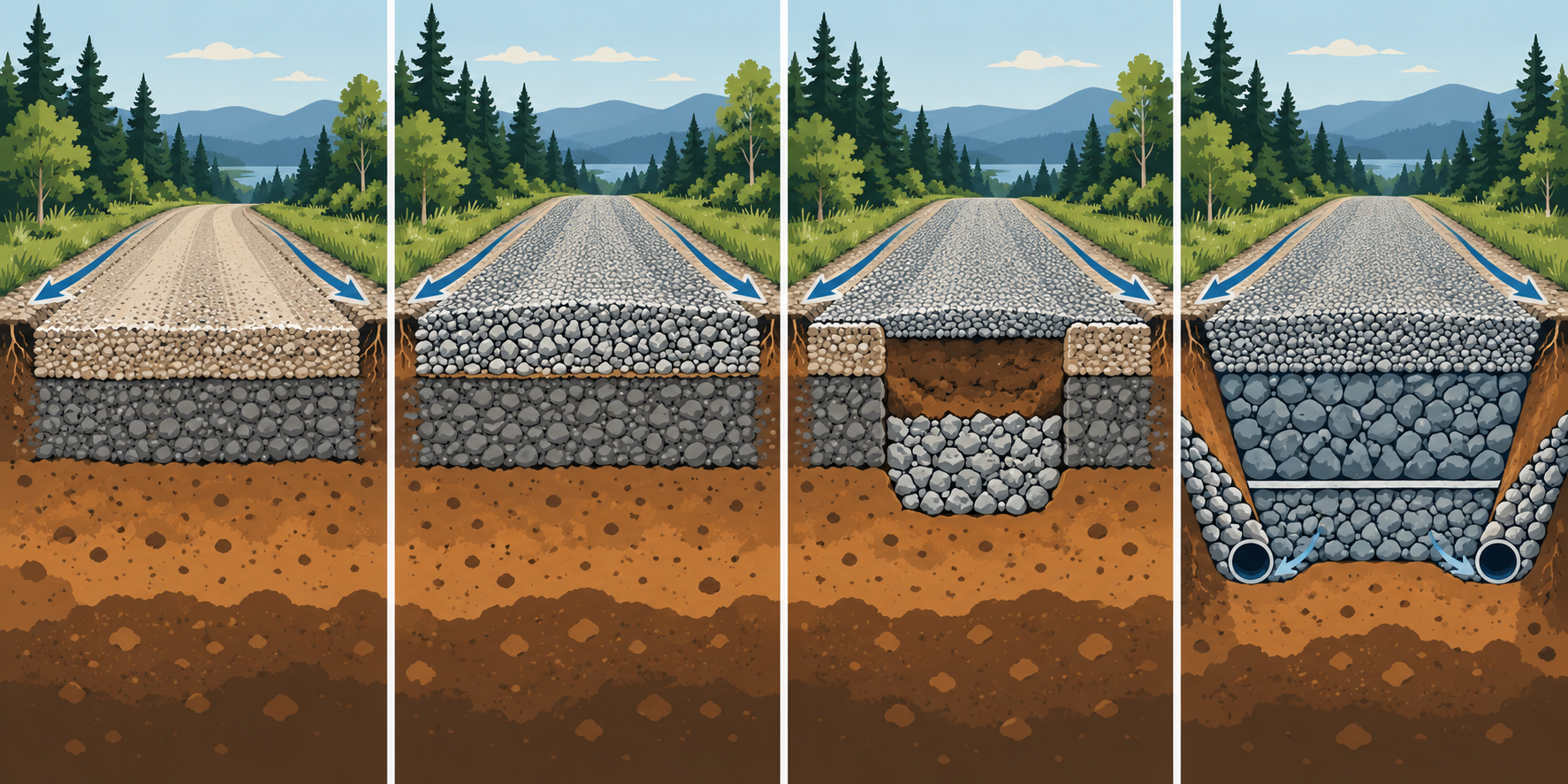
Failure signs that justify investigation
Look for ruts that return after grading, soft spots that remain wet, aggregate disappearing downhill, washouts, standing water, edge drop-offs, insufficient crown, blocked ditches, and culverts that surcharge or collapse. Document where the failure occurs and when it appears—after thaw, intense rain, snowmelt, or heavy vehicle use.
Price the cause before the surface
Ask for a site walk and a written scope that identifies:
- existing surface and base condition;
- drainage, culvert, ditch, and outlet work;
- excavation, unsuitable-soil removal, and replacement material;
- geotextile or stabilization products only where the design calls for them;
- aggregate type, thickness, delivery, and compaction;
- widening, turnarounds, grades, and passing areas;
- equipment access, staging, traffic control, and restoration.
The haul distance and ability to turn equipment around can matter as much as material quantity. A remote road may also require phased work so residents, fuel trucks, emergency vehicles, or contractors can continue to reach the property.
Compare bids on the same assumptions
Do not compare one contractor’s “new gravel” allowance with another’s full drainage reconstruction. Give bidders the same map, access limits, target width, known problem areas, material expectations, and restoration standard. Request alternates for culverts, base correction, additional aggregate, and difficult access.
If water crosses a stream, wetland, or other regulated feature, ask the local authority or qualified designer what review is required before work starts. There is no general North American permit rule or per-mile price that can replace that site-specific check.
Resurfacing is appropriate when the road foundation and water management are sound. Reconstruction becomes more rational when failures are structural, recurring, or distributed across the road. The decision should be based on the cause of failure and the access standard the property actually needs.
Diagnose the layer that is failing
Start by describing what happens to the road, where it happens, and when. A pothole that appears after a wet season may point to water trapped in the surface or a weak base. A road that loses its crown may need reshaping and aggregate, while rutting under loaded trucks can indicate a deeper support problem. Erosion at the edges or repeated washouts may begin with an undersized or blocked drainage path. These clues help the designer or contractor investigate; they are not a substitute for an on-site assessment where failure is extensive or water is involved.
Ask for a walk-through with the person preparing the estimate. Mark the limits of each damaged segment and distinguish isolated repairs from full-length work. Identify driveway entrances, branch roads, turnarounds, low points, culverts, ditches, slopes, and areas where a loaded delivery truck would need to turn. Note whether access must be maintained during construction and which vehicles must continue to pass. If the property shares the road, include the neighbors or road association before approving a standard that changes access for everyone.
Make the bid scope comparable
An estimate should say which treatment is proposed and why. For resurfacing, request the existing surface preparation, aggregate type and depth, delivery quantity, spreading, compaction, crown, shoulder tie-ins, drainage work, and traffic restrictions. For reconstruction, request limits of excavation, unsuitable-soil handling, subgrade treatment, geotextile or base layers if designed, compaction requirements, culvert interfaces, erosion control, and final surface. Do not presume every road needs engineered fabric or a specified aggregate; ask the qualified designer to justify materials for the actual soils and traffic.
Separate these line items so the owner can see cost drivers:
- Mobilization, survey, engineering, permits, and temporary access.
- Clearing, excavation, hauling, disposal, and imported material.
- Drainage structures, culverts, outlets, slope stabilization, and erosion control.
- Road base, surface aggregate or paving, compaction, and tie-ins.
- Traffic control, restoration, taxes, contingency, and post-work inspection.
One western Washington contractor publishes gravel-road package bands by road length for a stated 10-foot width and lists mobilization separately. The page is an individual provider offer, not an independent estimate or national benchmark; it does not state an ISO currency code or date, and its scope should not be assumed to include engineering, permits, drainage, or every site condition. Its useful budgeting lesson is to hold width, length, and mobilization constant when comparing bids. Obtain current local proposals with explicit inclusions.
Public project schedules illustrate why a treatment and quantity must accompany a road price. Park County, Colorado, lists a 2026 chip-seal project at $235,002 for 5.3 miles using two ¾-inch lifts. Stevens County, Washington, gives a $150,000–$500,000 per-mile range to pave gravel roads to County standards, while Washington County, Iowa, describes $600,000–$800,000 per mile for new public paving depending on terrain and drainage. These are different county programs and scopes, not a matched market sample or homeowner rate; the source dollar symbols do not state an ISO currency code. Do not average them or divide them into a private-road quote; specify the surface, width, base, drainage, traffic, mobilization, and restoration for a local bid.
Decide whether to repair, resurface, or rebuild
Use a staged decision when the diagnosis is uncertain. A qualified professional may first map drainage and test weak sections, then price a limited repair against resurfacing or reconstruction. Compare not only initial cost but also the expected maintenance interval, disruption, seasonal access, and consequences if the proposed treatment fails. A cheaper surface layer can be reasonable where the base is sound; it is poor value when water or weak support is likely to reappear beneath it.
Phasing can reduce a large cash requirement, but it should follow a coherent design. Prioritize areas that block emergency or service access, protect water crossings, and prevent damage from spreading. Do not finish a low-priority segment simply because equipment is already there if doing so leaves the main drainage failure unaddressed. If phases occur in different years, account for remobilization and material price changes rather than assuming one continuous contract rate.
Track change orders and acceptance
Before work starts, photograph existing conditions and confirm property boundaries, access rights, utility locations, work hours, staging, and responsibility for temporary traffic. Agree who can approve a change order and how concealed conditions will be documented. For each change, record the reason, quantity, price, schedule effect, and remaining contingency. A general allowance without approval rules can grow into an uncontrolled capital cost.
At completion, compare delivered quantities with the bid, inspect drainage flow after rain if practical, and obtain as-built notes for culverts and buried work. Record outstanding defects and the contractor’s correction plan. Keep the design, permits, invoices, and maintenance recommendations together. A sound decision is one where the chosen intervention addresses the demonstrated failure, the access outcome is stated, and the next maintenance obligation is understood.
Prepare for construction costs and disruption
For purchase planning, use the contractor’s written scope and a condition report rather than dividing one rough total by road length. Different segments may need different treatments, and a stream crossing, retaining wall, or shared access agreement can change both cost and authority.
Construction timing affects both price and access. Ask whether the contractor can work only when the base is dry, whether material suppliers deliver to the site, and how weather delays are billed. Identify where equipment will stage, where excavated material can be placed, and whether residents need a temporary route. For a remote road, travel, ferry, seasonal weight restrictions, or an extra equipment mobilization can change the bid substantially. Include those assumptions in every alternative.
Before signing, confirm who secures permits and road approvals, locates underground utilities, protects ditches and adjoining land, and restores disturbed areas. Confirm the owner has authority to commission the work if the road crosses shared property. Keep a realistic contingency for documented concealed conditions, but do not use it to cover optional upgrades with no agreed design.
After the project, schedule a follow-up inspection after the first substantial rain or thaw. Note settlement, drainage flow, erosion, and traffic damage while the contractor’s warranty or correction period is active. Add the agreed maintenance interval to the property calendar and retain the material and compaction records. The cheapest initial bid is not the lowest ownership cost if it omits the inspection and routine care needed to protect the rebuilt surface.
Match the capital plan to access needs
A temporary closure, staged route, or short detour may be needed while the base is repaired. Include the effect on residents, fuel and water deliveries, contractors, and seasonal occupancy when comparing alternatives. Confirm which segments can be completed first without making a later phase less effective, and whether mobilization will recur for every season of work. Ask the designer or contractor what observable result will show that the repair is complete and what maintenance is expected afterward. Owners can then compare a repair that restores defined access with a larger upgrade intended to support different vehicles or future development. Keep those purposes separate in the estimate so an optional capacity increase is not hidden inside a necessary repair.