
Full-time rural ownership often carries recurring costs that a conventional home budget does not show clearly: private-road work, snow access, well and septic service, delivered fuel, backup systems, longer service travel, and replacement of infrastructure that is difficult to reach. Build the budget from included systems rather than applying one rural-property percentage.
Use three budget buckets
| Bucket | Examples | How to record it |
|---|---|---|
| Annual cash expense | Fuel delivery, road dues, snow service, routine visits, monitoring | Amount expected to leave the account this year |
| Periodic service | Testing, septic pumping, tank service, grading, inspections | Convert the expected interval into an annual planning allowance |
| Capital reserve | Pumps, tanks, culverts, road rehabilitation, generators, batteries | Save for eventual replacement or major correction |
Keep emergency contingency separate from the replacement reserve. A reserve is planned lifecycle cost; contingency covers an uncertain event or condition.
Include access and private systems
List the property’s actual systems:
- private road, association dues, grading, gravel, drainage, and snow;
- well, pump, pressure equipment, storage, treatment, and testing;
- septic tank, distribution, pumps, inspections, and pumping;
- propane or oil tank, delivery, service, and access;
- generator, batteries, controls, and backup fuel;
- vegetation, driveway entrance, culverts, and storm response;
- service travel, mobilization, and contractor minimums.
EPA guidance gives a U.S. example of conventional septic inspection at least every three years and pumping typically every three to five years, depending on use and system conditions. It also contrasts an example of $250–$500 maintenance every three to five years with a $5,000–$15,000 repair or replacement example. These are EPA examples, not current local quotes or a universal septic budget.
If a private bridge controls access, list it as an asset with its own condition records, engineer-recommended inspections, routine maintenance, and capital-replacement exposure. Keep annual work separate from repair or replacement, and budget the gross project before any confirmed contribution. A Clark County, Washington, covenant is one local example of an annual assessment and shared repair/rebuild process; a 2023 California district proposal shows that a contribution can be tied to a permanent access easement. Neither supplies a universal reserve amount or homeowner entitlement. The private bridge guide and shared-road guide cover the ownership questions.
Build the annual model
For each system, record the service interval, last service, expected next service, current local quote, access assumption, and replacement exposure. Divide periodic costs by the interval only after confirming that the property actually has the system and that the service interval applies. Then add a separate line for difficult access, fuel price volatility, and a severe-weather response.
Use the budget to test a property
Compare a public-road, public-utility property with a remote property that has private road, well, septic, propane, backup power, and long service travel. The difference is not one “rural premium”; it is the sum of specific obligations. If a service is undocumented, use a verification allowance rather than pretending it is zero.
Review the budget after a major equipment change, a new occupancy pattern, a road or water failure, an insurance change, or a change in local service availability. A transparent schedule is more useful than a precise total built from unsupported assumptions.
Create a usable annual schedule
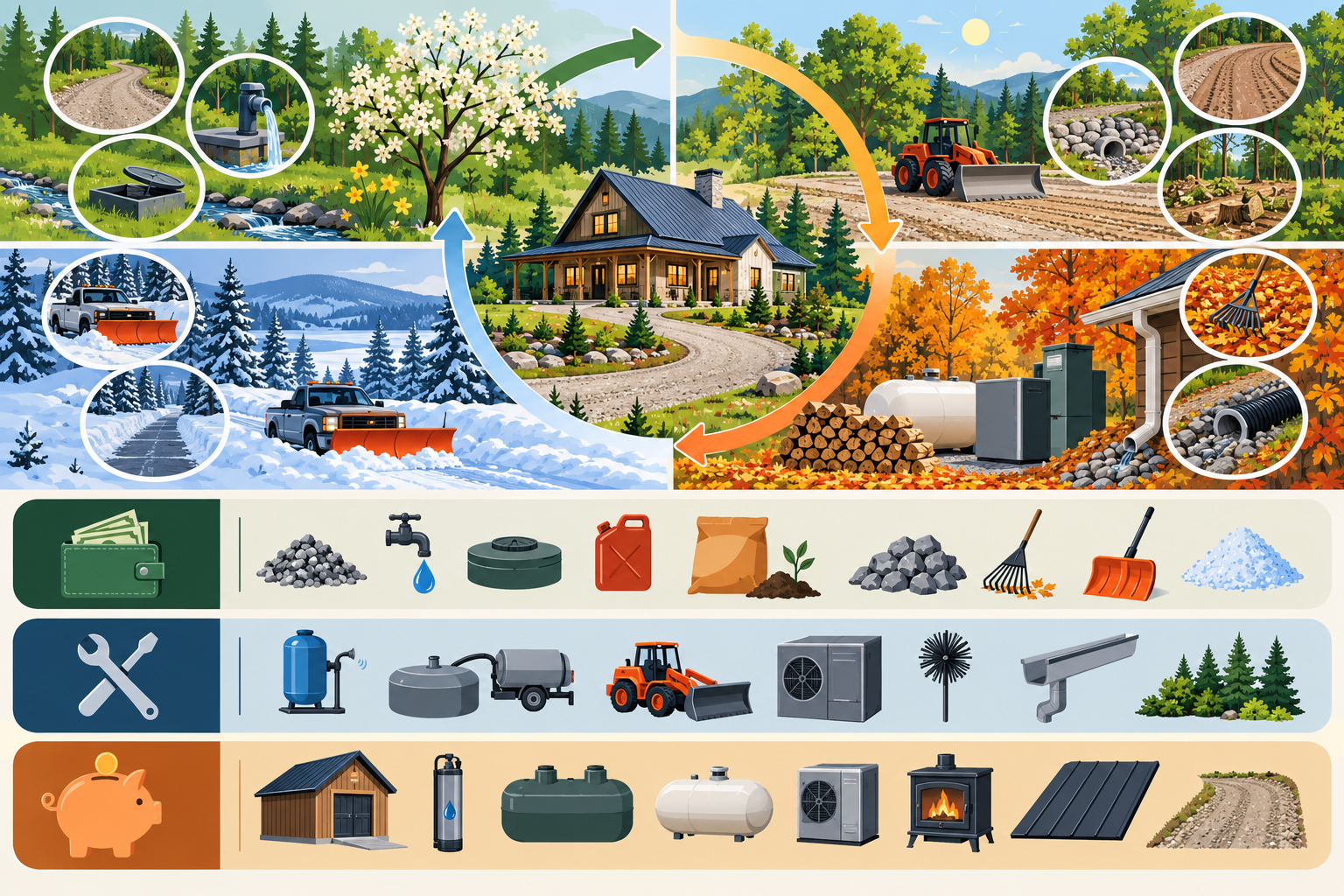
Start with a property inventory: road and driveway, culverts and drainage, well or water connection, septic system, heating and fuel storage, backup power, alarms, exterior structures, and any shared services. For each asset, record its last inspection or service, known condition, responsible provider, expected next task, and documentation location. Mark the task as scheduled maintenance, periodic professional service, condition-based repair, or eventual replacement. This helps prevent a reserve amount from being mistaken for cash due this year.
Organize the cash calendar by season. Spring may bring road and culvert inspection, thaw-related repairs, septic service, or well testing; summer can allow grading and larger site work; fall can include heating service, fuel planning, tree work, and drainage preparation; winter may add snow clearing, access checks, and emergency response. The right sequence varies by climate and equipment. Use manufacturer instructions and local professional guidance to set actual intervals rather than copying this example as a fixed schedule.
Separate annual cash from periodic work and capital
Track three totals:
- Cash paid this year: current contracts, fuel, power, road maintenance, routine supplies, and completed service calls.
- Periodic work: inspection, pumping, testing, or maintenance that happens on a multi-year cycle, shown in its actual due year and as an annual planning equivalent.
- Capital reserve: future replacement or major rehabilitation for roads, pumps, tanks, generators, heating equipment, water systems, and structures.
Keep the time basis explicit. If a service is expected every three years, show the expected invoice year and a separate annual saving target; do not report the saving as though a bill were paid every year. If a component has no reliable replacement estimate, record the uncertainty and next inspection rather than inventing a precise reserve. The reserve is a planning tool, not a prediction of actual useful life.
Connect estimates to evidence
Label each budget line as a current contract, recent invoice, provider estimate, public tariff, owner assumption, or unknown. Include source date, geography, unit, service frequency, tax treatment, travel, and scope. A municipal connection charge, a provider’s package price, and a contractor’s installed quote answer different questions. Keep U.S. and Canadian estimates in their original markets and currencies; do not combine them through an arbitrary exchange rate.
For each unknown, write the next useful action. Examples include requesting a private-road inspection, confirming a propane lease, testing a well, asking the septic authority about records, obtaining the insurer’s vacancy terms, or pricing a generator service. A clear action is more useful than a blank cell or a falsely precise placeholder. For a property under purchase review, distinguish known obligations from costs that depend on further inspection.
Stress-test the budget
Prepare a normal year and a difficult year. The difficult case might include a storm-damaged road, a delayed fuel delivery, a pump failure, unusual snow service, or multiple contractor trips because of remote access. Do not add every extreme event into the annual total as if it happens every year. Show it as a separate contingency or risk scenario and explain whether savings, insurance, a reserve, or owner capacity would cover it.
Ask providers to identify the assumptions behind recurring quotes, including road condition, service area, contract term, minimum callout, price adjustment, and excluded work. For shared assets, include the owner’s documented allocation and any special assessment exposure. Review the budget after a major repair, new equipment, change in occupancy, rate change, or service-market change. A reliable annual plan makes obligations visible, keeps periodic invoices in the right year, and leaves uncertain capital work labeled for investigation.
Make the budget easy to update
Use one line for each service or asset rather than grouping everything under “maintenance.” A practical record can include: task, property component, responsible provider, last completed date, next due date, quote or invoice, unit and frequency, tax and travel treatment, funding source, and evidence link. For work shared with neighbors, include the documented cost share and association contact. For unknown amounts, record the next step and date for obtaining a quote.
Keep original quotes alongside the annual total. If a provider changes a rate, update the new amount and retain the former one so the change is visible. Record whether a contract auto-renews, what notice is needed to cancel, and how far ahead a remote appointment must be booked. A budget can be accurate on paper and still fail if contractor capacity is unavailable when the seasonal work is due.
Use the budget during purchase and ownership
Before purchase, separate recurring costs supported by records from one-time work identified by inspection. Ask the seller for recent invoices and service logs, then confirm the current provider’s terms. Do not assume that a seller’s maintenance spending represents the future buyer’s expense: occupancy, service access, contract eligibility, fuel usage, and road responsibilities may differ.
During ownership, compare actual spending to plan once or twice a year. Explain the variance by changed scope, quantity, weather, access, or price rather than simply replacing the original estimate. Move deferred tasks into a future year with a clear priority and consequence. If the owner cannot fund all planned work, discuss the order with qualified providers, especially where water, fuel, wastewater, or safe access is involved. A written calendar makes those tradeoffs visible before they become emergency calls.
Keep separate documents for the operating budget, inspection findings, contracts, and capital plans, but link them by property component and date so an owner can trace a number back to its source.
Before each annual renewal, verify that the quoted service area, coverage dates, and named equipment still match the property. Record the change before updating the total.
Distinguish household costs from development work
A purchase or renovation may create one-time work that does not belong in a normal annual maintenance total. Keep major utility extension, road reconstruction, new well or septic installation, and conversion work in a separate capital plan. After the work is complete, add only the recurring inspections, service, fuel, access, and reserve contributions to the annual schedule. This prevents a one-time project from inflating every year’s ownership cost and prevents a large uncompleted project from disappearing into a routine maintenance allowance. State the budget period and property occupancy so another owner can understand what the total represents.