
The land price or advertised home price is only the starting point for a rural-property budget. The property may also need a private road, a well or cistern, septic, fuel storage, utility extension, winter access, backup power, or recurring service from contractors who travel farther. The useful question is not “What does rural property cost?” but “Which infrastructure is already usable, which still needs work, and who will pay to keep it operating?”
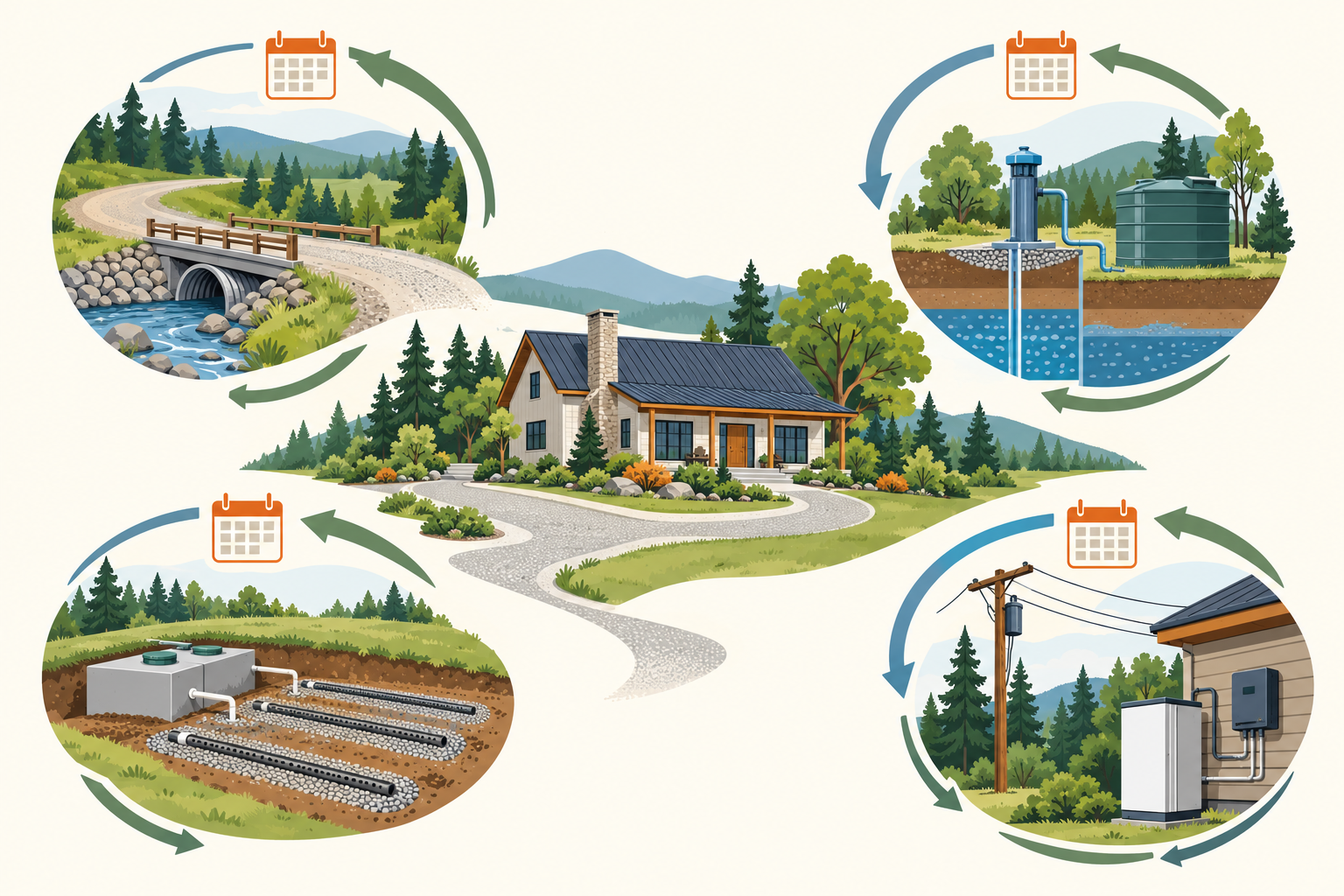
What counts as rural-property infrastructure
For budgeting, include anything that makes the home reachable, serviceable, supplied, and safe to occupy:
- access roads, bridges, culverts, gates, and winter service;
- electric, communications, and any extension or trenching from existing service;
- wells, springs, cisterns, water hauling, pumps, treatment, and testing;
- septic or another onsite wastewater system;
- propane, heating oil, wood, or other delivered-fuel storage and delivery access;
- heating, backup power, monitoring, and the loads those systems must support;
- contractor travel, equipment mobilization, material delivery, and restoration;
- inspections, design, permits, easements, and professional verification;
- routine service plus reserves for periodic replacement.
The main cost buckets
| Cost class | Examples | Budget question |
|---|---|---|
| Existing-system correction | Failed culvert, aging septic, poor drainage, unsafe tank | What condition is documented, and what is merely assumed? |
| One-time connection or construction | Utility extension, trench, well, cistern, septic, road rehabilitation | What distance, ground, access, and approval assumptions are in the quote? |
| Recurring operation | Fuel delivery, snow clearing, road grading, water hauling, inspections | What must be paid every year or every season? |
| Periodic service | Septic pumping, tank service, testing, winterization, opening visits | What interval and service scope apply to this property? |
| Replacement reserve | Pumps, batteries, generators, tanks, culverts, road sections | What will eventually fail even when maintained? |
These classes should stay separate. A low initial price can hide a large recurring obligation, while a high one-time upgrade may reduce service calls or winter risk.
Existing infrastructure versus infrastructure still required
Ask for records rather than relying on a listing description or a seller’s general statement that the property is “serviced.” Confirm the service owner, connection point, capacity, age, inspection history, access rights, and responsibility for repairs. A road that reaches the lot may not have a funded maintenance arrangement. A well may produce water but still need testing, treatment, storage, or pump work. A septic tank may exist without evidence that the full system is suitable for the intended occupancy.
For a Canadian rural purchase, CMHC specifically identifies well-water quality and adequacy, septic inspection, and service hook-up fees as costs to consider. Those are checkpoints, not a complete inspection package or a national fee schedule. U.S. and Canadian properties also differ in utility ownership, health requirements, local approvals, currency, and contractor markets; do not convert one market’s price into the other.
Access and service distance
Physical access affects more than the road line item. It can change whether a fuel truck, water truck, septic pumper, crane, excavator, or emergency contractor can reach the property. Ask whether the route is usable in wet or snowy conditions, whether a bridge or culvert has a load limit, where equipment can turn around, and whether a neighbor’s land or a private road agreement controls access.
If a bridge is the only practical vehicle route, treat it as a distinct condition and reserve question. Confirm access rights, maintenance responsibility, engineering and load records, inspection history, and the vehicles that must use it before relying on the road. A surface visit or an old load sign does not establish structural capacity. Repair or replacement can also require approvals, temporary access, demolition, restoration, and a maintenance handover. See the private access bridge guide for a quote and due-diligence framework; its local examples are not a property estimate.
Build a property-specific reserve
Before making an offer or setting a construction budget, create three totals:
- immediate work needed to make the property usable;
- recurring cash expenses for the first year;
- an annualized reserve for periodic service and eventual replacement.
Then add explicit allowances for unknown soil, rock, drainage, utility, access, and approval conditions. Do not label an unexplained percentage “contingency” and assume it covers everything. Obtain separate proposals for major systems and record what each proposal excludes.
Questions to answer before committing
- Which services are public, private, shared, seasonal, or unavailable?
- Who owns and maintains the road, culverts, meters, tanks, pumps, and service lines?
- Can each contractor reach the property when the work is actually needed?
- What testing, inspection, design, permit, or environmental review is required locally?
- What is the annual cash cost if the property is occupied full time or left vacant?
- Which systems need a replacement reserve even if they work today?
The result should be a list of verified scopes and open questions, not a single rural-property total.
Build a scenario budget before choosing a property
Start with the systems the property already has, then mark each as verified, serviceable but uncertain, or missing. For each line, separate the price of making it usable from what it costs to keep it usable. A well that works today may still need testing, a pump reserve, and service access. A private road may be passable now while carrying an unfunded grading or culvert obligation. A utility line near the parcel may still require a designed extension, an easement, and customer-paid site work.
A simple worksheet can organize the decision without pretending to know the final price:
| Budget line | Current condition | One-time work | Recurring cash cost | Periodic or replacement reserve | Evidence still needed |
|---|---|---|---|---|---|
| Access | Public, shared, private, or seasonal | Road repair, bridge or culvert work | Dues, grading, snow service | Surface rehabilitation and structures | Agreement, inspection, local bids |
| Water | Municipal, well, cistern, or hauled | Connection, storage, treatment, or pump work | Water, power, testing, delivery | Pump, tank, treatment, or source renewal | Records, tests, availability, quote |
| Wastewater | Sewer or onsite system | Inspection, connection, repair, or replacement | Pumping and routine service | Drainfield or component reserve | Permit, design, service history |
| Energy and fuel | Grid, private system, delivered fuel | Extension, capacity, storage, backup | Utility bill, fuel, monitoring | Battery, generator, tank, or line reserve | Utility offer, load review, supplier terms |
Then create three versions of the budget. The first is the minimum work needed for safe, intended use. The second includes likely first-year service and the property’s normal occupancy. The third covers a more difficult but plausible case: weak water yield, a failed access crossing, a long utility route, a blocked winter road, or several systems needing work at once. The third case is not a prediction. It exposes which unknowns could change the purchase or development decision.
Do not fill missing amounts with a single unexplained contingency percentage. Ask which uncertainty each allowance covers. Unknown rock during trenching, an uninspected wastewater system, a private road assessment, and a long utility contribution are different risks; one blanket percentage can obscure a large item that should be investigated before closing.
Distinguish a low quote from a low ownership cost
Compare the proposals on the same property plan and service assumptions. A connection quote may exclude trenching on the owner’s land. A road quote may include grading but omit aggregate hauling, drainage correction, or spring repairs. A cistern quote may cover the tank but not excavation, controls, treatment, water delivery, or the power needed to pump. A seasonal-service offer may price one visit but exclude travel, emergency response, and repairs discovered during the visit.
For each proposal, record the quoted work, quantity, materials, access assumptions, exclusions, permits, taxes, schedule, payment milestones, and the condition that would trigger extra work. Where estimates depend on an inspection or design, budget that first step separately. It can prevent a low-level assumption from being mistaken for a complete construction price.
Separate expected cash outlay from reserves. A monthly fuel delivery or annual road fee is cash paid in the current year. A septic inspection every few years is a periodic expense that can be averaged for planning once the applicable interval is confirmed. A future pump or culvert replacement is a capital reserve. Keep emergency contingency separate from all three: a reserve is a planned lifecycle cost, while contingency addresses an uncertain condition or event.
Check whether the property remains usable when conditions change
The cheapest arrangement on a mild day may not meet the household’s actual needs. Test the budget against the season when access is worst, the largest service vehicle that must reach the site, the longest planned vacancy, and the home’s intended water and energy use. Ask what happens if power fails while the home is empty, a road becomes impassable before a fuel delivery, or a shared system needs urgent work before owners can agree on cost allocation.
These are not reasons to reject every remote property. They help identify which service commitments need documentation and which choices are part of the property’s normal ownership cost. A seasonal owner may choose a narrower service plan and accept a different response time. A full-time household may value year-round access and professional system support enough to spend more upfront.
The cost comparison is ready for a decision when the essential systems have a known owner, a credible condition assessment, a realistic first-year scope, a recurring-cost plan, and a stated reserve for major replacement. Keep unresolved items visible in the offer, development schedule, or project budget instead of treating them as zero.