
A cistern can be a primary water supply, supplemental storage, or a buffer for a low-yield well. Hauled water can make a property viable where a well is unavailable or unreliable, but it replaces one kind of uncertainty with tank, pump, treatment, delivery, access, and recurring water costs. Start by identifying the supply problem the system is meant to solve.
The system cost classes
- tank or cistern, interior or exterior;
- excavation, foundation, enclosure, insulation, and freeze protection;
- fill connection, pump, pressure equipment, controls, and backup power;
- treatment, testing, disinfection, and potable-water approvals;
- water delivery, minimum loads, storage capacity, and truck access;
- monitoring, cleaning, maintenance, and eventual replacement;
- wastewater capacity and access, which remain a separate but connected system.
Storage size is a design question. It depends on occupancy, demand, delivery reliability, source, emergency reserve, climate, and whether the cistern supplements a well. Do not choose a tank size from a generic household rule without a local water professional.
Price delivery as an operating system
The delivered-water quote should state the source, quality responsibility, volume or minimum charge, travel distance, winter access, fill connection, scheduling, and emergency availability. A low per-load price may not remain low when the truck must travel a long route, wait for access, or return for a small partial load.
Snow, mud, gates, narrow bridges, turning space, and road weight limits can determine whether delivery is possible. Include road maintenance and winter-access service in the water budget rather than treating the truck price as the whole cost.
Compare a cistern with improving the well
For a low-yield well, compare intermediate storage and a matched pump with well work, drilling, treatment, or a new source. Penn State describes storage as one approach to insufficient yield; it does not establish a universal design or price. Consider water quality, reliability, power dependence, maintenance access, and the consequences of a pump or delivery failure.
Water and wastewater must fit together
Private-water planning should not ignore septic or onsite wastewater. EPA notes that poorly maintained or poorly located septic systems can affect drinking water. Local authorities or qualified professionals must confirm siting, testing, treatment, separation, and approval requirements; no general North American rule applies to every property.
Obtain a proposal that separates capital installation, delivery, testing, treatment, access, maintenance, and replacement. A cistern is economical only when the full supply strategy remains workable through the property’s normal occupancy and worst access season.
Size storage around demand and delivery
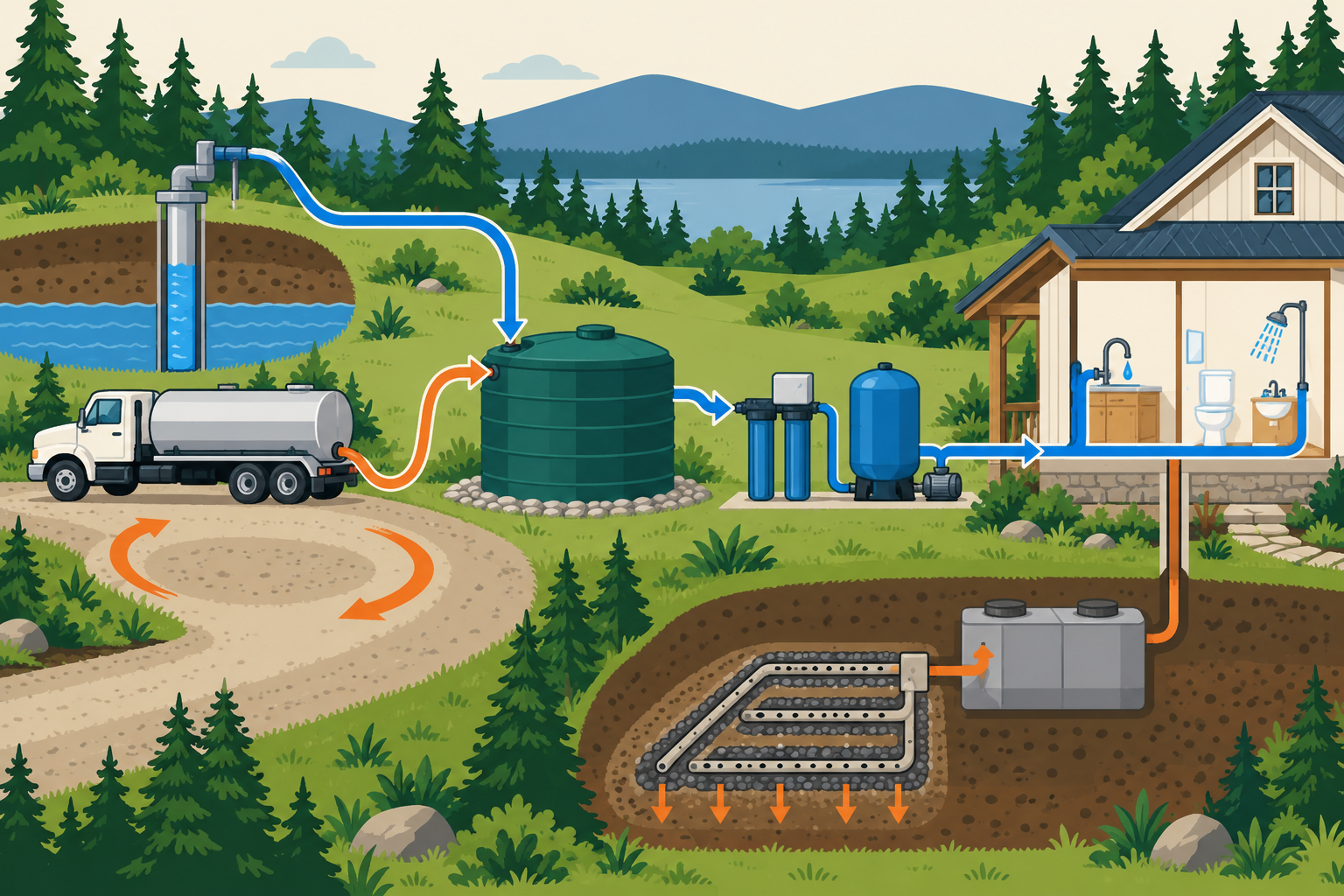
Start with household use, not a catalogue tank size. Estimate daily demand for the expected number of occupants and include cooking, bathing, laundry, cleaning, guests, and any outdoor use. Consider how long the property must operate between deliveries, the access season, water-source reliability, and whether a backup supply exists. A low-use seasonal home and a full-time household need different storage and delivery plans. A local designer or water professional should confirm the appropriate capacity, pump, pressure system, treatment, and emergency reserve for the actual site.
Ask the hauler for the delivered unit, minimum load, travel or remote-area fee, waiting charge, water source, treatment or quality documentation, and cancellation terms when roads are inaccessible. Clarify whether the price includes only water at the fill point or also pumping, hose distance, difficult access, winter delivery, and transfer into multiple tanks. Record the supplier’s service area and whether a backup hauler is available. Do not assume a posted municipal bulk-water price is a residential delivery quote.
One Alberta county utility publishes a potable bulk-water rate of $5 per cubic metre effective March 2026 and a $200 minimum prepaid account for its Crowfoot system. Its page states the rate with a dollar sign but does not specify an ISO currency code. This is a local counter-service tariff, not a hauled delivery price and not a full household water-system cost. The same utility describes a rural connection model that depends on line adjacency and available capacity, with landowners responsible for connection installation; homes relying on the described transmission line need cistern or reservoir storage. Verify eligibility, account rules, and current service details directly with the county before using the example.
A second local fill-point example shows why commodity water and delivery must be separate. Windham Water Works in Connecticut lists, effective July 1, 2026, $7.83 per load for 0–400 gallons, $15.65 for 401–1,000 gallons, and $62.62 for 1,001–3,000 gallons. The posted dollar symbol has no ISO currency code. Registered haulers must meet station requirements, and winter access should be checked; these are local fill charges, not a truck’s delivery price, a cistern installation cost, or a household water bill. Verify current station rates and access before using them in a scenario.
Include the full installed system
Request separate amounts for tank or cistern, excavation or foundation, delivery and crane access, plumbing, pump and pressure controls, filtration and disinfection, alarms, electrical work, freeze protection, testing, engineering, permits, and site restoration. Identify the connection between roof catchment, well, bulk filling, storage, and household distribution if more than one source is used. Keep drinking-water quality and non-potable use requirements clear; a system that stores water does not automatically make it safe to drink.
Ask what water testing is recommended for the source and how often treatment media, filters, UV equipment, pumps, and pressure tanks require service. Confirm who will maintain each component and what records the buyer receives. A proposal should state tank material and access for inspection and cleaning. Include delivery hose access and safe truck turnaround in the site plan. If a vehicle must cross a private road, confirm that the route can support it in the wet season and that the road agreement permits the use.
Plan for outage, vacancy, and replacement
For a seasonal property, specify how the system is protected during freezing weather, how it is safely shut down, what must be drained or isolated by a qualified person, and how it is restarted and tested. For continuous occupancy, ask what happens during a pump failure, power outage, contamination alert, or delayed delivery. Keep a practical reserve plan and contact information. Do not use a tank’s nominal capacity as usable household supply without accounting for operating limits and required reserves.
Separate routine operating costs from eventual capital replacement. Track water deliveries, testing, treatment supplies, service visits, power, and freeze damage. Keep an allowance for pump, controls, tank, or treatment replacement based on the installer’s maintenance information rather than a made-up universal lifespan. A complete comparison explains how water reaches the home, how quality is managed, what access the supplier needs, and what it costs to keep the system serviceable year after year.
Verify the source and service arrangement
Budget water quality and continuity together. A low-cost fill is not useful if the supplier cannot reach the tank during the property’s access season, while a large tank does not fix a treatment or pump failure. Record a backup source and the actions required before the household can safely resume normal use.
If a public or cooperative water line is nearby, ask the provider to confirm whether the parcel is eligible, whether capacity is available, and where the connection point would be. A line visible near the road does not prove the home can connect, and a published contribution or service rate may exclude trenching, meter, pump, reservoir, or interior plumbing. Request a written estimate that identifies who owns each section and who will maintain it.
If the property will rely on hauled water, contact the supplier before buying equipment. Verify the source and potable status, delivery unit, minimum order, hose reach, winter access, wait time, and whether the truck can safely turn around. Confirm whether there is a second supplier if the primary provider is unavailable. A posted bulk-fill tariff can help explain the price of water at one dispensing point, but it cannot by itself predict a delivered household bill.
Model household use without false precision
Prepare a low, typical, and high demand estimate using planned occupancy and actual uses. Include guests, laundry, outdoor taps, livestock or workshop use if relevant, and any requirements imposed by treatment or equipment. Compare each estimate with the supplier’s unit and minimum load to understand how many deliveries might be needed. Do not assume that tank capacity equals usable reserve; operating limits, sediment, pump location, and emergency storage affect practical supply.
Check that storage, pump, pressure tank, treatment, and distribution are designed as one system. Confirm what happens if electricity fails, the pump stops, the treatment device alarms, or a delivery is delayed. Record who is responsible for testing quality and when the system can be used after maintenance. If the property is vacant in freezing weather, have a professional document the shutdown and reopening procedure for the installed equipment.
At purchase, ask for well logs or testing where a well supplements the cistern, water delivery receipts, tank cleaning and repair history, and treatment-service records. Review the septic location and wastewater plan with the appropriate local professional so that water storage, access, and onsite disposal are considered together. The final budget should distinguish the one-time installed system, actual water purchases, scheduled service, and uncertain future replacement.
Clarify delivery and access costs in writing
Ask the hauler to state whether its quote includes the water, transfer into the tank, travel, minimum load, wait time, and any repeat trip if the tank cannot be filled on arrival. Confirm hose reach and the space needed for the truck to stop and turn. If the route is shared or seasonal, verify that the road agreement and surface condition allow a loaded vehicle. Keep the supplier’s delivery unit and water source on each invoice so household use can be compared with the budget. A fill-point charge, home delivery price, installed cistern proposal, and monthly household cost answer different questions and should remain separate in the estimate.