
An off-grid home is an integrated infrastructure project. Power must support pumps, refrigeration, heating controls, communications, and other loads. Water may need a well, cistern, intermediate storage, treatment, and backup power. Wastewater still needs a suitable system and maintenance access. Fuel, roads, monitoring, and replacement reserves determine whether the home remains usable after the initial installation.
The infrastructure stack
Budget each layer separately, then test the interactions:
- generation and electrical distribution;
- batteries or other storage and controls;
- generator or another backup source, including fuel;
- water source, pump, pressure equipment, storage, and treatment;
- wastewater collection and disposal;
- heating and domestic hot water;
- communications, monitoring, and alarms;
- road access, deliveries, service travel, and spare parts;
- commissioning, training, maintenance, and replacement reserves.
The DOE off-grid case illustrates why a stand-alone home can combine renewable generation, batteries, an inverter, a generator, pumps, AC and DC loads, and monitoring. It is a case study, not a standard package or price list.
Power and water are linked
A water system can be technically available but operationally fragile if the pump cannot run during poor generation, a battery outage, or a generator failure. Penn State describes intermediate storage as one possible response to insufficient well yield; that adds a tank, pump controls, space, protection, and maintenance rather than eliminating the water problem.
Ask the designer to show normal, peak, emergency, and winter loads. Include the power required to move, treat, heat, and dispose of water, not only lights and appliances.
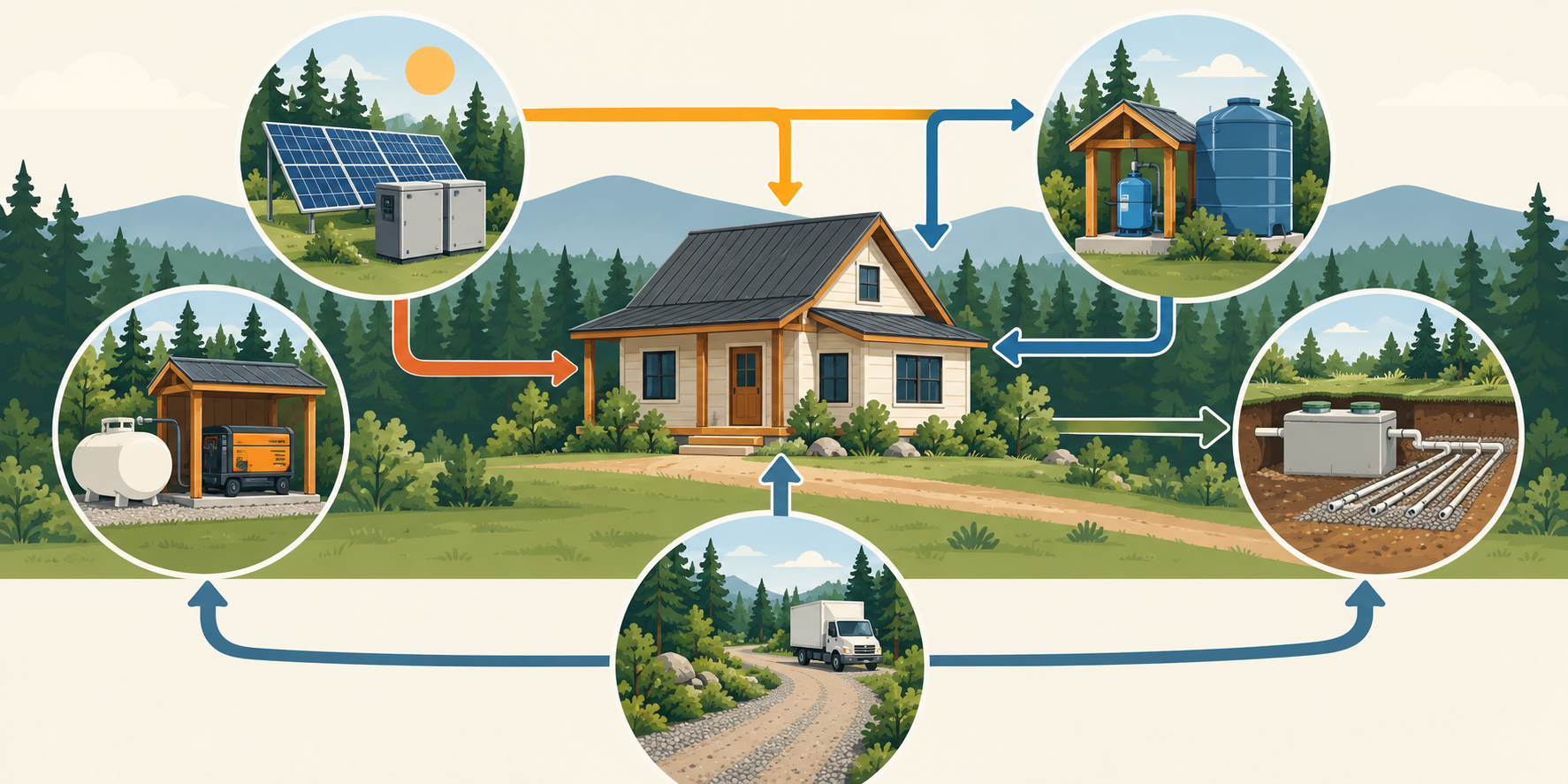
Heating, fuel, and wastewater
The cheapest electrical design on paper may not be the cheapest whole-property design if it requires a large electric heating load. Delivered propane, oil, wood, or another fuel can change the electrical system, but it adds storage, delivery access, inspection, and supply-continuity questions. Wastewater adds site feasibility, pumps where applicable, maintenance access, and local approval requirements. A septic or onsite system is not a substitute for integrated site planning.
Three useful budget scenarios
Instead of one false precise total, model at least three scenarios:
- Low-complexity: efficient loads, favorable access, dependable water source, straightforward wastewater, and modest seasonal demand.
- Base case: full-time occupancy, storage and backup, normal service travel, private access, and ordinary replacement allowances.
- High-complexity: difficult terrain, weak water yield, hauled water, long access, severe winter, high loads, extended vacancy, or limited service availability.
For each scenario, show what is included, what is excluded, the operating assumptions, and which professional proposal would replace the planning allowance.
Do not forget the replacement reserve
Record the expected service life and replacement path for batteries, inverters, pumps, generators, controls, fuel equipment, water storage, and access structures. A system that works only while one specialist is available or one fuel route remains open has a serviceability risk that belongs in the decision.
Use qualified designers and installers for electrical, fuel, structural, water, and wastewater work. The responsible budget is the one that makes system dependencies visible without pretending that one off-grid design fits every property.
Screen assistance by applicant and asset before including it in a household budget. USDA’s Rural Energy for America Program serves qualifying agricultural producers and rural small businesses, while community energy awards are made for community-scale projects. Those awards do not automatically reduce an individual homeowner’s off-grid system cost. Use the gross project total in the base case; include assistance only in a separate scenario after the administrator confirms the applicant, property, eligible work, current application path, award, and payment timing.
Define the service level before choosing components
Begin with the household’s actual use rather than the equipment list in an online example. Record full-time or seasonal occupancy, the longest period the property may be empty, expected heating and hot-water choices, water source, communications needs, critical medical or work loads, and the level of interruption the household can tolerate. Identify what must operate during a storm or fuel delay and what can wait until access returns.
Separate peak demand from energy use over time. A pump, compressor, heating element, or workshop tool may create a short high load even if it runs infrequently. Continuous refrigeration, communications, or monitoring may use less power at any one moment but operate throughout the day. A qualified designer can translate those patterns into system capacity; a generic “average household” assumption may not represent an isolated property.
The same service level affects water and wastewater. Estimate water demand by intended occupancy and use, then confirm source yield, storage, treatment, pump capacity, and backup power with the relevant professionals. A storage tank can buffer an uneven source or delivery schedule, but it does not make water quality, potable approval, or wastewater capacity automatic. Private systems still need local review and ongoing service access.
Budget interfaces between systems
Whole-property costs often appear where two systems meet. A generator may need a fuel arrangement, transfer equipment, maintenance access, and safe placement. A well pump may need electrical capacity and water storage. A battery room may affect ventilation, structural support, or temperature management. A septic system can constrain the location of a well, cistern, driveway, or future addition. A snow route may need to preserve access for fuel, water, or service vehicles.
Ask designers and installers to state what their proposal assumes about adjacent work. A power bid may exclude trenching or generator fuel storage. A water proposal may assume a reliable electrical supply. An access contractor may not include drainage or a bridge assessment. Write these interfaces into the project scope so that a missing prerequisite does not appear after the main contract is signed.
| Interface | Budget question |
|---|---|
| Power and water | Can the pump, treatment, and storage controls operate during the expected outage case? |
| Generation and fuel | Is storage, delivery access, maintenance, and eventual equipment replacement included? |
| Heating and electricity | Which heating loads are included in the design, and which use another fuel? |
| Water and wastewater | Do source, storage, treatment, occupancy, and onsite disposal fit the same site plan? |
| Access and service | Can the people, parts, fuel, water, and equipment needed for repairs reach the property in the season of use? |
Match the scenario to occupancy
A seasonal property may have a lower annual operating demand than a full-time home but a higher need for monitoring, freeze protection, and restart planning. A low-use system still needs to remain safe and recoverable while vacant. A full-time property may justify more storage, redundancy, or a different heating strategy because a long interruption has a higher household cost.
For a low-complexity scenario, document the assumptions that make it possible: favorable access, a dependable water source, modest loads, a manageable wastewater solution, and service providers able to reach the site. A base scenario should represent the household’s normal routine and include ordinary maintenance and replacement savings. A high-complexity scenario might include weak water yield, winter occupancy, long fuel routes, difficult equipment access, larger loads, or a limited local service market. Do not attach universal dollar amounts to these labels; use them to compare design choices and identify where quotes are needed.
Changing occupancy later can change the whole system. Adding full-time winter use may increase heating, water, wastewater, road, and backup requirements together. Adding an electric vehicle or workshop may affect capacity and storage. Before making one upgrade, ask whether the design has space and capacity for planned future use or whether expansion would require major replacement.
Make replacement and outage exposure visible
List the expected service and replacement path for each major component, even if the final date or cost is not known. Record the warranty, service provider, critical spare parts, expected maintenance, and what can operate while that component is unavailable. A system may have an acceptable purchase price but a difficult lifecycle if a specialist must travel a long distance or a replacement part cannot be obtained quickly.
The reserve plan should distinguish routine annual spending from an eventual capital event. Set aside a planning allowance for pumps, controls, batteries, generator work, storage, and access structures where present. If a component’s life depends on use, weather, or maintenance, write the range of assumptions instead of choosing one precise replacement year. Review the reserve after a major load change, a change in occupancy, a failed component, or a new local service option.
Finally, ask what the household will do during a failure. A backup generator does not automatically solve a fuel shortage; a large battery does not fix a broken pump; remote monitoring does not provide a person who can reach a closed road. A robust whole-property plan ties equipment redundancy to access, maintenance, communications, and a practical response procedure. That is the difference between owning several off-grid components and budgeting for a serviceable home.
Keep a service calendar with the system budget
For each major component, record the installer, model, warranty, maintenance instruction, service contact, consumables, and equipment needed to reach it. Schedule routine generator checks, battery and control inspections, pump or treatment service, fuel planning, and water testing according to the relevant manufacturer and professional guidance. These are separate from the capital reserve. Include the cost and travel assumptions for a qualified person who can work on the system when the owner is away or the property is occupied. If one component fails, document what remains operational and what temporary source of power, heat, water, or wastewater service is available. This makes redundancy a real operating plan instead of an unpriced list of backup equipment.