
Roof-over or recover work can reduce initial labor, disposal, and weather exposure by leaving an existing covering in place. Tear-off costs more upfront but reveals the deck, removes old weight and defects, and gives the new system a known substrate. The cheaper choice depends on whether recover is allowed and technically suitable—not simply whether the old surface looks flat from the ground.
What each option means
Tear-off: Remove existing covering and underlayers to the specified substrate, inspect and repair deck, then install the new assembly.
Roof-over/recover: Install an approved new system over a retained existing system, sometimes with a separation layer, cover board, battens, or other preparation.
These terms do not define one universal method. Asphalt-over-asphalt, metal over an existing roof, and low-slope membrane recover have different rules and risks.
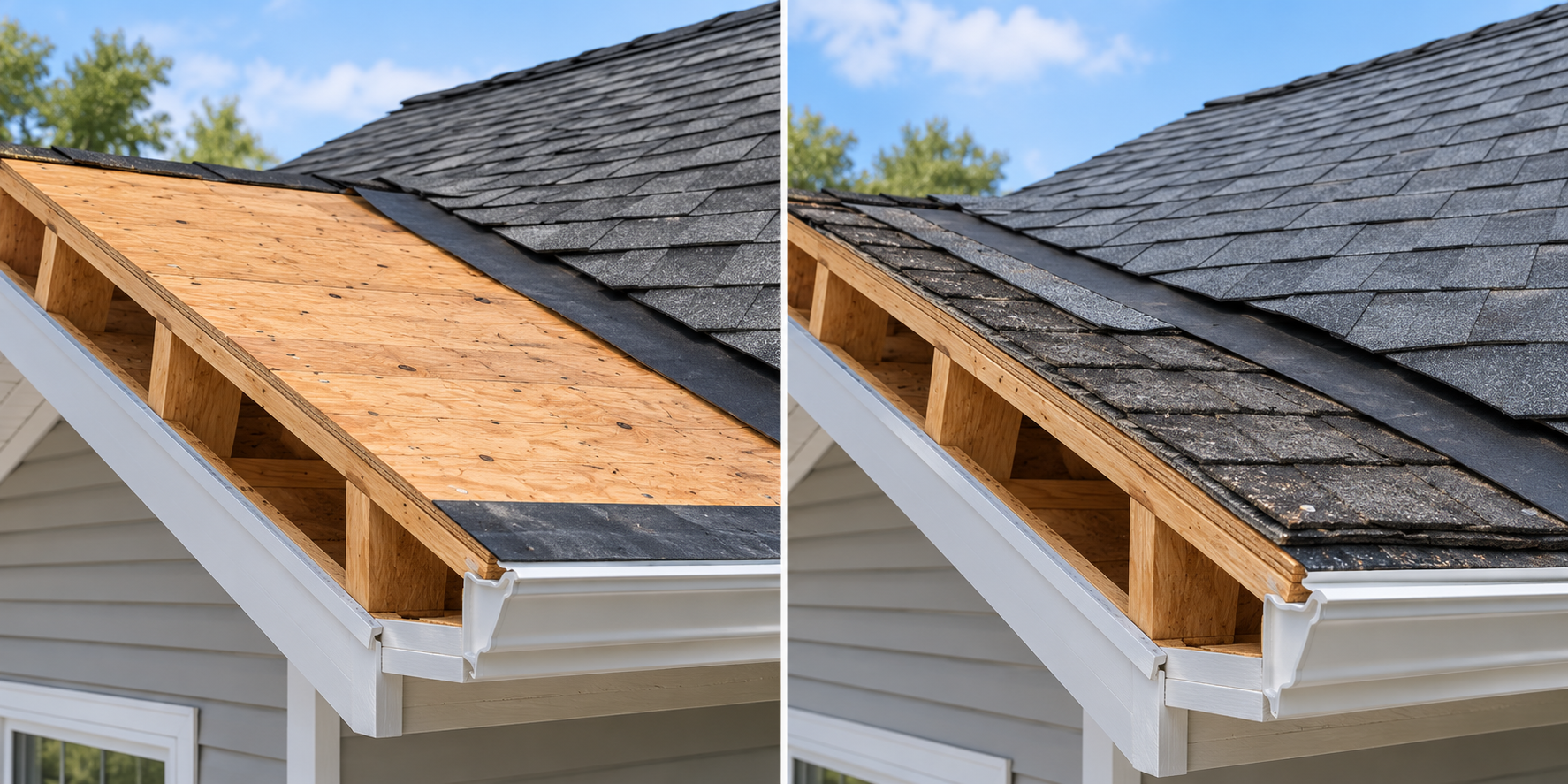
Upfront savings
Recover can avoid some demolition, containers, disposal fees, and cleanup. It may shorten the open-roof phase. Savings are largest when removal would be difficult and the retained assembly is genuinely suitable.
Preparation can consume the savings if the surface needs leveling, repairs, wet-material removal, edge reconstruction, or extensive new flashings. Request side-by-side scopes rather than a generic percentage discount.
What tear-off reveals
Removing the old roof permits direct deck inspection, replacement of deteriorated sheathing, and correction of flashing or underlayment details. It does not guarantee that every framing or moisture problem will be visible, but it reduces a major uncertainty.
Recover retains concealed conditions. Selective investigation may reduce uncertainty, especially on low-slope systems, but cannot equal full exposure.
Weight and structure
An added layer increases load. Natural Resources Canada notes this consideration and generally recommends removing existing shingles when installing new ones. That is guidance, not a universal structural calculation. The existing layers, new product, framing, snow, and local rules control.
Do not accept either “one more layer is always fine” or “every overlay needs engineering” without property-specific basis.
Details, appearance, and performance
Existing irregularities can telegraph through a new covering. Edges, valleys, walls, chimneys, skylights, vents, and drainage heights may be harder to detail with added thickness. Some manufacturers prohibit or condition recover installations, while some systems are designed for them.
Warranty treatment must be checked for the exact product and contractor. Code layer limits and permits are local.
Future cost
Recover defers removal; it does not erase it. The next replacement may need to remove multiple systems, raising labor and disposal. Compare the present saving with a conservative future tear-off allowance, adjusted for how long you expect to own the property.
Deferral still has value. Spending less today may be rational if the recover is durable and suitable, even if future removal costs more.
Scenarios
Sound single-layer asphalt roof: Product and local rules permit overlay, deck concerns are low, and geometry is simple. Recover can be a legitimate value option.
Leak history and unknown decking: Tear-off provides information and access worth more than avoided disposal.
Low-slope dry assembly: Investigation supports a compatible recover with new cover board and details. This may reduce disruption and waste.
Multiple layers or uneven substrate: Added weight, poor surface, and edge complexity favor tear-off.
Decision checklist
Verify existing layers, moisture/deck investigation, structural basis, local permission, product instructions, surface preparation, flashing and edge details, ventilation/drainage effects, warranty, present savings, and eventual removal. If the recover quote does not explain how concealed condition and interfaces were evaluated, the lower price may simply transfer risk to the homeowner.
Build a two-cycle cost model
For tear-off now, include removal, disposal, deck repair, and a renewed assembly on a known substrate. For recover, include preparation, retained-condition risk, current savings, and the probability that the next project removes both systems. Adjust for ownership horizon rather than simply adding future dollars at full present value.
If you expect to sell soon, future removal may not remain your cash cost, though condition and disclosure can still affect value. If you intend long ownership, the second-cycle scope deserves more weight.
Material-specific recover questions
Asphalt overlay can telegraph old irregularities. Metal-over-roof proposals may use battens or direct attachment with different ventilation and flashing implications. Low-slope recover may add cover board or separation layers after moisture investigation. Tile, slate, and wood have other constraints.
Ask for exact manufacturer documents supporting the proposed assembly. Do not infer permission across material families.
Details that can erase savings
Added thickness changes eaves, rakes, gutters, wall flashings, skylights, curbs, drains, and pipe penetrations. Shortcuts at these interfaces can create future leakage. Price proper reconstruction and compare again.
Waste and disruption
Recover reduces immediate debris, truck/container use, noise, and exposed-deck time. Tear-off removes old material from the building and allows correction. Environmental preference can be part of the choice, but future combined disposal remains relevant.
Decision rule
Choose recover when investigation shows a dry stable suitable assembly, exact product and local rules permit it, details can be integrated, and savings remain after preparation. Choose tear-off when uncertainty, moisture, layers, irregularity, weight, or interfaces make the retained roof a weak substrate.
Normalize the two proposals
Use the same roof area, new covering, underlayment or separation functions, flashings, ventilation, edges, accessories, deck assumptions, site protection, and warranty level. Then separate what recover omits—removal, disposal, exposed-deck repair—and what it adds—preparation, fastening through existing layers, cover board or battens where designed, altered details, and future combined removal.
A recover quote should identify every retained layer and the evidence that it is dry, stable, sufficiently regular, and compatible with the exact assembly. A tear-off quote should include a controlled deck contingency rather than using visibility as an excuse for unlimited extras.
Confirm local and manufacturer eligibility from current project-specific documents. The fact that one roof can receive an overlay does not establish that another material, layer count, slope, or substrate can.
Low, typical, and complex cases
A low-complexity recover candidate has one known suitable layer, sound dry substrate, simple geometry, and edges and penetrations that can be integrated without awkward buildup. The avoided removal and shorter exposure can create real first-cycle value.
A typical decision includes some investigation, localized correction, uneven areas, several flashings, and a meaningful but not overwhelming tear-off saving. Compare the prepared recover total with tear-off after the same product and details are restored.
A complex or weak candidate has uncertain layers, moisture, deflection, widespread irregularity, weight concerns, low transitions, multiple penetrations, or a future solar/equipment plan. Retaining the old roof can multiply detail problems and preserve the very uncertainty the capital project should resolve.
Two-cycle economics and ownership horizon
For recover, include today’s preparation and the possibility that the next intervention removes both old and new layers. For tear-off, include today’s disposal and deck repairs but credit the visibility and cleaner substrate actually purchased. Do not assign either path a guaranteed service period; model a conservative, expected, and difficult next cycle.
Short-horizon owners may value lower disruption and capital, but should document the retained assembly and avoid assuming sale value is unchanged or impaired. Long-horizon owners should give more weight to future removal, repair access, and whether new flashings or solar work will be disturbed.
Roof-over can preserve option value when it is a documented compatible system, not merely a way to avoid looking underneath. Tear-off can buy risk reduction, but removing sound suitable material is not automatically valuable if it does not change the new assembly’s performance.
Decision thresholds before work
Define what finding disqualifies recover: moisture extent, unstable substrate, extra layers, unacceptable irregularity, or detail conditions. Agree on the investigation method and a fallback tear-off price. If the threshold is crossed, the owner can switch scopes without negotiating from scratch after mobilization.
For tear-off, define deck unit prices, structural escalation, and dry-in. Both options contain uncertainty; the better proposal identifies and controls it rather than using a generic “cheaper now” or “always do it right” slogan.
Read recover quote assumptions
“Install over existing roof” should state retained material and layer count, attachment into the supporting structure or deck as designed, preparation, separation/underlayment, irregularity treatment, flashings, ventilation, edges, weight basis, and exact manufacturer eligibility. If moisture investigation is absent, the owner cannot know whether the central recover assumption has been tested.
“Tear off to deck” should state removal layers, disposal, deck allowance, unsuitable-board or structural response, temporary dry-in, and whether old flashings or accessories are also removed. Visibility is valuable only when the contract uses it to correct defined conditions.
Example two-cycle comparison
The recover path pays less removal now, adds preparation, retains old material, and may face combined removal later. The tear-off path pays disposal and deck correction now, then begins from a visible substrate. Model both with the same new covering and a conservative next intervention. Do not assume recover fails early or tear-off guarantees longer service.
If recover savings remain meaningful after proper edges, penetrations, preparation, and future-removal allowance, it may be rational. If savings disappear once those details are included, tear-off buys visibility and cleaner integration at a small true increment.
Project conditions that reverse the answer
Recover becomes weaker as moisture uncertainty, existing irregularity, layer complexity, weight, and low clearances grow. Tear-off becomes less compelling when the existing assembly is documented dry, stable, compatible, simple to detail, and removal would add disruption without changing substrate work. Future solar, skylight, drainage, or wall projects can reverse either decision by changing how soon layers must be reopened.
The final selection should state why retained material is an asset or liability on this roof. That property-specific sentence is more useful than a universal prohibition or endorsement.
Compare financing, disruption, and option value
If financed, include interest on the higher tear-off total and on any recover preparation. If paid in cash, recognize the capital difference without assuming an investment return. Recover can reduce immediate debris, noise, and open-roof time; tear-off can reduce substrate uncertainty and make deck/attachment work easier to define.
Those benefits have option value even when they cannot be priced precisely. A documented recover can preserve capital for another urgent project. Tear-off can make future solar, flashing, or repair work easier to interpret. State these benefits separately rather than inventing a dollar payback.
Repairability after each choice
Ask how a future leak is traced through retained layers, how one damaged area is opened, and whether the recover attachment or separation affects repair. For tear-off, ask what concealed findings and photographs will be retained so later contractors know the substrate and flashings. A new surface over old material should not make every later repair a mystery.
Final comparison checklist
Confirm exact eligibility, moisture investigation, layer/weight basis, preparation, attachment, edges and penetrations, ventilation/assembly effect, deck controls, future combined removal, warranty, repair path, and planned projects. If recover remains suitable and meaningfully less expensive after every line, it is a legitimate system choice. If not, tear-off purchases information and integration rather than merely disposal.
Compare warranty and sales claims
Confirm that the exact manufacturer accepts the proposed recover assembly and what substrate, layers, preparation, ventilation, and fastening conditions apply. Ask whether warranty remedy differs from the tear-off assembly and whether retained-layer failures are excluded. “Full warranty” is not evidence of moisture or structural suitability.
Tear-off should not be sold as automatically extending life; recover should not be sold as the same roof for less. One buys removal and visibility, the other buys reuse of a qualified substrate. The quote must show how either physical choice supports the new system.
Final regret test
If recover wins, budget the difficult case of future combined removal or leak tracing and confirm today’s savings remain worthwhile. If tear-off wins, acknowledge the disruption and serviceable retained material removed and confirm visibility/integration justify the increment. Record the disqualifying findings so the choice can be verified during work.
Uncertainty boundary
Investigation cannot prove every retained area dry and sound, while tear-off cannot promise a defect-free deck. Set recover-disqualification findings and tear-off deck units before work. Both choices then carry controlled uncertainty, allowing eligibility, integration, disruption, and two-cycle cost to decide.