
A focused skylight flashing repair commonly costs high hundreds to a few thousand dollars because surrounding covering must be removed and restored. Replacing the skylight unit, rebuilding a curb, repairing broad deck damage, or working on a steep specialty roof can cost more.
First determine whether water is entering through the roof interface, the skylight unit, or interior condensation.
Three sources that look alike indoors
Roof flashing failure: Water bypasses the layered flashing and surrounding roofing.
Skylight unit failure: Glazing seals, frame, gaskets, drainage paths, or operating components are defective.
Condensation: Indoor moisture collects on a cold surface or in the shaft, sometimes only under weather conditions associated with leaks.
Staining at the opening does not distinguish them. Diagnosis may require exterior and interior observations and, where appropriate, product-specific testing.
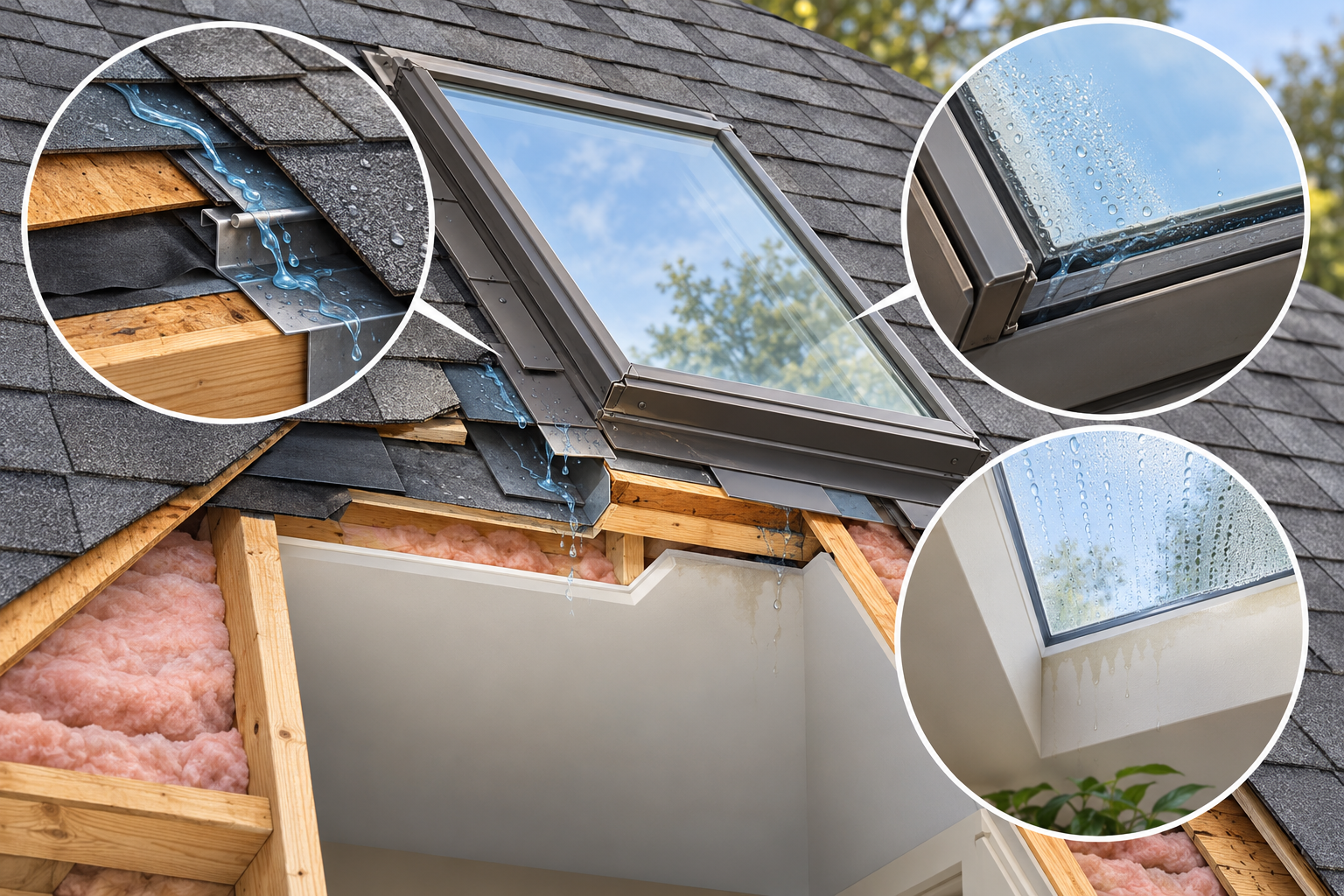
Roofing-side repair scope
A roofer may remove shingles, tile, slate, metal, or membrane around the skylight; inspect deck and underlayment; install a compatible flashing kit or site-built detail; restore covering; and address nearby drainage. Curb-mounted and deck-mounted units have different interfaces, but product and installation details control.
Surface sealant may temporarily alter water entry without fixing improperly layered flashing. Ask how the new detail routes water around and below the unit.
Cost drivers
- roof material and quantity opened;
- steepness, height, and staging;
- skylight size, number, and mounting type;
- availability of a compatible manufacturer flashing kit;
- deck or shaft damage;
- brittle or discontinued surrounding covering;
- reroof timing and whether the unit is reused;
- interior finish restoration, usually a separate scope.
Repair or replace the unit
Flashing repair is strongest when the skylight itself is sound, appropriately installed, and compatible components exist. Unit replacement becomes stronger when glazing seals, frame, operation, or curb are failing; the product is obsolete; or reroofing will already expose the opening.
Do not replace a serviceable skylight solely because access is available without pricing the incremental value. Conversely, reusing a marginal unit can make a new roof vulnerable to near-term reopening.
Scenarios
Failed flashing kit, sound unit: Remove surrounding shingles, replace the compatible kit, inspect deck, and restore the roof. This remains a roofing-side project.
Condensation misdiagnosed as leak: Roof detail is dry; shaft insulation or indoor moisture requires enclosure work. More exterior sealant offers little value.
Old unit during reroof: Compare reflash-only with full unit replacement while opening is already available. Include interior trim and electrical blind work if present.
Tile or slate roof: Specialist access, salvage, matching, and breakage raise cost even when the skylight is small.
Quote checklist
Require diagnostic basis, unit identification, roof covering removal, flashing product/detail, deck allowance, underlayment, unit reuse or replacement responsibility, interior finish exclusions, and warranty split. If roofer and skylight installer differ, one party should own coordination.
The least expensive durable decision comes from separating the roof’s water-control interface from the window unit and the indoor moisture environment.
Diagnostic sequence and cost control
Start with leak timing, interior condensation pattern, exterior covering, uphill water paths, and accessible shaft/attic observations. Product identification can reveal whether a compatible flashing kit exists. If evidence remains inconclusive, price a controlled opening or test rather than defaulting to full unit replacement.
Reroof timing economics
During reroofing, surrounding covering is already removed. Reflashing or replacing an aging unit can be much cheaper incrementally than reopening later. Compare three alternates: reuse and reflash, replace with same-size unit, and remove/close the opening where appropriate. Include interior trim, blinds/electrical, shaft, and finish work.
Curb and deck conditions
Low-slope curb-mounted units may involve membrane and curb reconstruction. Steep-slope deck-mounted units use product-specific kits and underlayment integration. Deteriorated curb or deck enlarges scope; structural framing around the opening is separate.
Material-specific access
Tile, slate, wood, metal, and membrane roofs require different removal and replacement strategies. A cheap asphalt-flashing allowance cannot be carried over. Require salvage/breakage and matching assumptions.
Warranty split
Skylight product warranty, installer workmanship, roofer flashing, and interior condensation are different. Identify who diagnoses a repeat symptom. A contract that guarantees “no leak” without defining source may create a dispute rather than protection.
Related decisions
If the unit has fogged glazing, failed operation, poor energy performance, or chronic condensation, roof flashing alone cannot solve it. If the unit is sound but roof integration failed, full replacement may destroy value. Let observed component condition determine which article and contractor owns the next step.
Normalize three priced options
Where technically plausible, request a roofing-side repair, a complete reflash retaining the unit, and unit replacement with new integration. Use the same access, roof-covering removal, underlayment, deck/curb allowance, interior protection, disposal, and finish exclusions. The price difference should reveal what is being replaced, not hide a broader roof scope in one option.
Record the exact skylight identity if available, roof system, mount type, surrounding material quantity, flashing-kit or fabricated detail, and responsibility for interior trim and electrical controls. If the product cannot be identified or supported, that uncertainty belongs in the replacement discussion.
Low, typical, and complex cases
A low-complexity case has an operational, otherwise sound unit with a verified local roof-side integration defect and workable surrounding covering. Reflashing can preserve product value.
A typical case has uncertain source, aged seals or glazing, several courses of roofing to remove, and possible curb or deck correction. Diagnosis and alternate pricing help avoid spending on flashing when the unit itself is failing—or discarding a sound unit for convenience.
A complex case includes specialty roofing, low-slope membrane and curb reconstruction, several linked skylights, solar conflicts, framing damage, or an unsupported custom unit. Roofing, glazing/product, carpentry, interior, and electrical scopes may need coordination.
Reroof and ownership economics
During an imminent reroof, compare the incremental cost of a new unit with retaining and reflashing the existing one. Shared access and removed covering can make the decision different from a stand-alone service. Consider component condition, support and parts, operation, glazing, interior finish disruption, and whether a retained unit is likely to force reopening new roofing.
If the roof has a long horizon and the unit is sound, replacement merely to obtain a new flashing kit can waste serviceability. If ownership is short, do not assume a new skylight is repaid through resale; prioritize a documented dry, functional installation and disclose remaining component condition.
Set a change-order threshold for deck, curb, and unidentified-product issues before opening. Require photographs of the concealed integration and closeout detail. This narrow article intentionally stops at the skylight/roof interface rather than duplicating whole-roof or interior-condensation analysis.
Read warranties and source claims
“Leak warranty” should say whether it covers the roof-side flashing, skylight unit, glazing seals, curb, interior condensation, and consequential finishes. “Manufacturer kit” should identify that it matches the exact unit and roof material. “Replace because of age” is not a diagnosis; ask which component condition or support risk makes retention uneconomic.
If water appears again, the contract should identify who inspects first and how roof, product, and condensation causes are separated. That process can be more valuable than a broad warranty headline that every provider interprets differently.
Compare component value with opening cost
The stand-alone decision is not simply flashing price versus skylight price. Both options can require access, surrounding-roof removal, underlayment integration, deck or curb work, and interior protection. Normalize those shared costs, then isolate the additional unit, controls, interior finish, disposal, and warranty changes.
Retaining a sound supported unit can preserve value when the roof-side failure is clear. Replacing can be economical when the unit, glazing, seals, operation, or support is already likely to force another opening. Do not count a new unit’s full price as avoidable if product failure—not flashing—is the diagnosed source.
Low, expected, and difficult totals
The low case reflashes an identifiable supported unit in workable accessible roofing. The expected case includes several courses of removal, new compatible flashing/underlayment, curb or deck units, and an explicit product-retention assumption. The difficult case adds specialty roofing, low-slope curb reconstruction, unsupported/custom product, framing, electrical controls, or broad interior finish work.
Final homeowner worksheet
Record source hypotheses, unit identity and condition, roof system, removal area, kit or fabricated detail, curb/deck assumptions, retain/replace alternates, interior/electrical exclusions, warranties, and reroof timing. The decision is complete when a repeat symptom has a named diagnostic path and neither the unit nor the roof interface is being replaced solely because the other is uncertain.