
Removing and reinstalling an existing rooftop photovoltaic system commonly adds several thousand dollars to a reroof, but there is no reliable universal price. Panel count, roof layout, racking, electrical scope, storage, equipment condition, installer availability, travel, permitting or utility steps, and warranty terms can move the cost widely.
Treat the work as its own contracted project rather than a small roofer allowance.
Why panels must be coordinated
Roof replacement requires access to covering, flashings, deck, and underlayment beneath the array. DOE program guidance states that the solar installer should remove the system before replacement and reinstall it afterward. That supports sequencing, but actual responsibility depends on the installed system and contracts.
Do not assume a roofer is authorized or qualified to disconnect, store, and recommission the PV system. Conversely, the solar contractor must coordinate new roof penetrations and water-control details with the roofer.
Cost categories
- site review and system documentation;
- electrical shutdown and safe disconnection;
- panel, rail, and hardware removal;
- labeling, transport, and secure storage;
- disposal or replacement of damaged/obsolete components;
- new mounts, flashings, seals, or attachment points;
- panel and electrical reinstallation;
- commissioning and production verification;
- permits, inspections, or utility interaction where required;
- extra trips caused by roofing schedule changes.
Ask for a fixed scope plus unit prices for uncertain hardware, not a vague “solar extra.”
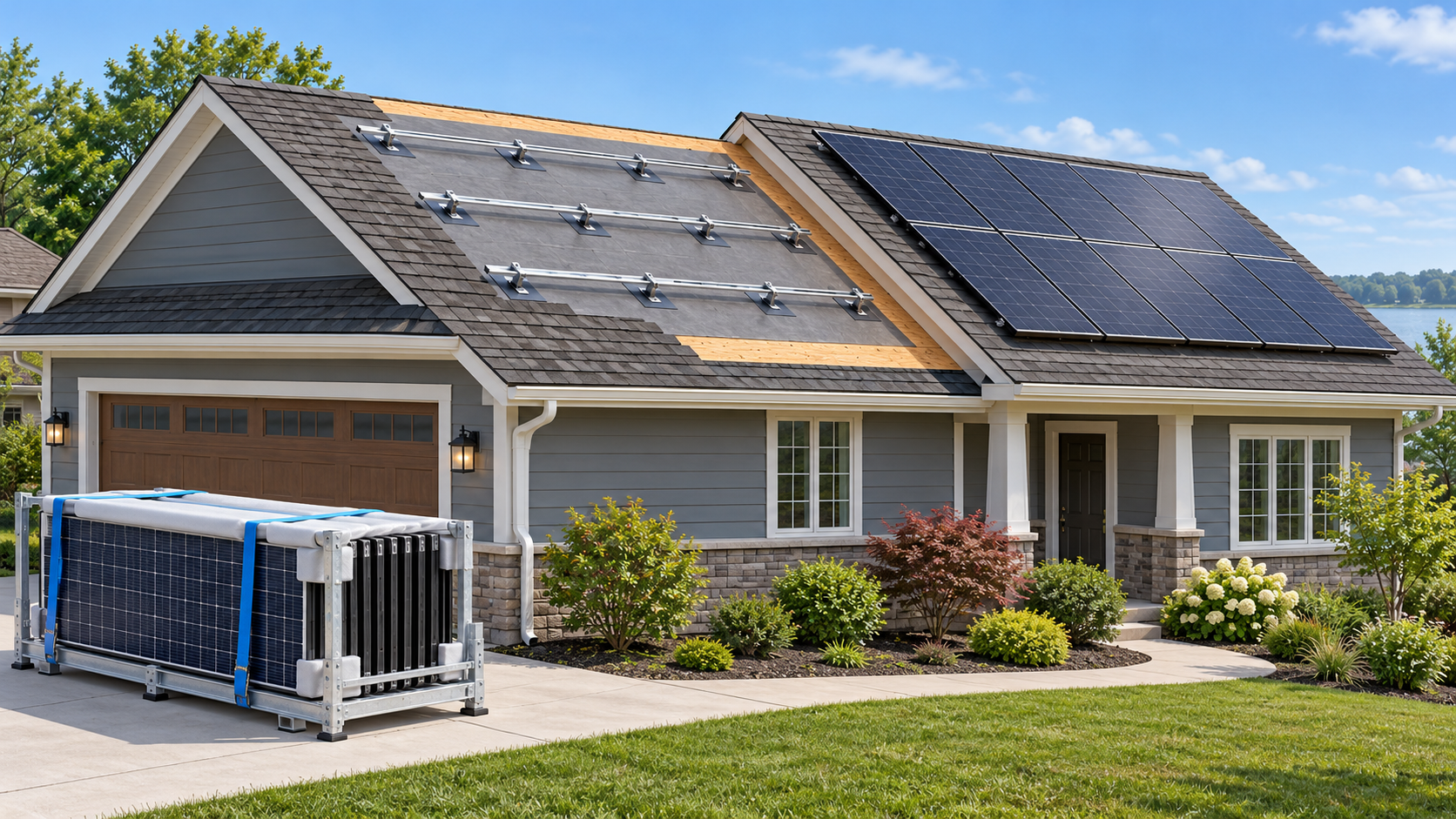
Responsibility split
The roofer should define deck, underlayment, covering, and roof flashing responsibility. The solar provider should define PV equipment, racking, wiring, grounding, disconnection, reinstallation, and system testing. One contract or coordinator should establish who owns the mount-to-roof interface.
Without that split, each party can exclude leaks near mounts or production problems after reinstall.
Warranty and installer availability
Solar systems can have separate component, production, and workmanship warranties. Removal by another company may affect contract treatment, but no universal outcome applies. Review the original agreement before work.
If the original installer is unavailable, identify a provider willing to assume a defined reinstall scope. Replacement parts for older racking or inverters may be limited. This can turn removal into a system-upgrade decision.
Older-system economics
DOE notes that many PV systems retain substantial output over a long operating horizon, but that is not a warranty for every array. Before paying to reinstall an older system, compare present production, equipment condition, remaining contractual value, compatibility, and the cost of a new system. Keep the roof decision separate from solar incentives and production economics, but coordinate the timelines.
Reinstalling a sound productive array can be rational. Automatically discarding it because panels are down can waste remaining value.
Scenarios
Recent system, original installer available: Remove, label, store, reroof, reinstall with compatible new flashings, and verify production. This is the most predictable path.
Older proprietary racking: Some mounts cannot be reused or exact parts are unavailable. Hardware and redesign allowances raise cost.
Storm loss: Roof and solar damage, temporary protection, insurer documentation, and interior restoration may require broader loss coordination. Coverage is policy-specific; do not assume reimbursement.
Roof geometry change: New vents, skylights, or altered array layout can trigger solar design and possibly approval work beyond simple reinstall.
Schedule control
Coordinate removal shortly before roofing, weather protection after equipment comes off, storage responsibility, reinstall date, and response if roofing uncovers structural work. Define who pays for extra mobilizations caused by delay.
Quote checklist
Require panel count, system inventory, shutdown, removal, labeling, storage, hardware reuse/replacement, roof mounts and flashing, electrical work, permits/utility steps, reinstall, commissioning, monitoring verification, warranty treatment, schedule, and exclusions. The cheapest line item is not valuable if the array remains offline or roof and solar warranties leave the interface unowned.
Get the solar quote before selecting the roof bid
Removal cost can change reroof economics enough to affect repair-versus-replace and material selection. Obtain system inventory and removal/reinstall proposal early, then give roofing bidders the same array and mount assumptions. A roof bid that excludes solar is not comparable with one that coordinates it.
Mounting and new roof details
Reinstall may reuse rails or panels while replacing flashings, attachments, seals, wiring supports, or damaged hardware. Exact product and roof covering control. Switching from asphalt to metal, changing deck, or altering vents can require redesign rather than simple reinstall.
Ask who lays out mounts before covering completion and who inspects the finished interface. Preserve roof photos before panels obscure it.
Downtime and production
System downtime has an opportunity cost, but do not invent a flat daily value. Estimate from actual monitoring and season, accounting for utility rules. More important operational risk is an undefined delay between roof completion and recommissioning. Put target timing and dependency conditions in the schedule.
Storage and damage
Define where panels and hardware are stored, weather/security protection, inventory, condition documentation, transport, and risk of loss. Roofers should not have to move undocumented energized or fragile equipment; solar contractors should not leave arrays blocking roofing access.
Replacement versus reinstall alternatives
For older equipment, compare reinstall, partial equipment update, full system replacement, or permanent removal through a separate solar-economic analysis. Do not let a federal program FAQ’s broad system statements substitute for product condition, local incentives, utility rules, or a current warranty.
Closeout
Require production/monitoring verification, updated layout, serial or equipment changes, permit/inspection closeout where applicable, and both workmanship contacts. A successful reroof-with-solar project returns two systems to documented operation.
Normalize the combined project budget
Keep five ledgers: solar de-energization and removal; storage and protection; roofing; mount/flashing preparation; and solar reinstall, electrical work, testing, and recommissioning. Add permit or inspection tasks only where the project requires them. This structure exposes gaps between a roofer’s “solar excluded” quote and a solar provider’s “remove and replace” allowance.
Count modules, arrays, roof planes, attachment points, equipment, conduit routes, and access constraints. Confirm whether pricing assumes every component is reusable and what happens if hardware, wiring, modules, or monitoring equipment fails inspection. A fixed base plus listed replacement options is more transparent than a broad contingency.
Roof bids should share the same solar schedule and roof boundary. One may include rebuilding attachment locations or preserving pathways while another assumes the array contractor handles every penetration. Assign one responsible party for final roof-side integration and name how disputes are tested.
Three coordination scenarios
A low-complexity case has an active available solar contractor, accessible standard equipment, clear records, simple storage, and a roof scope that does not change layout. Removal and reinstall can bracket the reroof with limited downtime.
A typical case requires several providers, replacement mount flashings, updated layout details, permitting or inspection coordination, and a schedule gap. Roofing and solar prices may be predictable while dependency risk drives inconvenience and lost production.
A complex case involves an unavailable original installer, older or unsupported equipment, damaged components, tile/slate or specialty roof access, structural/layout changes, battery or service-equipment interfaces, or an array that cannot be restored as originally configured. A solar redesign or partial replacement becomes a separate capital decision.
Reinstall, update, or remove permanently
Reinstall is usually the baseline when equipment is serviceable, compatible, and economically supportable. A targeted update may make sense when only mounts, wiring, inverter-related equipment, or selected components need work. Full replacement or permanent removal requires its own analysis of current equipment condition, incentives, utility rules, production, and warranty; roofing urgency should not be used to rush that choice.
For each path, avoid sunk-cost reasoning. Existing equipment may still have use even if its original purchase is unrecoverable. Conversely, paying to reinstall equipment with no credible service path can be poor value. Obtain a qualified solar condition assessment before the roof is open when this choice could affect layout or schedule.
Ownership and repeat-work economics
Owners planning long occupancy should value mount documentation, future service pathways, roof material repairability, and an array layout that avoids unnecessary obstruction of valleys, drains, or equipment access. Short-horizon owners should not assume all coordination cost is recovered at sale, but leaving two documented functional systems can reduce transactional uncertainty.
Price future disturbance qualitatively: Will one roof repair require removing many modules? Can a damaged panel or flashing be reached? Are spare roof materials retained? Good layout may not reduce today’s headline total, but it can prevent the next intervention from repeating a full removal.
Read combined-project quote language
“Remove and reinstall solar” should state module/equipment count, de-energization, permits/inspection assumptions, hardware reuse, storage, wiring, testing, monitoring, and damaged-component process. “Roofer to flash mounts” should identify who supplies the mount system, who installs roof-side components, and who warrants water control. “Solar by owner” is an exclusion, not a coordination plan.
Ask for milestone dependencies and a recovery process if the solar crew cannot return on schedule. Roof completion should not depend on leaving temporary penetrations, and recommissioning should not occur before roof-side closeout. Lost production can be estimated from actual system records, but schedule reliability and weather protection often carry greater practical risk.
Budget contingencies without double counting
Carry roof decking and concealed work under the roof contract. Carry solar component condition under the solar contract. Carry redesign only if roof or equipment changes require it. Do not let both contractors hold full allowances for the same mounts or assume the other will repair damage.
A low combined case reuses documented equipment and keeps layout. The expected case includes mount/flash replacement, modest schedule and inspection work, and a controlled component allowance. The difficult case includes unsupported equipment or redesign. These scenarios support budgeting without inventing component failure rates.