
If you already own a vegetative roof, the budgeting question is what a professional service should cover and how to handle problems that reach the roof assembly. This is not ordinary lawn care: plants and growing medium sit over drainage and waterproofing layers, so service needs to protect the full roof system.
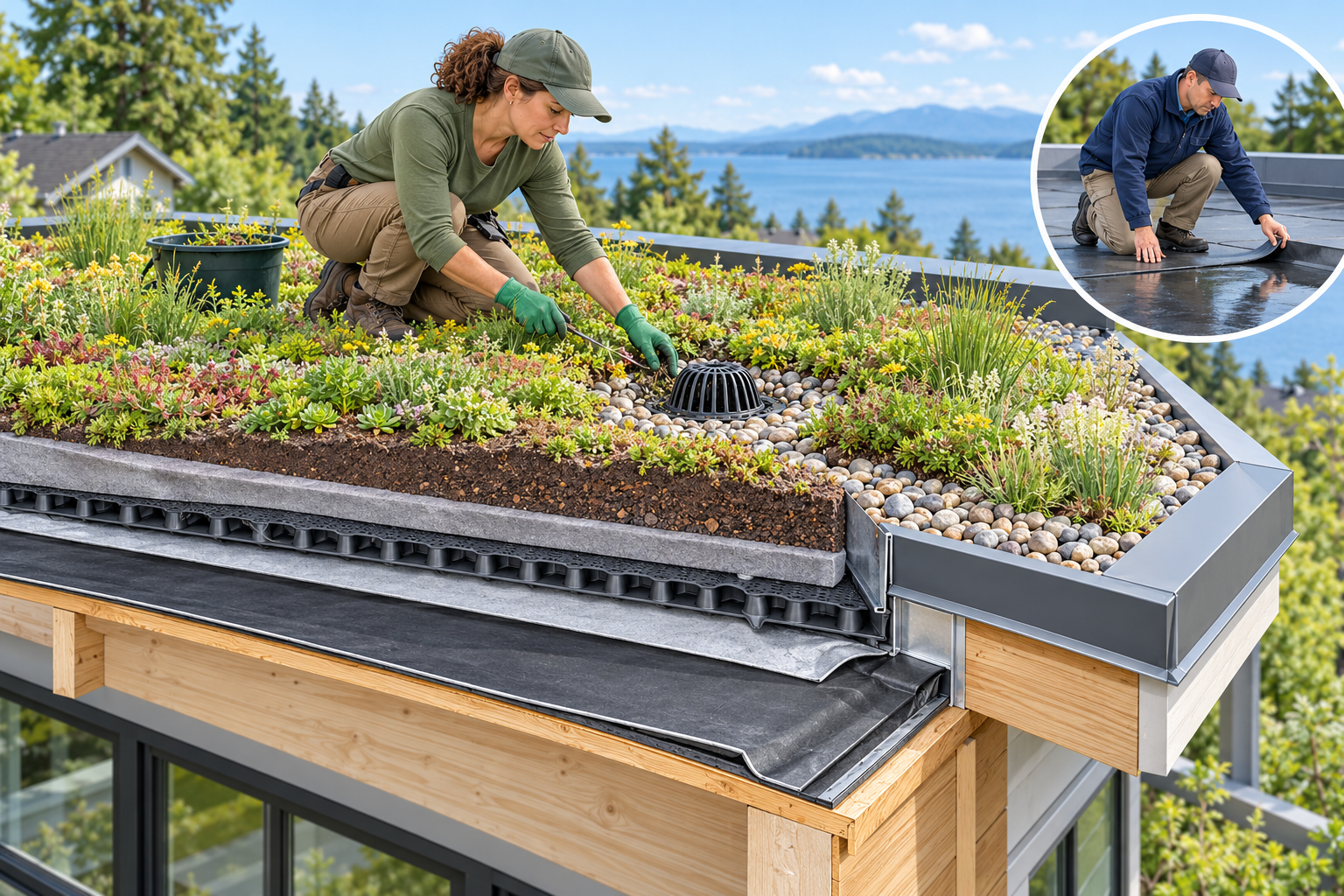
There is no current, comparable U.S. and Canadian residential price schedule for green roof maintenance, and the evidence does not establish a standard visit interval. A useful budget starts with the installed system’s care documents and local quotes that describe the same work. Do not infer a price from a landscape-maintenance rate or an installation quote.
What existing price evidence can tell you
The U.S. Environmental Protection Agency’s December 2021 green-roof fact sheet compiles research published from 2007 through 2020. It cites a Minnesota Pollution Control Agency 2020 estimate of $0.10–$1.00 per square foot per year after year five, while noting higher maintenance during establishment. This is dated study context, not a current residential bid range: the studies do not define one consistent home-roof scope, market, visit schedule, or price basis. It should not be used as a present-day quote or adjusted into Canadian dollars.
The Canadian Roofing Contractors Association’s vegetative-roof reference describes care tasks but does not set fees or a universal frequency. The City of Portland’s ecoroof guidance is a local owner example, not a service specification for every climate or municipality. Neither source establishes what a provider in your area will charge.
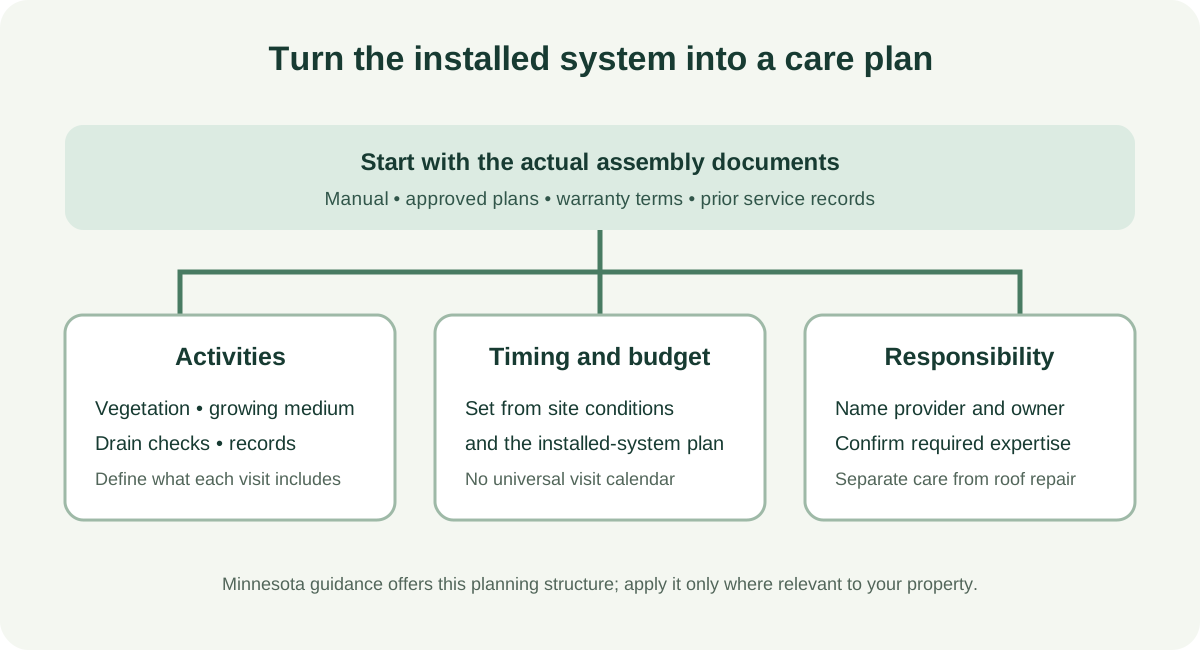
Start with the installed system and its documents
A vegetative roof commonly combines plants and growing medium with a filter or separation layer, drainage, protection, and a waterproofing assembly. The exact design matters. Some roofs support a relatively shallow planted layer; others have deeper soil, more varied planting, irrigation, paths, or other features. Service scope and access depend on what is actually installed, not the generic label “green roof.”
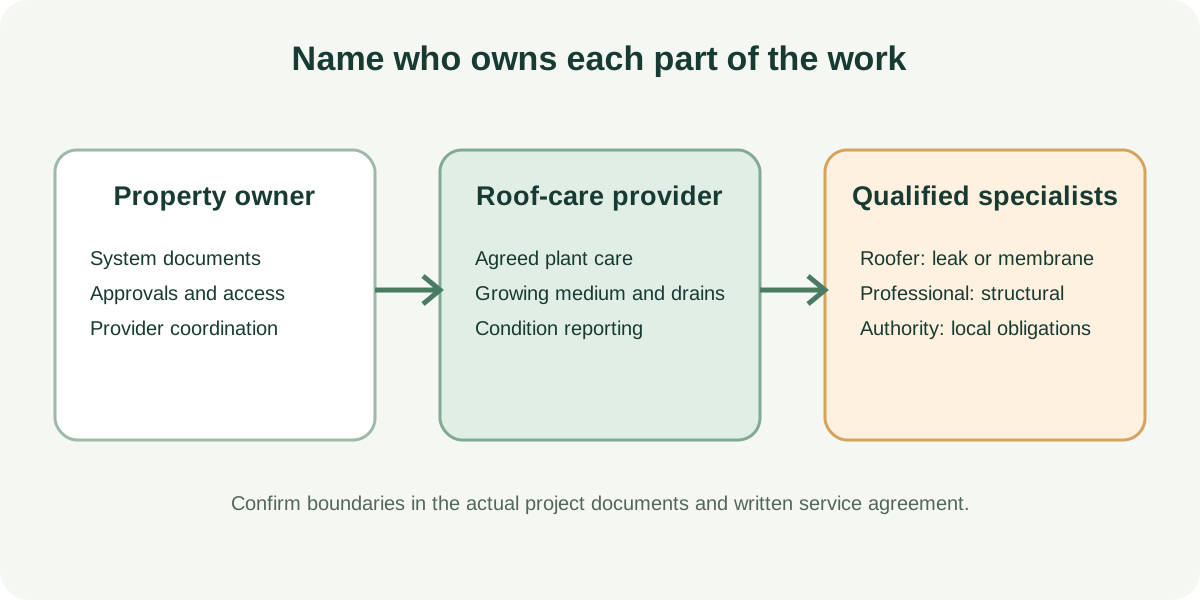
Before requesting a visit, gather the installation and warranty documents, maintenance manual, product information, prior service notes, and any owner-operation requirements. Ask the installer or property manager to identify who is responsible for vegetation, drains, waterproofing, and reporting. Do not assume the landscaper maintains the roof membrane or that a roofing contractor includes plant care.
What a maintenance visit may include
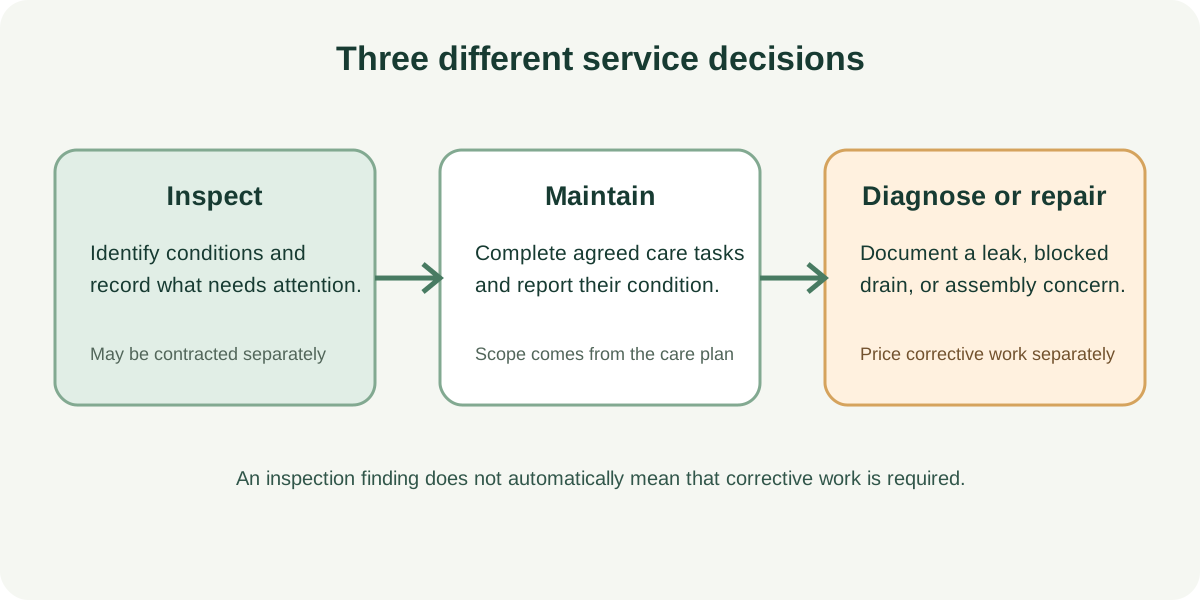
The CRCA reference identifies recurring care such as watering or irrigation when appropriate, removing debris and weeds, inspecting and clearing drains, replacing missing vegetation, and correcting displaced or damaged growing medium. A proposal should say which of those tasks are included, how the provider will report findings, and which are excluded. “Green roof maintenance” by itself is too vague to compare.
For each quote, clarify:
- whether the visit is visual review, vegetation care, drainage service, or a combination;
- whether irrigation checks, water, replacement plants, or growing-medium materials are included;
- how drains, edges, penetrations, and any designated clear zones are handled;
- whether debris and green waste are bagged, carried through the building, or removed by another service;
- what photographs or written observations the owner receives;
- how a suspected roof leak or drainage defect is referred to a qualified roofer;
- whether tax, travel, mobilization, access equipment, and follow-up are included.
If a building has separately contracted landscape and roofing providers, coordinate the visit scope so each knows which areas and components they own. A single combined visit may reduce duplicate mobilization, but only when the providers’ qualifications, responsibilities, and price lines are clear.
Establishment, routine care, and corrective work
Establishment care covers the period when plants and growing medium are becoming established. It may involve more observation, irrigation, weed control, and replacement of failed or missing plants than a mature roof. Portland’s guidance, for example, calls for particular attention to weeding in the first two years. That is a local example, not a universal two-year service schedule; use the installed system’s planting and care plan.
The Minnesota Stormwater Manual offers a useful planning example: write a site-specific operations and maintenance plan that names the activities, timing, budget, responsible parties, and needed expertise. It separates inspection, which identifies issues, from maintenance, which addresses them; those services can be contracted separately or together. This is Minnesota guidance, not a universal visit schedule. For your property, confirm whether establishment visits are already included in the installation agreement and who will report conditions that need corrective work.
Routine upkeep is the planned service for an established roof. It may cover seasonal or condition-based vegetation care, debris removal, drain review, and a concise condition record. Ask the provider what observations determine repeat visits. The available references do not establish one required annual or seasonal interval for all residential roofs.
Corrective work responds to a problem or a condition outside the recurring service. It can include replanting larger areas, replacing growing medium, correcting ponding or blocked drainage, or investigating water entry. The quote should distinguish diagnosis, materials, access, any roofing work, and reinstatement. Do not authorize an undefined “restore green roof” allowance without a description of affected area and responsibility.
What moves a quote
The main price drivers are the roof area and system design, the amount and type of work, and the cost of reaching and serving the roof. A simple planted surface with clear access is different from a larger, deeper, irrigated system with several drains, edges, penetrations, or planted zones. Roof height, pitch, elevators, ladders or other approved access, loading limits, staging location, and travel can add labor or equipment.
Material handling also matters. Plants, growing medium, water, tools, and waste may need to move through a building or be lifted to the roof. A quote may include hauling, disposal, or replacement materials—or leave them as unit prices. Ask how the provider will document quantities and obtain approval before work expands.
Other factors include local labor markets, climate, season, prior neglect, provider minimum charges, and whether the service is performed by a vegetation specialist, roofer, or coordinated team. A low annual fee may exclude the drain work or reporting that matters most; a larger contract may bundle optional horticultural work. Compare written scope and exclusions before comparing totals.
Build a budget from actual service options
Because a reliable residential rate is not established, build the reserve from quotes rather than a made-up per-square-foot range. Request a price for a defined baseline visit, any likely establishment or seasonal visits supported by the system documents, and separately priced corrective items. If a provider offers an agreement, compare its total term cost with the same visits purchased individually and note escalation, cancellation, emergency response, and materials.
You can then reserve for the service you expect to commission while keeping a separate contingency for unplanned roof or drainage work. Do not assume a maintenance agreement includes replacement plants, irrigation repairs, membrane work, leak diagnosis, structural review, or compliance reporting unless each item is written into it.
A one-time visit may fit an established system when the owner has current care documents and can commission a clearly defined drain and vegetation review as needed. An agreement may be more useful during establishment or when a property manager needs scheduled records, but only if it states the actual visits, deliverables, response expectations, and extra-work rates. For a neglected roof or an active drainage concern, ask for a condition assessment and separate corrective estimate before signing a recurring plan. These are service-planning choices, not universal timing rules.
When plant care is no longer the whole problem
Routine vegetation work is not the right allowance for persistent ponding, a drain that cannot be cleared within the agreed service, water entry, damaged growing medium, or a change in roof performance. Ask the provider to stop and document the finding, then bring in a roofer or other qualified professional with experience in the installed assembly. A drain or leak problem may require focused diagnosis; it does not automatically mean the entire planted area must be removed.
The roof-care article is also separate from roof leak repair, flat-roof drain and scupper repair, and roof replacement budgeting. Those pages address diagnosis or construction when the service issue becomes a roof repair or capital project. This guide does not provide roof-access, pesticide, sampling, membrane-repair, or structural-design instructions.
Local obligations and responsibility
Some owners may have project-specific operations documents, stormwater conditions, warranties, or shared-property rules. Confirm the actual requirement with the responsible authority, installer, association, or property manager. Portland’s ecoroof material is useful for understanding that local programs can give owners care guidance; Portland practices and municipal requirements do not apply automatically elsewhere.
For shared buildings, confirm who approves the service, pays for it, and receives condition reports. Structural-capacity decisions belong with a qualified professional, and stormwater or irrigation design questions belong with the relevant designer or authority. The vegetation provider should not be left to infer those responsibilities from a maintenance contract.
Compare proposals before signing
Ask each provider to quote the same roof area, visit purpose, task list, materials, debris removal, access assumptions, report, and follow-up. Separate recurring care from corrective work and roof-assembly repair. Confirm who is accountable for plants, drains, waterproofing concerns, and any required records; ask how additional work will be approved and billed.
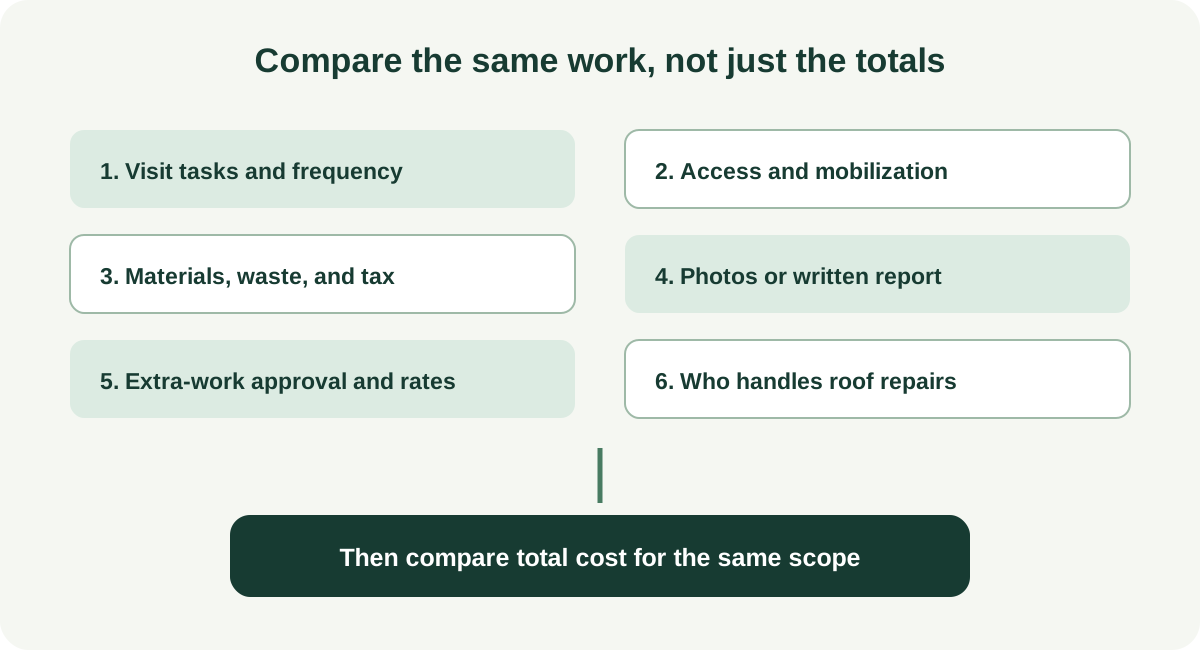
The best budget is property-specific. Use the system documents to define appropriate care, then compare local proposals that show the work, exclusions, and responsibility clearly. Until comparable residential prices and intervals are available, quote anatomy is more dependable than a universal annual cost.