
RenoQuotes’ August 2026 Canadian guide reports professionally installed gutter guards at CAD $8–$28 per linear foot; DIY materials are listed at CAD $1–$5 per foot, excluding installation labor and access costs. Treat these as one specialist source’s planning ranges, not a representative bid survey; the guide does not state tax treatment. It also gives CAD $150–$400 for gutter maintenance, but does not define the task, home size, access, or service frequency, so that figure cannot establish a guard’s payback by itself.
The right question is not whether guards “work.” It is whether a specific design reduces your actual debris burden enough to justify cost and remaining maintenance.
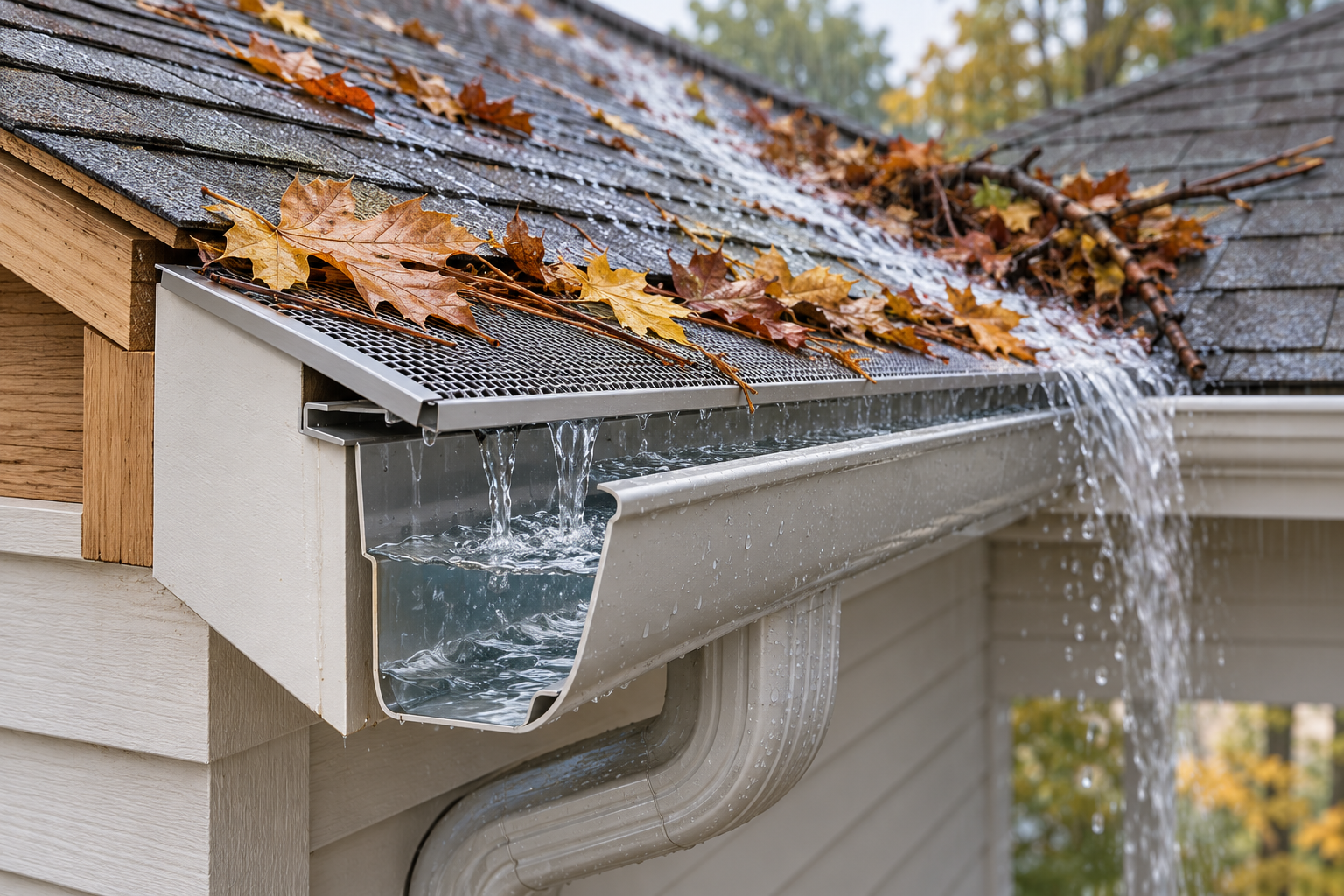
Product families
Screens, perforated covers, micro-mesh products, solid-surface/slot designs, inserts, brushes, and proprietary systems manage debris differently. Fine needles, seed pods, roof grit, broad leaves, snow, and ice do not behave the same way.
Manufacturer demonstrations explain product mechanics but cannot establish universal performance on every roof slope, valley, rainfall, and tree mix.
What guards can and cannot do
Guards can reduce large debris entering gutters. They do not eliminate inspection, surface clearing, fine sediment, outlet blockage, or every need to open the system. Material can bridge over the guard, collect at valleys, or enter at gaps.
Guards also do not increase a gutter’s underlying hydraulic capacity. If clean gutters overflow because outlets, downspouts, layout, or downstream drainage are insufficient, adding a cover may worsen the symptom.
Payback model
Calculate installed price divided by the annual cleaning cost actually avoided—but include remaining guard cleaning and the owner’s time horizon. Model low, likely, and high performance rather than assuming zero cleaning.
Example: a $2,000 system that reduces a $250 service from twice yearly to one lighter $200 visit avoids only $300 per year before repair or financing. That suggests a long simple payback, though safety, scheduling, and convenience may still have value. Use your quotes, not this example, as the decision basis.
Cost drivers
- gutter footage and guard product;
- roof height, pitch, and access;
- removal of old guards;
- gutter cleaning and repair before installation;
- roof-edge or shingle interaction;
- corners, valleys, and complex layouts;
- snow/ice accessories and warranty conditions;
- future access labor to remove and reinstall panels.
Compatibility and weather
Some products interact with roof edges or may be installed beneath covering; verify roofing manufacturer and installer implications. Snow and ice can behave differently at the eave. Heavy rainfall concentrated by valleys can exceed the intake behavior of a guard even when the gutter below is large enough.
Avoid claims that a guard prevents ice dams. Ice-dam causation can involve attic heat loss and assembly conditions.
Scenarios
Broad leaves, tall house, expensive access: A well-matched guard may reduce risky, costly cleanings enough to justify the investment.
Fine pine needles and seed debris: Require property-relevant evidence and a cleaning plan; generic leaf demonstrations are weak.
Low accessible bungalow: Continued cleaning may cost less and preserve easy inspection.
Clean overflow at roof valley: Capacity or outlet changes should precede guards.
Quote checklist
Require exact product, footage, preparation, gutter repairs, roof-edge attachment, debris limitations, rain/snow assumptions, cleaning access, warranty exclusions, and removal cost. Reject “maintenance free.” A guard is worth it when it reduces a measured service burden without hiding defects or restricting flow.
Compare product proposals on your debris
Ask the provider to address the actual leaves, needles, seeds, blossoms, roof grit, and valley flow at the property. Independent test evidence is preferable where available; a demonstration with unrelated debris is weak. Request local references with similar tree and snow/rain conditions.
Installation prerequisites
Gutters should be clean, sound, correctly pitched, adequately attached, and appropriately sized before guards are installed. Otherwise the guard can hide a repair problem. Price gutter correction separately.
Roof-edge attachment must be compatible with the covering and warranty. Products that alter shingle position or rely on fascia/gutter strength need exact review.
Remaining service cost
Clarify whether cleaning occurs from above, below, or by panel removal; who performs it; and what it costs. Fine sediment and surface debris may still require visits. Add inspection after storms or ice where exposure warrants.
The cited guide’s CAD $150–$400 maintenance range is a total estimate with no stated frequency, footage, access, or service inclusions. Ask providers to price the actual cleaning task and likely repeat interval before using avoided service cost in a payback calculation.
Snow, ice, and concentrated rain
Product behavior varies with freezing, sliding snow, meltwater, and roof valleys. A guard is not an ice-dam prevention system. If water sheets over the guard only during intense valley flow, layout or capacity work may outperform a different screen.
Warranty value
Read what “no clog” or performance coverage actually remedies: cleaning, product replacement, labor, consequential damage, or only material defects. Long terms do not guarantee the provider will service the property or that maintenance is included.
Decision after installation
Track cleaning frequency, overflow locations, and service invoices. If the guard does not reduce the expected burden, use warranty or redesign options rather than purchasing repeated generic cleaning without investigating the mismatch.
Build a realistic payback range
Start with actual cleaning invoices or a defensible service estimate, visit frequency, high-access premium, and the portions of service a guard may reduce. Then add guard installation, prerequisite gutter repair, periodic surface clearing, downspout checks, difficult panel removal, and expected repair access. Model a low, expected, and disappointing reduction in cleaning rather than assuming zero future service.
For a short ownership horizon, the product may be an appearance or convenience purchase; do not assume sale price repays it. For long ownership, avoided high-access visits can have meaningful value, especially where debris behavior matches the selected product. If current cleaning is infrequent and inexpensive, even an effective guard may not have an economic payback.
Low, typical, and poor-fit cases
A strong low-complexity fit has sound properly sloped gutters, adequate outlets, a known debris type the product handles, straightforward installation, and a credible service method. The owner buys reduced cleaning burden, not elimination of inspection.
A typical case has mixed leaves, needles or seed material, valleys concentrating water, some high access, and several product options. A test section or property-relevant references can be more useful than generic demonstrations.
A poor-fit case has undersized or badly pitched gutters, blocked downspouts, deteriorated fascia, snow/ice loads the system does not address, or fine debris that enters and is hard to remove. Correct prerequisites or choose another strategy before adding a cover.
Normalize guard proposals
Compare product and fastening, footage and omitted runs, corners/valleys, roof-edge interaction, gutter cleaning and repair before installation, downspout work, access, snow or roof-material compatibility, maintenance method, removal for reroof/repair, and warranty remedy. A high price may include new gutters; a low one may install over existing debris and defects.
Ask for the cost of one future cleaning and one panel repair or removal. That service path is part of lifetime cost. If only the original seller can open the system, provider continuity becomes a decision factor.
Alternatives and decision threshold
On-demand or scheduled cleaning preserves flexibility. Tree management may reduce a specific source where appropriate. Added outlets, larger leaders, re-pitching, or valley-flow changes address hydraulic problems. A different guard family may trade fine-debris exclusion for easier cleaning or stronger intake under concentrated flow.
Choose a guard when prerequisites are sound, debris/product fit is credible, installed and future service cost are clear, and convenience or avoided visits justify the total. Decline when the sales case depends on “never clean again,” a universal payback, or using the guard to hide capacity and discharge defects.
Read demonstrations and guarantees skeptically
A showroom water test may not reproduce the property’s valley concentration, roof slope, wind-driven debris, freezing, or mixed particles. Ask for references with similar trees, roof geometry, and climate, and inspect how the product handles corners and outlets. Where uncertainty is high and layout permits, a limited test area can provide more evidence than a whole-house promise.
“No clog” may refer to the gutter while debris remains on the product and water overshoots. “Lifetime” may cover only the guard material. “Free cleaning” may require the original provider, exclude access or downspouts, or offer only a remedy after a defined failure. Put the actual service and remedy into the cost model.
Example payback logic without invented numbers
On a high two-story home needing frequent professional cleaning, even a partial reduction in visits can make a well-matched serviceable guard valuable. On a low home cleaned inexpensively every few years, the same installed system may never recover its price. On a property where overflow comes from one valley and small outlet, neither comparison matters until capacity is corrected.
The owner should therefore record current burden, expected remaining visits with the product, future service price, and the nonfinancial value of scheduling convenience. If the purchase remains attractive under a disappointing maintenance scenario, it is a more resilient decision.
Product-family tradeoffs in practice
Screens, perforated covers, fine-mesh products, surface-tension styles, inserts, and other designs balance debris exclusion, water intake, visibility, cleaning access, snow/ice behavior, and price differently. Use exact product documents and property debris rather than assuming a family name guarantees an outcome.
Fine exclusion can help with small material while making surface accumulation and cleaning method important. More open designs may accept water and be easy to service while allowing finer debris through. Inserts can be simple to deploy but may hold organic material. Surface-tension approaches depend heavily on edge condition and concentrated flow. These are comparison questions, not universal verdicts.
Repair and reroof boundaries
Ask whether the guard must be removed for gutter repair, fascia work, or reroofing; who pays; and whether it can be reinstalled without loss of warranty. A guard attached under or through roof-edge materials can change that future scope. If a reroof or gutter replacement is imminent, coordinating the product may avoid duplicated installation, but it should not rush selection before drainage design is known.
Final decision table in words
Choose the product only after scoring debris fit, concentrated flow, snow/ice exposure, gutter prerequisites, high-access burden, future cleaning method, provider/service continuity, warranty remedy, installed price, and ownership horizon. A product can win on convenience even without a strict payback; it should not win by pretending the remaining service rows are zero.
Compare low, expected, and disappointing ownership cases
In the low-service case, the guard handles the property’s main debris, surface clearing is easy, outlets remain visible, and professional cleaning visits fall substantially. In the expected case, some surface work and periodic opening remain but high-access visits decline. In the disappointing case, fine debris, valleys, snow/ice, or service restrictions preserve much of the old burden.
Apply installation, prerequisite repair, ongoing service, panel removal, and reroof interaction to all three. If the purchase only works when future cleaning is zero, the payback claim is fragile. If it remains acceptable in the expected case and the owner values convenience, it can be rational.
Alternatives under the same scenarios
Compare no guard plus cleaning, a different guard family, targeted installation on the difficult elevation, outlet/capacity correction, and appropriate tree/debris management. A whole-house product is not the only unit of purchase. Targeted work may preserve service access while reducing the expensive part of maintenance.
The final decision should record why the selected product fits actual debris and water patterns, not simply that guards are “worth it” in general. That evidence is what distinguishes an investment from an expensive cover over an unresolved drainage problem.
Compare warranty remedies and provider risk
Separate product-material failure, fastening/workmanship, finish, clog or performance promises, cleaning labor, removal/reinstallation, consequential water, transfer, and service-call charges. Ask whether an independent gutter contractor can maintain the product without voiding terms. A long warranty is weak economic protection if only a distant or short-lived seller can perform the remedy.
Keep exact product, locations, attachment, prerequisite repairs, outlet/downspout changes, roof-edge photographs, cleaning method, and warranty contacts. If performance disappoints, these records show whether the issue is debris fit, installation, flow concentration, capacity, or maintenance.
Final regret test
If guards are selected, accept the expected surface service and a disappointing case with some continued professional cleaning. If no guards are selected, accept scheduled access and possible emergency clogs. Choose the case whose total cost, safety, convenience, and uncertainty fit the property—without setting future cleaning to zero on either side.
Uncertainty boundary
Debris cycles, storms, snow, and provider continuity change over time. Model expected and disappointing maintenance, require an accessible service method, and keep ordinary inspection in every option. This uncertainty prevents guaranteed payback; it does not prevent a well-supported convenience and access decision.