
A small above-ground extension or elbow repair may cost under a few hundred dollars, especially when bundled with gutter work. Replacing a tall full downspout, enlarging outlets, adding new drops, or rerouting several lines can cost several hundred to low thousands. Buried drainage, grading, foundation drainage, and municipal connections are separate projects.
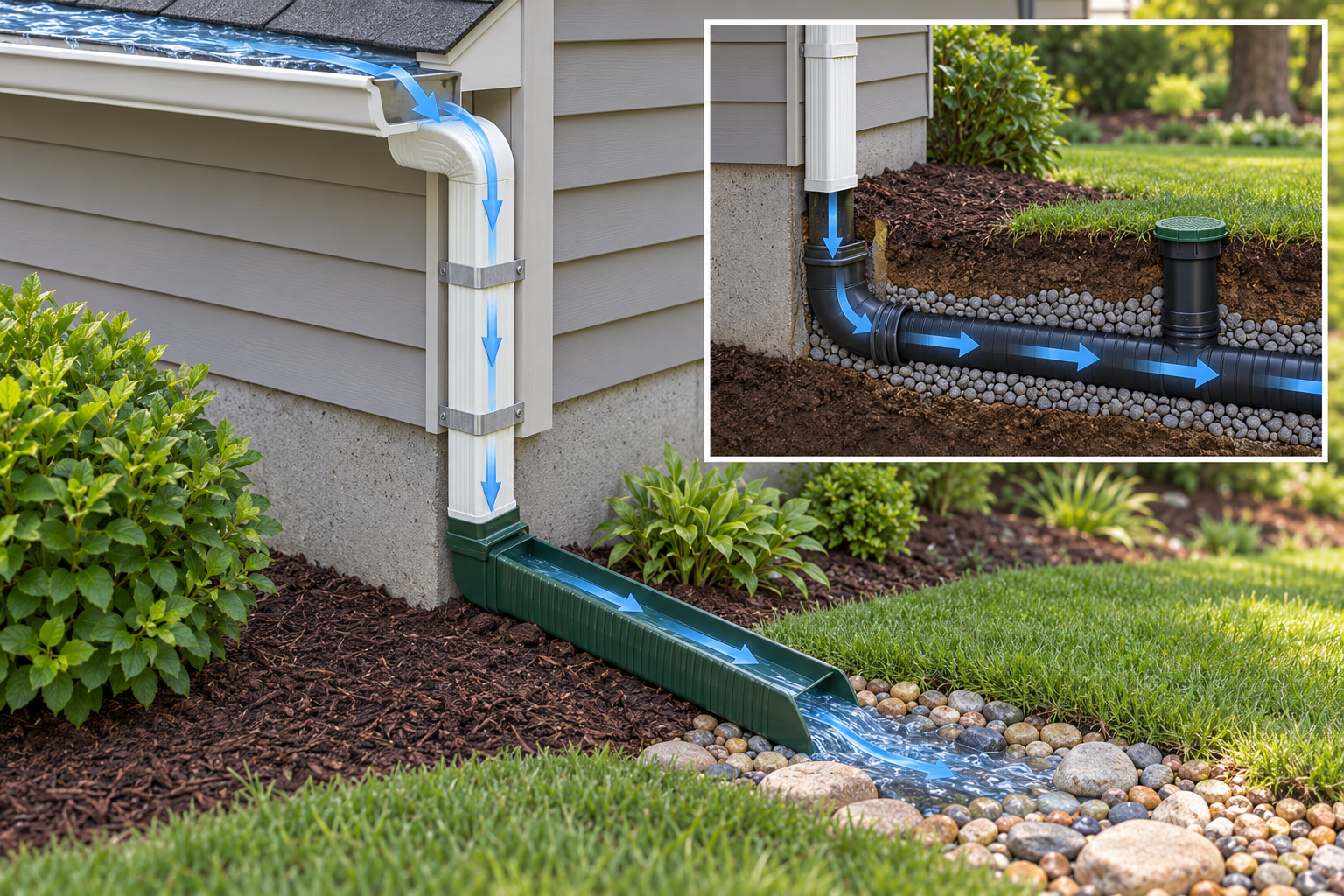
Common scopes
- replace crushed or corroded sections;
- reconnect elbows, straps, or offsets;
- repair or enlarge the gutter outlet;
- replace one full vertical downspout;
- add an above-ground extension or splash block;
- add a new downspout to divide a long gutter run;
- disconnect or reroute an existing municipal/buried connection where locally required.
Material, profile, color, height, corners, and access affect cost.
Discharge location matters
Government of Canada guidance recommends directing runoff toward a well-drained area and, where possible, about 2 m (6 ft) from surrounding foundations. Treat this as homeowner guidance, not a universal code value. Lot slope, neighboring property, sidewalks, freezing, erosion, basements, and local rules may require a different solution.
Moving water away from one wall is not successful if it creates ponding at another structure or nuisance runoff off-site.
Above-ground versus buried
Above-ground extensions are visible, inspectable, inexpensive, and easy to change, but can obstruct paths or landscaping. Buried piping improves appearance and access but adds excavation, slope, cleanouts, outlet design, freeze and blockage concerns, and site-drainage scope.
The gutter contractor’s responsibility often ends at the ground connection. Establish who verifies and clears a buried line before attaching a new downspout.
Capacity and outlet changes
A larger downspout can help only if the gutter outlet feeds it and downstream discharge accepts the flow. Adding one at a concentrated valley may be more effective than replacing every vertical section. Exact sizing requires roof area, rainfall, slope, layout, and local criteria.
Local connection rules
Some municipalities restrict or require disconnection from sanitary, combined, or storm systems and may offer programs. Requirements and incentives vary. Verify locally before pricing a direct connection or disconnection.
Scenarios
Damaged lower section: Replace the section and straps, then confirm water reaches a sound discharge point.
Water dumps beside foundation: Add a compatible extension to a suitable area if grade and local conditions permit. This is a low-cost roof-drainage fix, not basement waterproofing.
Long gutter overflows: Add or enlarge outlet/downspout after capacity assessment; do not assume blockage is the only cause.
Buried line backs up: Diagnose the site line. Replacing the visible downspout will not clear or resize underground drainage.
Quote checklist
Require profile/material, section lengths, elbows, outlets, straps, extensions, discharge destination, buried-line boundary, local-rule responsibility, testing, and restoration. The best downspout repair completes the water path instead of stopping at a new piece of vertical pipe.
Cost by intervention
One elbow, strap, or lower extension can remain near a service minimum. A full two-story downspout adds material, access, offsets, and attachment. A new drop requires cutting or fabricating the gutter outlet. Several rerouted lines may require landscape or site-drainage design and no longer fit a simple per-downspout price.
Ask for each vertical run and discharge extension separately so the highest-priority water paths can proceed even if broader site work is deferred.
Material and connection compatibility
Match profile, material, finish, outlet size, and connection method. Mixing metals or forcing a large downspout onto a small outlet can create corrosion or a bottleneck depending on materials and design. Exact compatibility should come from the installed system.
Freeze and pedestrian tradeoffs
Above-ground extensions can freeze, be crushed, or cross walking and mowing paths. Hinged or removable arrangements add convenience but still need reliable use. Buried systems reduce surface obstruction but can freeze or block if poorly designed. Balance drainage, access, winter, and maintenance rather than hiding the extension behind landscaping.
Responsibility boundaries
Roof-drainage work ends once water is conveyed to a suitable discharge. Persistent basement water may require below-grade diagnosis; erosion or yard ponding may require grading/site drainage; municipal piping rules require local verification. Adding a longer extension is not a universal waterproofing solution.
Maintenance and testing
Provide accessible cleanout or disconnection where the design requires it, keep straps and outlets observable, and test after meaningful rain. A hose can confirm continuity but not full design-storm capacity. Record buried connection location before it is concealed.
Alternatives
Repair a sound downspout, replace a broadly corroded one, add an outlet to divide flow, use a rain barrel only with adequate overflow, or route to site drainage after design. Choose the lowest-cost option that handles both ordinary flow and a safe overflow path.
Normalize the full water path
Compare outlet work, downspout height and material, elbows, straps and substrate, lower extension, transition fittings, cleanout or access, splash control, trenching or buried piping where included, outlet destination, restoration, testing, and disposal. A price for vertical pipe alone does not establish that roof water reaches a suitable discharge.
Map each outlet independently. A front leader may need only a repaired elbow; a rear leader may empty into a blocked underground line; a long gutter may need a second outlet instead of a larger pipe. Per-downspout averages obscure these different interventions.
Three bounded cases
A low-complexity case replaces or reconnects an accessible damaged segment and restores above-ground discharge. Minimum service and matching finish can dominate.
A typical case replaces a full leader, adds secure straps, improves the lower extension, and confirms that the gutter outlet and receiving surface work together. Freeze, mowing, pedestrian, and appearance tradeoffs shape the final route.
A complex case adds outlets, crosses several elevations, connects to buried drainage, requires excavation or hardscape restoration, or reveals foundation/site-water concerns. Roofing/drainage, landscaping, plumbing, and waterproofing boundaries must remain clear.
Repair, redesign, or escalate
Repair when the pipe and layout are sound and the defect is local. Replace when corrosion, crushing, split seams, or poor attachment is distributed. Redesign when gutter runs overwhelm an outlet or the destination cannot accept flow. Escalate to site or below-grade diagnosis when water remains at the building despite a functioning roof-drainage path.
Compare repeat clogs and temporary extensions with a durable accessible route, but do not assume burying is automatically superior. Concealed lines add excavation, freezing/blockage, locate, and maintenance concerns. An above-ground route may be less elegant but easier to inspect and repair.
Decision and closeout
Require a drawing or photographs of discharge, responsibility at connections, local-rule verification where relevant, and a safe overflow path. Test continuity without claiming a hose reproduces design rainfall. Record buried routes before concealment.
This component guide remains narrower than a whole-site drainage analysis: once the downspout delivers water to the agreed destination, grading, foundation drainage, sewer/storm connections, and waterproofing become separately designed projects.
Read quote wording
“Extend away from house” should identify route, length, slope concept, outlet surface, trip/mowing treatment, overflow, and whether the extension must be deployed manually. “Connect underground” should identify pipe route and material, cleanout/access, excavation, utility/obstruction assumptions, restoration, receiving connection, and local verification.
A buried line allowance is not comparable with an above-ground accessory. The former buys concealment and site work but creates maintenance and locating obligations. The latter remains visible and inexpensive but can conflict with use and winter conditions.
This narrow decision is resolved when the roof outlet, conveyance, destination, overflow, maintenance, and adjacent-scope boundary are all clear. Broader basement-water or grading economics require their own evidence and should not be padded into the downspout article.
Low, expected, and difficult totals
The low case repairs one elbow, seam, strap, or short extension and keeps a suitable visible destination. The expected case replaces a complete leader, corrects outlet and attachment, routes around use conflicts, and provides an observable discharge and overflow. The difficult case adds new outlets, long routing, buried drainage, excavation, hardscape/landscape restoration, or escalation to site-water work.
Price the receiving path independently. A larger leader can be inexpensive while the suitable destination is costly; a long extension can be cheap but unacceptable across a walk. The best option balances conveyance, use, freeze exposure, maintenance, and downstream consequence rather than minimizing pipe price.
Ownership and repeat-work economics
Recurring lower-section damage may favor a guarded or rerouted above-ground detail. Repeated buried-line blockage may favor accessible cleanouts, a different route, or returning to visible discharge. If reroof/gutter work is planned, coordinate outlet size and location once, but do not bury an unverified line simply because crews are present.
Final homeowner worksheet
Record gutter outlet, pipe size/material, route, straps/substrate, lower fitting, destination, overflow, freeze/use conflicts, buried access, local verification, testing limits, and the boundary to grading or waterproofing. Once these are answered, the remaining decision genuinely lies outside the downspout scope.