
Upsizing gutters and downspouts can add hundreds to several thousand dollars over ordinary replacement, depending on footage, profile, custom fabrication, outlet count, vertical runs, height, fascia, and downstream drainage. Sometimes the most economical capacity upgrade is one additional outlet and downspout rather than larger gutters everywhere.
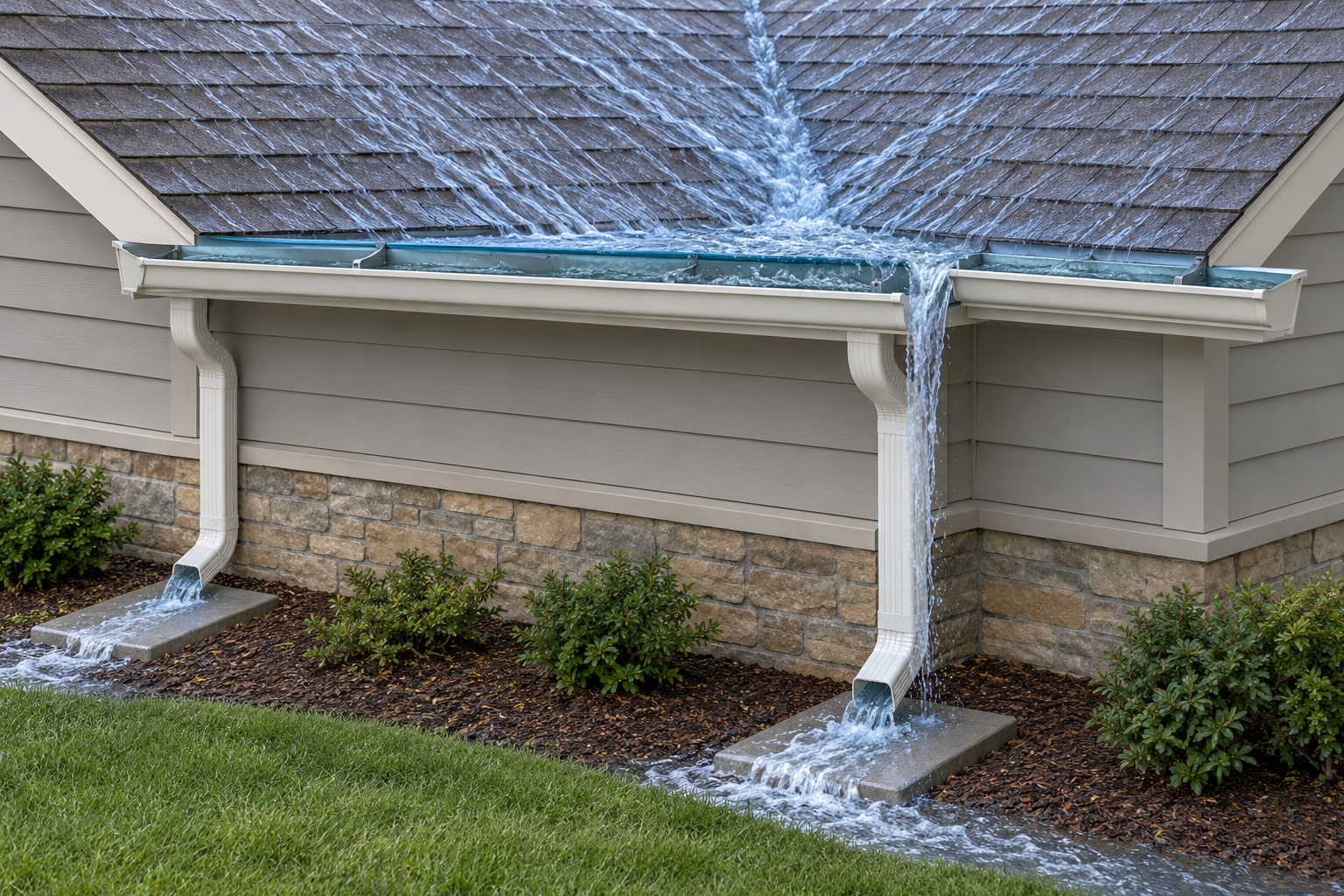
Why clean gutters overflow
Possible causes include too much roof area for the outlet layout, concentrated flow from valleys, high rainfall intensity, improper slope, small or obstructed outlets, insufficient downspouts, guard intake limits, or downstream backup. Water can also overshoot a gutter at a steep edge.
Observe where overflow starts during rain if it can be done safely from the ground. A uniform long-run overflow suggests a different issue from one torrent below a valley.
Capacity variables
- projected roof drainage area feeding each run;
- local design rainfall, not annual rainfall totals;
- roof pitch and surface behavior;
- valleys and concentrated discharge points;
- gutter cross-section and slope;
- outlet count and opening size;
- downspout size, bends, and horizontal offsets;
- downstream surface or buried-system capacity.
Exact sizing should use recognized local design methods. A generic “six-inch gutter solves everything” claim is not enough.
Upgrade options
Add outlets/downspouts: Divides flow and shortens travel distance. Often cost-effective if discharge locations exist.
Enlarge outlets/downspouts: Removes a bottleneck while retaining serviceable gutter runs.
Install larger gutters: Increases collection capacity but may require new hangers, fascia assessment, and custom corners.
Change valley handling or layout: Can manage concentrated flow but must remain compatible with roof and drainage design.
Correct downstream drainage: Necessary when larger roof components would simply deliver more water to an inadequate yard drain, buried line, or discharge area.
Cost drivers
Premium profile/material, field fabrication, many corners, high access, guard integration, fascia reinforcement or repair, new discharge paths, and buried drainage all increase cost. Large components may also affect appearance and snow/ice behavior.
Scenarios
One overflowing long run: Add a second outlet and downspout if analysis and discharge allow. This may beat full replacement.
Valley overshoot: Adjust layout or use a designed high-flow solution rather than upsizing distant runs.
Whole system undersized in intense rain: Replace gutters and downspouts as a coordinated high-capacity system.
Downstream ponding: Stop at site-drainage design; roof drainage is only the upstream component.
Quote checklist
Require problem diagnosis, roof areas, design rainfall basis, gutter profile, outlets/downspouts, concentrated valleys, guards, attachment, discharge destinations, buried-system capacity, testing, and local requirements. Upsizing is valuable when it removes the actual bottleneck. Bigger visible gutters cannot solve an obstructed or undersized downstream system.
Diagnose with a flow map
Divide the roof into drainage areas and trace each valley, gutter run, outlet, downspout, extension, and final discharge. Mark where water first escapes. This distinguishes collection, outlet, vertical, and downstream failures and prevents whole-house replacement for one bottleneck.
Professional sizing may use local rainfall intensity and roof-projection methods. The Government of Canada’s broad downspout-spacing guideline is useful orientation but not a capacity calculation.
Cost comparison options
Request alternates for cleaning/repair only, added outlets, larger downspouts, limited large-gutter runs beneath concentrated areas, and whole-system upgrade. Include fascia, guards, discharge, and buried work consistently.
A mixed system can be rational when one roof section creates most flow. Uniform oversized components may cost more and change appearance without improving other runs.
Structural and attachment considerations
Larger gutters carry more water and potentially ice/snow loads. Fascia, hanger system, roof edge, material, and local exposure matter. Do not interpret “high capacity” as permission to space supports generically or retain deteriorated fascia.
Overflow planning
No residential system makes every extreme event disappear. Consider where water goes if capacity is exceeded or an outlet blocks. Overflow away from sensitive walls and entrances can reduce consequence, subject to site and local rules.
Guards and leaf screens
Guards can alter intake under concentrated flow. If debris is not the cause, installing a restrictive product may worsen overflow. Evaluate guard and capacity together and retain maintenance access.
Downstream economics
The visible upgrade may deliver more water faster to a small extension, saturated planting bed, blocked buried line, or municipal connection. Price that receiving system before authorizing large components. Site grading or drainage can become the larger but necessary investment.
Normalize capacity alternatives
Ask for a baseline repair/cleaning option, added or relocated outlets, larger downspouts, larger gutter profile, divided runs, valley-flow changes, and downstream work as separate alternates where technically plausible. Use the same material, removal, fascia, access, hangers, finish, and discharge assumptions. This shows whether capacity comes from collection size, outlet relief, conveyance, or a complete redesign.
Record roof areas feeding each run, concentrated valleys, slope and length, outlet/downspout layout, guards, observed overflow location, and receiving path. Exact sizing and local rainfall design require project-specific calculation; the purpose of the map is to prevent a generic “six-inch upgrade” from replacing diagnosis.
Low, typical, and complex cases
A low-complexity case has clean sound gutters but one constrained outlet or long run. Adding or enlarging the outlet and leader may solve the bottleneck without replacing every run.
A typical case combines concentrated valley flow, several long runs, limited downspout locations, and fascia or guard choices. Larger components may help, but pitch, attachment, and receiving capacity must be upgraded coherently.
A complex case includes multiple roof levels, high flow onto lower roofs, snow/ice or sliding-metal-roof effects, architectural outlet constraints, undersized buried piping, erosion, or foundation concerns. Site drainage and overflow consequences may dominate the visible gutter purchase.
Test the economics against simpler remedies
Cleaning, re-pitching, joint repair, and clearing a blocked leader are low-cost when obstruction or local defect is the cause. Added outlets can divide a run. Larger leaders can improve conveyance. Larger gutters are most defensible when collection capacity is actually limiting and the downstream path can accept the added flow.
For each option, compare installed cost, maintenance access, guard compatibility, fascia/support work, snow/ice exposure, overflow behavior, and future roof-edge disturbance. Do not promise that any residential system contains every extreme event; reduce consequence by controlling where overflow travels.
Ownership and project timing
Coordinate a justified upgrade with reroofing or fascia work when edges will already be open, but keep hydraulic diagnosis independent of sales convenience. A short-horizon owner should prioritize correction of documented damaging overflow without assuming a premium system repays at sale. A long-horizon owner may value lower recurrence and accessible maintenance if the redesign addresses the real constraint.
Approve the high-capacity option only when the proposal identifies the bottleneck, prices the entire path to discharge, and preserves a safe overflow route. Otherwise the larger visible gutter may simply move the problem out of sight.
Read upgrade quote language
“Oversized gutter” should identify profile/dimensions, material, outlet openings, downspout size and count, attachment/support basis, guard compatibility, and discharge. “High capacity” without those components is a marketing description. “Correct overflow” should state the rain/flow observations and whether extreme-event overflow remains expected.
Ask for the price difference between larger collection only, outlet/downspout changes, and full downstream work. If the receiving line or site work is provisional, use controlled units and a stop threshold. A low visible-system price can become expensive once buried constraints appear.
Example: valley overshoot versus long-run backup
Water overshooting at one steep valley may call for a locally compatible flow transition, outlet/layout change, or larger collection at that point. Water backing up along a long clear run may indicate outlet/conveyance limitation. Water spilling everywhere during an extreme event may exceed the design expectation while still requiring safer overflow routing.
These observations should lead to different alternates. Replacing every gutter with the largest available profile without tracing the pattern spends capital before identifying the constraint.
Closeout and observation
Keep the flow map, component specifications, attachment/fascia work, buried-route records, and safe observation points. Verify ordinary performance after rain and note where overflow is intended under greater events. The useful outcome is controlled water and consequence, not a promise that the owner will never see overflow.
Compare total installed paths
Build totals for repair/cleaning, outlet/downspout relief, larger collection and conveyance, and full site-connected redesign. Include fascia/support, guards, roof-edge work, access, excavation/restoration, and maintenance. The most expensive visible option can still be incomplete if its downstream line is omitted; the least expensive can be sufficient if a single blockage or outlet is the verified constraint.
Repeat-work economics
Add documented overflow-related fascia, siding, landscaping, or service costs without assuming every nearby moisture issue was caused by the gutter. Compare them with the upgrade over the owner’s planning horizon. If damaging overflow is frequent and the redesigned full path is credible, payback need not be precise to justify risk reduction. If overflow is rare and harmless at a planned route, maximum capacity may add little ownership value.
Guards and high-capacity design also alter future cleaning. Larger components can be easier to access or hold more debris; restrictive covers can reduce intake. Ask for a maintenance method and price so the upgrade does not solve peak flow while creating an inaccessible sediment problem.
Quote normalization checklist
Compare roof catchment and valley assumptions, run/profile, outlets, downspouts, hangers/support, material, guards, roof edge, fascia, removal, access, discharge, buried work, overflow, restoration, maintenance, and warranty. Require the contractor or designer to state which constraint each changed line addresses.
If exact hydraulic sizing is required, obtain project-specific design rather than relying on this editorial model. The homeowner still needs to understand the economic boundary: whether the priced project ends at the gutter, at an above-ground outlet, at a buried connection, or at a complete safe receiving system.
Alternatives that preserve capital
A targeted extra outlet can sometimes relieve a long run without larger profiles. A valley-flow change can address one concentrated overshoot. Cleaning and pitch correction can restore existing capacity. Planned overflow away from sensitive areas can reduce consequence when extreme-event containment is impractical. Each should be priced against—not casually bundled into—the full replacement option.
Low, expected, and difficult budgets
The low case changes one outlet or leader on sound accessible gutters and keeps discharge above ground. The expected case changes collection and conveyance across several runs, strengthens attachment where required, and extends water to a verified destination. The difficult case adds fascia reconstruction, high access, buried piping or site drainage, and property constraints.
Use these as scope cases, not national prices. The contractor should show which observation places the property in each and what finding stops the visible gutter work for downstream design. That range is more honest than one “oversized” per-foot number.
Final economic threshold
Approve the least extensive option that corrects the documented constraint and carries water to a suitable destination. Move to the complete high-capacity path when lesser outlet, pitch, blockage, or local-flow remedies cannot manage ordinary design needs and damaging overflow justifies the added collection, support, and downstream cost.