
Smoke and soot can travel beyond the room where a fire started. A contained fire may still leave residue, odor, corrosion risk, damaged contents, affected finishes, or HVAC questions across a much larger area.
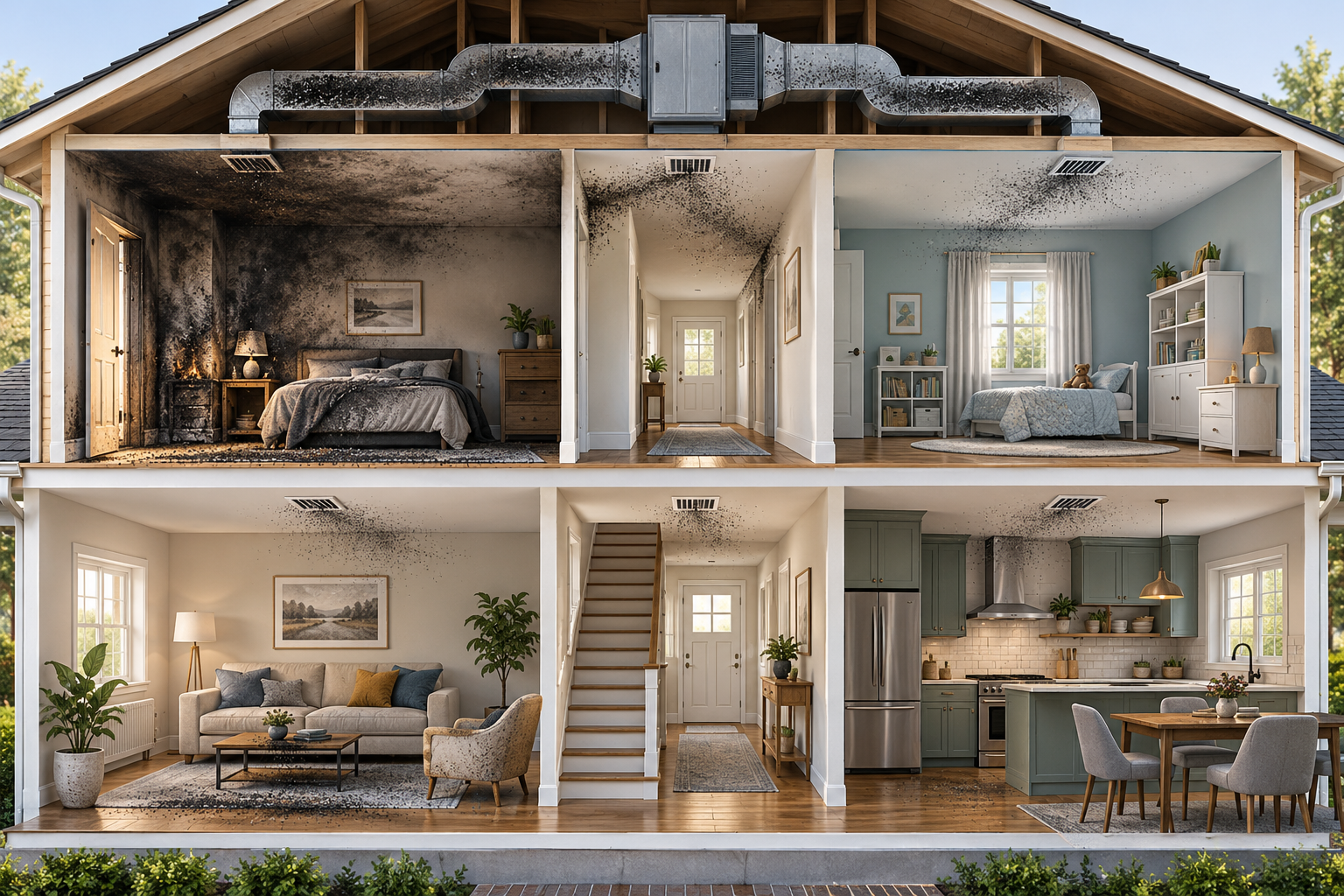
The affected boundary is an assessment question
Smoke can travel beyond the room where the fire started, but that does not mean every room needs the same treatment. Ask the provider to distinguish visible residue, odor, heat damage, suppression-water damage, contents impact, and HVAC concerns. The proposed cleaning method and price should match the material and condition.
If the quote relies on a later inspection, identify that dependency. A low first visit may be appropriate for assessment, but it should not be presented as the final smoke-restoration price.
Keep treatment claims precise
Ask what the service is intended to change and what limitations remain. “Deodorize,” “clean,” “seal,” and “replace” describe different interventions. None alone establishes structural safety, air quality, or permission to reoccupy. That distinction protects the household from paying for a promise that was never defined.
Scope depends on the type and intensity of residue, surfaces, contents, ventilation, exposure duration, and whether smoke entered concealed spaces or air-distribution systems. A restoration assessment may identify rooms and items to clean, deodorize, seal, remove, replace, or send to a specialist.
Cleaning method is not a universal recipe. A surface that can be cleaned may still have staining or cosmetic loss. Porous contents and soft goods may require a separate salvage decision. An HVAC system involved in a fire or smoke event should be assessed rather than automatically used or replaced.
Cost range and cost drivers
The bill may contain assessment, labor, equipment, residue cleaning, deodorization, contents handling, HVAC work, surface sealing or repainting, demolition, disposal, access, and reconstruction. A 2026 U.S. consumer-market observation reports roughly $200–$12,000 for smoke remediation. It is a community market signal, not a universal price, Canadian estimate, safety determination, or occupancy clearance.
The visible soot area is not enough to compare quotes. Ask what surfaces, rooms, contents, and systems were examined; what method is proposed; what is excluded; and when the scope will be reassessed.
Smoke cleanup is not a safety certificate
Neither a cleaned surface nor an odor treatment by itself proves that the building is safe to occupy. Structural condition, electrical systems, air quality, HVAC, and local requirements may need separate professional evaluation. The restoration standard information published by IICRC describes professional standards and their status; it does not make a particular treatment legally mandatory or guarantee reoccupation.
When rebuilding enters the picture
Replace or rebuild when assemblies cannot be cleaned or restored economically, when heat or water damage affects structure, or when the required work is a reconstruction scope. The decision should be documented by condition and cost, not by a simple rule that all smoke-affected surfaces must be removed.
Why smoke reaches apparently unaffected rooms
Smoke can move through air pathways, doors, wall penetrations, return-air paths, and HVAC systems. Residue may settle on ceilings, walls, cabinets, finishes, contents, and surfaces far from the point of combustion. The type of residue, heat exposure, time, ventilation, and material all affect whether cleaning is practical. A visual walk-through that sees no heavy soot is not a complete assessment of odor or contamination.
Ask the restoration professional to identify the affected boundary and how it was assessed. A quote should distinguish inspection from treatment and name the rooms, surfaces, contents, and systems included. It should also explain what happens if residue or odor is found after cleaning begins.
A useful smoke-cleanup handoff
Before treatment begins, ask for a room-by-room record of visible residue, odor, contents, HVAC, finishes, and inaccessible areas. After treatment, ask for the same areas to be identified as cleaned, sealed, removed, replaced, or still unresolved. This makes a later reconstruction or reoccupation question concrete and avoids treating a generalized deodorizing service as a complete restoration.
If the household must leave, track temporary lodging, storage, and access costs separately. Smoke cleaning may overlap with fire repair, water mitigation, contents restoration, and reconstruction, but those scopes can have different contractors and payment questions. A clear handoff preserves the reader’s ability to compare what was actually purchased.
Treatment choices are condition-dependent
Smoke and soot do not affect every material in the same way. A hard surface may be cleanable but still stained. A porous finish or soft good may retain odor or residue. A cabinet, ceiling, duct, electronic item, textile, or painted surface may need a different assessment. The relevant questions are what residue is present, where it travelled, how long it remained, what the material can tolerate, and whether the result can be verified.
Ask the provider to distinguish cleaning, deodorization, sealing, refinishing, removal, replacement, and specialist treatment. These are not interchangeable. A coating can change an odor or surface without proving that the underlying material or air system is unaffected. A cleaning method can be reasonable without promising that every cosmetic mark will disappear.
Cost scenarios
A localized, low-residue loss may involve room assessment, surface cleaning, limited odor treatment, and a small amount of finish work. A broader smoke loss can add multiple rooms, contents, HVAC assessment, equipment, repeated treatment, sealing or repainting, and selective demolition.
A loss with suppression water, heat damage, corrosion, or porous contents can move beyond smoke cleaning into drying, contents restoration, replacement, and reconstruction. The smoke-remediation market observation of roughly $200–$12,000 from a 2026 U.S. community source is broad and may combine very different scopes. It should not be treated as a rate, Canadian price, safety decision, or occupancy clearance.
HVAC and contents need their own questions
Smoke can enter return-air paths and other parts of an HVAC system. An affected system should be assessed by an appropriate professional rather than automatically used or replaced. Ask whether the quote includes inspection, testing, cleaning, restoration planning, or replacement, and what evidence supports the recommendation.
Contents can be more expensive to handle than the visible room suggests. Inventory, photographs, pack-out, storage, specialty cleaning, odor treatment, disposal, and replacement may be separate. Sentimental value can change the homeowner’s decision even when a replacement-cost comparison favors discarding an item. Keep contents decisions separate from building-surface cleaning.
Compare the estimate and the end condition
Ask which rooms and surfaces were examined, whether concealed spaces were inspected, what methods are proposed, what equipment and labor are included, and what happens if cleaning exposes additional residue. Ask whether the price includes moving contents, protecting clean areas, disposal, repainting, HVAC, and reconstruction.
The end condition should be described plainly: cleaned, odor-treated, sealed, removed, replaced, or handed to another specialist. Neither IICRC standards information nor a contractor’s treatment label makes a universal legal rule or guarantees safe reoccupation. Structural, electrical, air-quality, health, and local-authority decisions remain separate.
Smoke cleanup is most useful when it explains what is known, what remains uncertain, and what the next decision will be. That is more informative than treating either a small quote or a large quote as proof that the scope is right.
When cleaning and replacement compete
Some materials may be cleaned, some may need sealing or refinishing, and some may be more practical to remove and replace. That choice depends on the material, the type and duration of exposure, access to the affected surface, odor persistence, and the finish the household needs. A quote that lists “cleaning” without saying which materials are expected to remain does not make that decision visible.
Ask for the proposed path by room or assembly. A smoke-affected room may involve surface cleaning, insulation or drywall removal, framing treatment, primer or sealant, finish replacement, and HVAC or contents work. Those are different scopes even when they are described together as odor remediation. If replacement is recommended, ask what condition made cleaning unsuitable and whether the item is being replaced for damage, performance, code, or preference.
This distinction also helps with claim conversations. The homeowner can document the observed condition and the professional recommendation without promising that every preferred finish or replacement will be covered. A clear room-by-room choice is easier to compare, revise, and hand off than a single treatment label.
Before work closes, ask what was treated, what was removed, what remains inaccessible, and what follow-up belongs to another professional. That short record is useful if odor, residue, or reconstruction questions return later.
Keep that record with the estimate, photographs, invoices, and contents decisions.