
A constant-pressure system is an upgrade to the pump-and-pressure-control design, not simply a larger pressure tank. It commonly uses variable-speed control to adjust pump operation as demand changes, but “constant pressure” can describe different proprietary arrangements. The available evidence does not establish a reliable national installed-price premium, so budget this as a system-specific comparison rather than a fixed percentage.
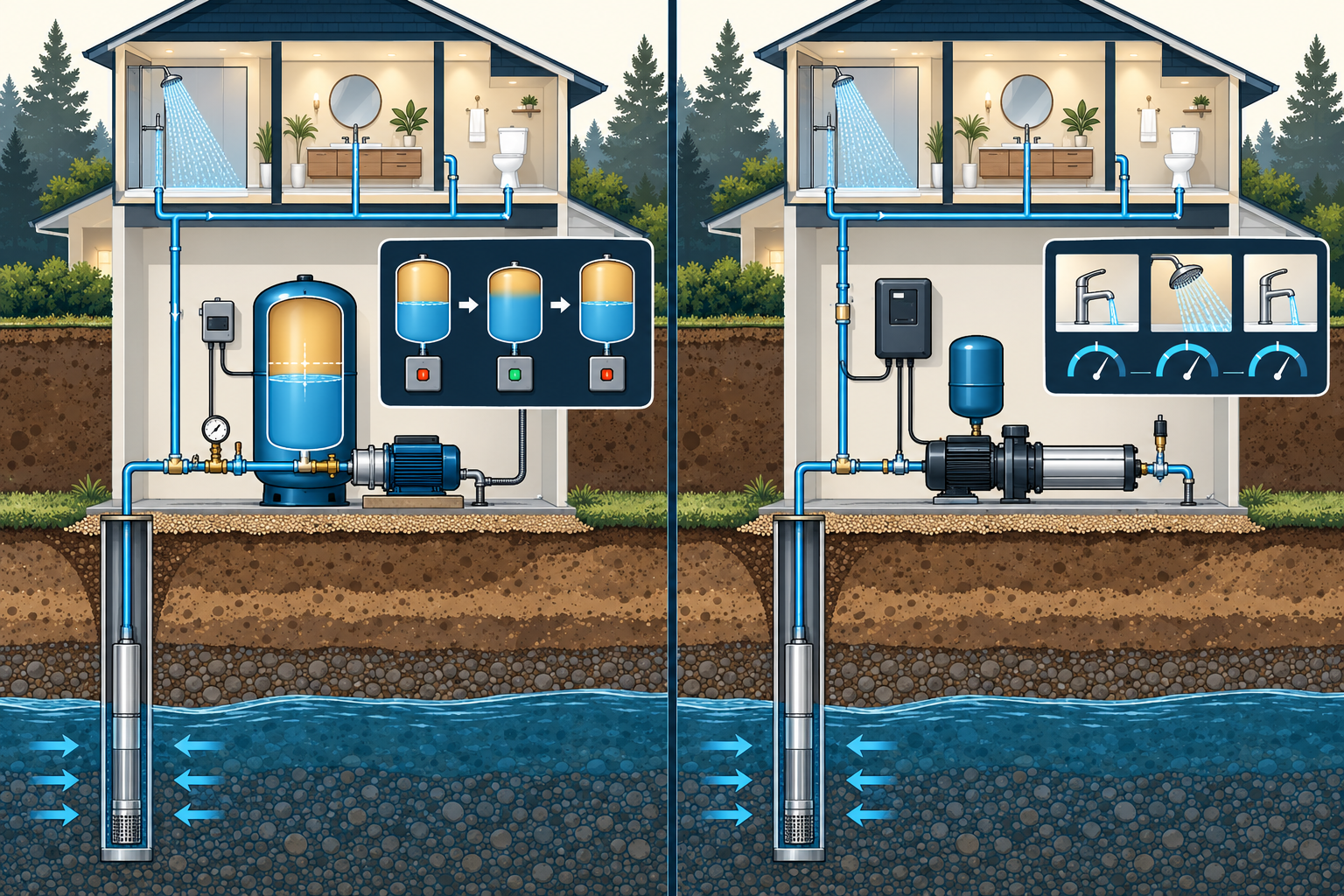
What changes from a conventional system
A conventional well system cycles between pressure settings. A constant-pressure design aims to reduce that change at fixtures by coordinating a pump, controller, pressure sensor, and compatible plumbing and electrical equipment. The exact configuration may retain or change the pressure tank.
The benefit is primarily a different pressure experience and control strategy. It does not create more water in a low-yield well, correct a leaking pipe, make unsafe wiring safe, or replace the need for water-quality treatment. If the original complaint is no water, first establish whether the problem is source production, the pump, the tank, or the controls.
Cost structure
The upgrade can include a compatible variable-speed pump, controller, sensor, pressure tank or vessel, wiring and disconnect work, piping, programming or commissioning, and future service provisions. If the existing pump is already at end of life, the comparison is an upgrade premium over a conventional replacement. If the pump is healthy, conversion may require more compatibility work and may be harder to justify.
Ask for two complete bids: a conventional like-for-like replacement and the constant-pressure system. Hold the well depth, required flow, pressure target, house connection, access, testing, and warranty boundaries constant. The incremental price should identify which equipment and labor actually change.
When the upgrade may make sense
It may fit a home where fluctuating pressure is a persistent nuisance, demand changes frequently, the well and electrical supply suit the control strategy, and the owner expects to remain long enough to value the different operating experience. It can also be considered during a pump replacement when the added equipment does not introduce disproportionate complexity.
It is a weaker fit when the source is low yield, power quality is unreliable, the existing system is difficult to service, the house has little demand variation, or the owner expects to sell soon and cannot recover the premium. A conventional system with a correctly selected pressure tank may be the simpler ownership choice.
Compatibility is the decision point
The installer should verify the pump, well production, pressure requirements, electrical supply, controls, wire, pressure tank, piping, and any booster or treatment equipment. Do not assume that an existing pump can accept a controller or that a constant-pressure package will suit every well. Consequential performance and compatibility claims belong to the actual manufacturer and system design.
Power interruptions also matter. The pump and controls can require a particular supply and starting or operating behavior. A backup-power plan belongs with the power-system decision, but the well installer should state the system’s electrical requirements and what equipment must remain energized for water service or treatment.
Maintenance and repair economics
The upgrade may reduce cycling or improve comfort, but it does not eliminate maintenance. Sensors, controls, pump components, pressure equipment, and electrical connections remain service items. A fault may require a provider familiar with the controller rather than a generic tank replacement.
Ask about service availability, replacement-controller cost, diagnostic process, warranty separation between equipment and labor, and whether a conventional fallback is possible. The most expensive failure is not always the part; it can be a specialized service delay in a remote market.
Three ownership cases
Upgrade during normal pump replacement: The pump pull and installation labor already belong in both bids. The premium is easier to isolate, and the owner can compare comfort against complexity.
Healthy pump, pressure preference: The owner pays additional conversion labor and may disturb a working system. The benefit needs to be durable enough to justify the disruption and future service model.
Low-yield well: A controller cannot manufacture source water. Storage, demand management, rehabilitation, deepening, or a new source should be evaluated first if the actual failure is production.
Questions for an installer
- What exact pump and controller architecture is proposed?
- Is the existing pump, tank, wiring, and piping compatible?
- What well-yield and flow assumptions are being used?
- What is the complete conventional alternative on the same scope?
- What happens during power loss or poor power quality?
- Which parts require specialized service and what are the likely replacement costs?
- What testing and commissioning are included?
US and Canadian uncertainty
The market sources available for this category support system-cost drivers but not a durable US or Canadian price premium. Equipment brands, labor, electrical requirements, and service networks vary. Obtain a local CAD or USD quote as applicable, and treat “constant” as a system description that must be specified, not as proof of one universal result.
Compare the ownership horizon
The premium is easiest to justify when the upgrade is already being considered during a pump replacement, the household notices pressure cycling every day, and the owner expects to keep the property long enough to value the different service. It is harder to justify when the existing system is healthy, the owner may move soon, or the property has unreliable power and limited specialist support.
Ask the installer to model the full horizon: initial equipment, conversion labor, electricity assumptions, controller or sensor replacement, pump service, pressure-tank service, and the cost of a conventional fallback. Avoid universal energy-savings claims; the available evidence does not establish them for every system. The value may be comfort and control rather than a guaranteed utility reduction.
A useful acceptance test
Before authorizing the upgrade, require a written operating target, the well-yield and flow assumptions, exact compatible equipment, commissioning steps, alarm behavior, and service contact. Confirm what happens if the controller fails and whether the home can be supplied temporarily or returned to a conventional arrangement. Those terms turn an attractive feature into a priced, supportable system decision.
The quote should also identify what is not improved: constant pressure does not create source yield, correct water quality, or remove the need for a properly sized pump and electrical supply. That boundary is the economic test. Pay the premium when the system solves a real, durable pressure-control problem and the household can support its service model; otherwise a conventional system may deliver better value.
Compare the failure and service model
The upgrade decision is incomplete until the owner understands how the system behaves when a sensor, controller, pump, or power supply fails. Ask whether a local provider can diagnose the equipment, which replacement parts are stocked, and whether a temporary conventional arrangement is possible. A system that offers excellent pressure but requires a long specialist trip for a common fault may carry a different ownership cost from a conventional arrangement even when the installation totals are similar.
The proposal should also state the operating limits that matter to the source: well recovery, minimum flow, pressure target, electrical supply, and any treatment or booster equipment in the path. Those limits are not reasons to reject constant pressure; they are the conditions that make the comparison valid. If the design cannot show how the system responds to a low-yield period or a power interruption, the owner is still pricing a feature rather than a complete service outcome.
For a replacement project, keep the conventional and constant-pressure alternatives on matching scopes. Show the pump pull, controls, wiring, tank, commissioning, testing, warranty, future service, and temporary-water plan in both columns. The premium is meaningful only after the baseline is complete.
Separate comfort from capacity
If the proposal changes the pump, ask how the new operating range interacts with well recovery and pressure-tank drawdown. A controller can change cycling without changing the amount of water available. That is why a pressure complaint and a supply complaint should be priced as separate diagnoses before the owner accepts an upgrade.
Constant pressure can make pressure behavior feel more consistent, but it does not increase the sustainable yield of a low-producing well or create additional water in storage. If the complaint is a dry period, long recovery, rapid cycling, or low flow, the provider should show which part of the system the upgrade addresses. A control change may be appropriate for pressure regulation while storage, source work, or demand management is needed for volume.
Compare the upgrade with a conventional repair or replacement using the same demand and pressure targets. Include compatibility checks, commissioning, electrical work, controller support, and what remains at the property. The price premium is easier to judge when the expected benefit is named rather than implied by the product label.