
A storage tank can solve a timing problem: the well produces water slowly but can refill a reservoir before the next peak-demand period. It cannot create groundwater, correct contamination, or guarantee that a low-yield source will remain adequate. There is no reliable universal price or capacity formula in the available evidence; a complete quote must be designed around measured production, household demand, equipment, site, and local conditions.
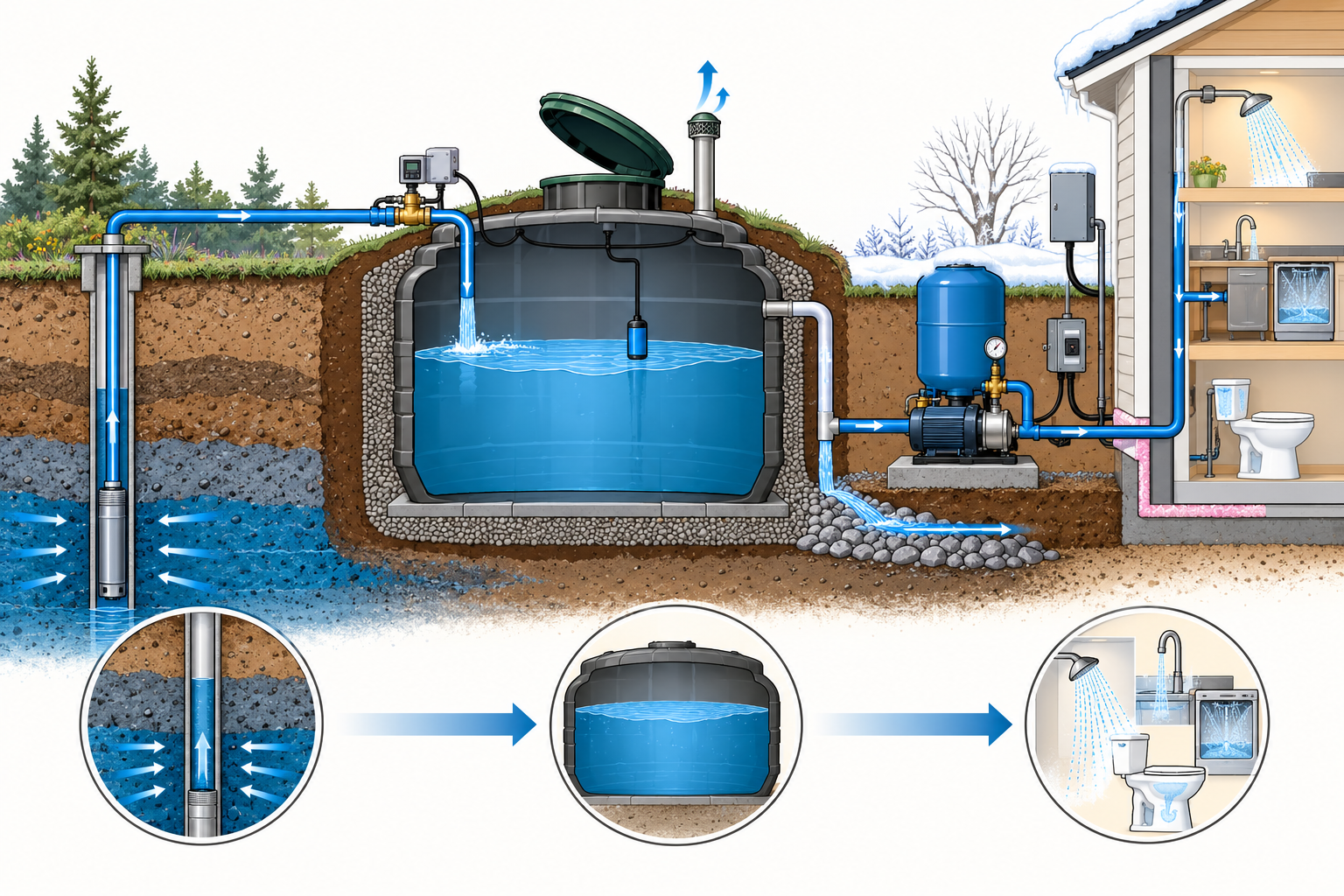
Storage tank versus pressure tank
A conventional pressure tank is part of the pump’s pressurized control system. A bulk or intermediate storage tank holds a larger supply at a different point in the system, then a booster pump and pressure controls deliver water to the house. Replacing a pressure tank with a larger one is not the same project and does not turn a low-yield well into a high-yield source.
Penn State Extension describes reservoir and booster arrangements as a way to buffer production against peak demand. The correct capacity depends on actual well recovery, water use, reserve expectations, pump cycling, and the system’s ability to keep water sanitary—not simply the number of bedrooms.
Components in a complete installation
Budget for the tank, potable-water-rated materials and fittings, fill control, inlet and outlet plumbing, booster pump, pressure tank or controls after storage, check valves, overflow and drain provisions, monitoring, electrical supply, foundation or excavation, freeze protection, access, commissioning, and future cleaning or inspection. A buried tank may add excavation and restoration; an indoor tank may require structural access and floor protection.
The quote should show who designs the controls, how the tank is protected from contamination, what happens during a power outage, and where overflow or discharge goes. Site drainage and electrical work may be separate categories of work even though they affect the water budget.
Above-ground, buried, and cold-climate choices
An above-ground tank is often easier to inspect and service but consumes conditioned or protected space and may need insulation or heating strategy. A buried tank saves indoor space but adds excavation, access, groundwater, traffic-load, and repair considerations. Cold climates add freeze-protection requirements for the tank, lines, controls, and booster system.
Do not treat insulation as a complete freeze strategy without a design for the actual exposure. Remote or seasonal properties need a shutdown, draining, monitoring, or winterization plan that fits the equipment and local conditions.
Water quality and sanitation
Storage adds residence time and more surfaces that must remain suitable for potable water. Specify the tank’s intended use, material, certification, cleaning access, lid or seal, venting, overflow protection, and monitoring. A tank chosen for irrigation or non-potable service is not automatically suitable for household drinking water.
If the raw water already has contamination or treatment needs, decide where treatment belongs relative to storage and the booster. Some arrangements need pretreatment; others need protection from recontamination. Test and follow applicable professional or health guidance rather than treating the tank as a passive container.
Cost scenarios
Simple buffer: A suitable indoor location, short plumbing runs, straightforward controls, and a known low-yield timing problem. The cost is the tank, booster, controls, connection, testing, and commissioning.
Typical site installation: Outdoor or mechanical-room storage needs a foundation, freeze protection, electrical work, monitoring, and more pipework. The tank price is only part of the project.
Difficult remote or buried installation: Excavation, rock, long service travel, limited access, drainage, restoration, backup power, or a treatment train can dominate. A new well or rehabilitation should be priced as a competing option rather than assumed unnecessary.
Operating costs
The booster pump adds electricity and another service item. Filters, disinfection or treatment, inspections, tank cleaning, controls, and eventual pump replacement add lifecycle cost. Power loss can interrupt delivery even when the well continues to produce, so backup-power requirements belong in the comparison when continuous supply matters.
Storage versus source work
Storage is attractive when the measured production is adequate over a longer period and the shortage is concentrated in peak use. Rehabilitation may be better when a professional diagnosis finds incrustation, biofouling, sediment, or another correctable well-condition issue. Deepening or drilling may be more appropriate when the source is persistently inadequate, the storage system is too large or complex, or water quality changes make the current design unsuitable.
Ask for staged pricing: diagnosis, storage system, source rehabilitation, and replacement well. Compare total ownership cost and failure exposure over the period you expect to own the property.
Questions for a storage quote
- What measured well yield and household demand support the proposed capacity?
- Is the tank certified or otherwise appropriate for potable water?
- What are the fill controls, booster, pressure system, overflow, and monitoring components?
- How will the system be protected from freezing and contamination?
- Are excavation, foundation, electrical, backup power, treatment, testing, and restoration included?
- What maintenance, cleaning, and replacement work is expected?
- What is the alternative cost for rehabilitation, deepening, or a new well?
No national price can answer those questions by itself. Canadian costs must be obtained independently from US market context, and remote properties may face travel and mobilization premiums. The tank is worth considering when it buys reliable timing from an adequate source; it is not a substitute for diagnosing an inadequate one.
Size from production and demand
The capacity decision should use measured or professionally estimated well recovery, peak household flow, desired reserve, refill time, and the booster system’s operating limits. A large tank can be wasteful if the source is abundant and the issue is pressure; a small tank can fail to bridge the actual peak. Avoid a universal gallons-per-bedroom rule.
Ask the designer to show what happens after a long shower, several fixtures, or a power interruption. The system may need alarms, a low-level cutoff, overflow protection, or a temporary-water plan. These are not decorative additions: they determine whether storage provides resilience or merely adds another vessel that can fail.
Make future service part of the quote
A tank should have safe access for inspection and cleaning, a drain or discharge plan, replaceable controls, and records of material, capacity, plumbing, and commissioning. If it is buried, document the location and access points. If it is seasonal, document winterization and restart conditions. Include those arrangements in the ownership cost because a difficult tank can make an inexpensive source much harder to maintain.
Test the storage assumption against the source
Storage is useful only if the well can refill it at a sustainable rate and the controls prevent demand from outrunning recovery. Ask the designer to show the assumed well yield, refill time, usable—not merely nominal—volume, and the demand period the tank is intended to bridge. A large vessel may add cost without solving a source that cannot recover, while a smaller vessel may be adequate for a seasonal peak mismatch.
Also price the consequences of a contaminated or stagnant supply. Storage does not improve raw-water quality by itself, and a tank can add sanitation, inspection, and treatment requirements. The quote should say how testing, cleaning, overflow, and a prolonged power outage affect normal use. That turns “more gallons” into a verifiable service plan.
The operating objective should be stated in the proposal: how many hours or demand events the tank is expected to bridge, what minimum level protects the pump, how the booster responds, and what happens when the well does not recover on schedule. Those details help distinguish a storage system sized for a low-yield timing problem from a larger cistern intended for seasonal or remote-property resilience.
Compare the tank with the alternatives on the same service boundary. Include the cost of the well test, design, tank, controls, booster, plumbing, electrical work, excavation or foundation, freeze protection, commissioning, water testing, and recurring cleaning or service. If storage only postpones an inevitable source replacement, the proposal should say what result would justify moving to rehabilitation, deepening, or a new well.