
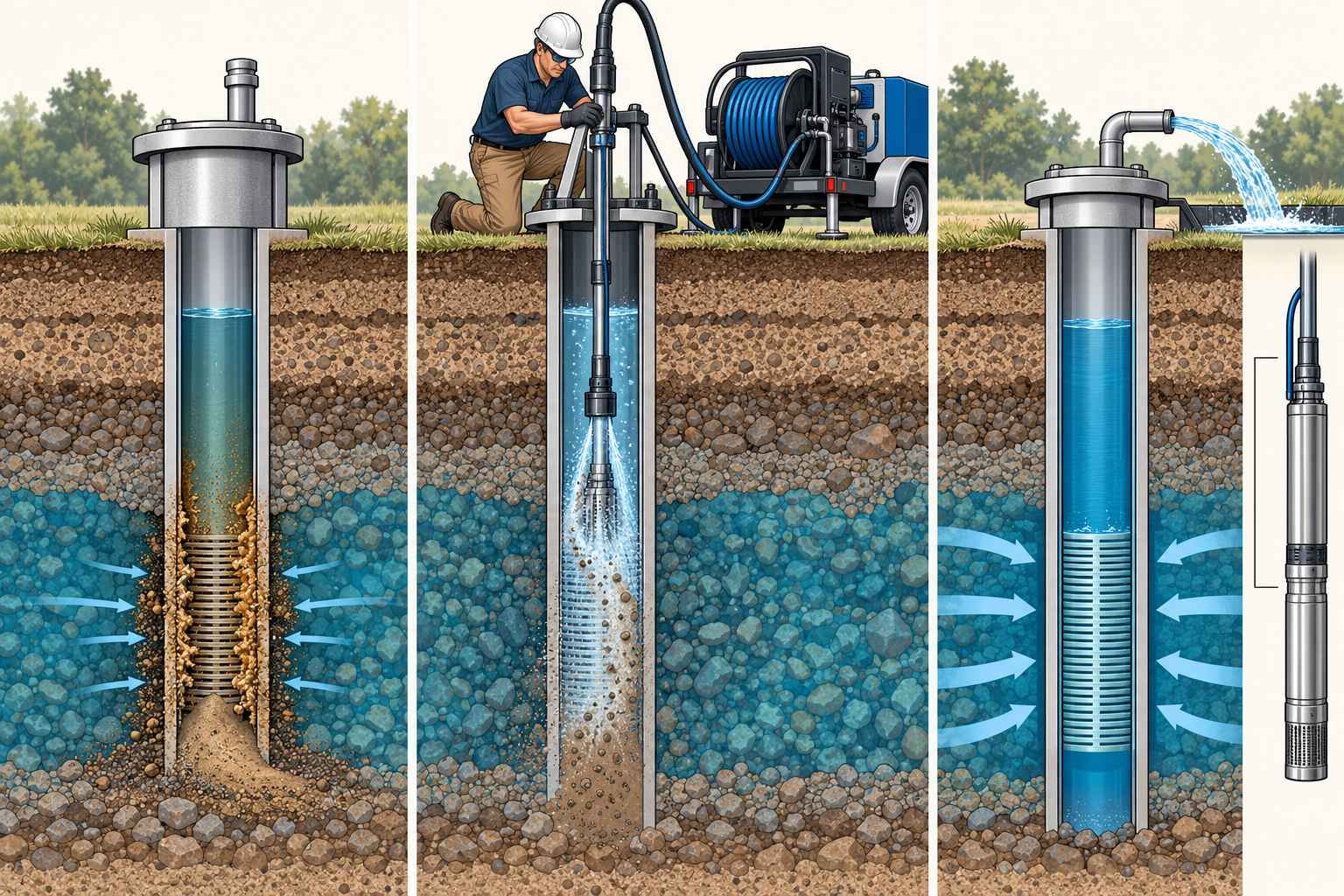
Well rehabilitation is a professional attempt to restore or maximize the performance of an existing well when the cause of decline may be correctable. It is not the same as replacing the pump, and it is not a guaranteed way to create a new water source. The available evidence supports the intervention and its causes but not a durable national price or success rate, so a responsible budget starts with diagnosis and carries outcome uncertainty.
When rehabilitation enters the decision
A well may produce less because of mineral incrustation, biofouling, sediment plugging, sand pumping, casing or screen corrosion, pump damage, drought, or over-pumping. A pressure problem, leak, or failed pump can look similar. Penn State Extension notes that a yield decline of about 25% or more generally signals that rehabilitation should be considered, but this is guidance rather than a universal code threshold.
The first scope should establish whether the decline is real, seasonal, source-related, or equipment-related. Review historical yield, water levels, pump performance, water quality, and maintenance records. A downhole camera or other specialist diagnosis may be useful where the construction allows it.
What the work may involve
At a high level, rehabilitation can include assessment, removal of deposits or obstructions, mechanical redevelopment, professional cleaning, or a chemistry-specific treatment selected by the provider. The exact method depends on the construction, material, screen, formation, contaminant, and local requirements. This article does not provide chemical recipes or contractor procedures.
The quote should say whether pump removal, camera inspection, cleaning, redevelopment, waste handling, disinfection, and post-work testing are included. “Rehab” without a defined method and success measure is not a comparable scope.
Cost structure
Costs commonly come from mobilization and diagnosis, pump pull or access, equipment and labor, the selected rehabilitation method, water handling and disposal, disinfection, testing, and restoration. Deep wells and remote properties can carry substantial travel and mobilization. A constrained wellhead or uncertain records may make the diagnosis itself more expensive.
Because comparable pricing is not durable, use a staged proposal. Pay for enough diagnosis to determine whether rehabilitation is technically credible, then authorize the treatment with a defined outcome measurement. Price a backup plan—storage, deepening, or a new well—if failure would leave the household without a viable supply.
What makes success more or less plausible
Rehabilitation is more promising when the cause is identifiable, the well construction is serviceable, the decline is consistent with a correctable condition, and the source formation can still provide the required production. It is less attractive when the formation is inherently inadequate, casing or screen damage is extensive, the problem is a failed pump, or the well repeatedly declines after prior work.
Do not treat a visual improvement or temporary flow increase as proof of long-term success. Measure the relevant performance after the work and compare it with the household’s actual demand. Test water after an intervention if the work disturbs the well or changes the source conditions.
Rehabilitation versus a new source
Rehabilitation generally preserves the well location, connection, and existing construction, which can reduce disruption if the cause is correctable. A new well can change siting and construction options but introduces drilling, casing, pump, connection, testing, yield, and possible old-well closure costs. Deepening occupies a middle ground but also carries geological uncertainty.
Storage may be a better economic response if the well makes enough water over time and fails only during peak demand. Pump replacement is appropriate when the pump is the failed component. These distinctions prevent an expensive rehabilitation quote from being used to solve the wrong problem.
Three cases
Defined condition: Records and testing point to incrustation, biofouling, or sediment, access is good, and the provider can measure output before and after. Rehabilitation can be evaluated as a focused alternative.
Mixed condition: The well, pump, casing, and pressure system have all aged. The quote should separate pump work from well work and state how each result is measured.
Uncertain or severe decline: The cause is unknown, the source is seasonal, casing is damaged, or prior rehabilitation failed. Diagnosis and a replacement or storage comparison are more important than a low headline price.
Questions to ask
- What evidence identifies the cause of declining output?
- Is the pump included, or is this only well rehabilitation?
- What method is proposed and what construction assumptions control it?
- What pre-work and post-work measurements will be recorded?
- Is disinfection or water testing included?
- What happens if output does not improve?
- How does the total compare with storage, deepening, and a replacement well?
US and Canadian uncertainty
Professional methods, labor, travel, geology, and local requirements vary across both countries. Do not convert US market observations to Canadian pricing or publish a universal success probability. A good rehabilitation quote makes uncertainty explicit and buys a measurable decision point; it does not promise that an old well will perform like a new one.
Build the proposal around evidence
Ask for the historical output, current yield or recovery measurement, pump condition, water-level information, construction record, and the suspected degradation mechanism. If the proposal recommends mechanical or chemical work, it should explain which condition the method addresses and what it will not correct. A general “cleaning” allowance is not comparable with a staged diagnosis and a defined post-work test.
The outcome measure should reflect the decision. If the goal is domestic supply, compare sustainable production with actual peak demand. If the goal is protecting a treatment system from sand or deposits, include particle and water-quality results. If the goal is delaying a new well, price the cost of a repeat decline and the fallback source. This makes rehabilitation a decision with a measurable benefit rather than a hopeful maintenance purchase.
Keep pump work separate. A new pump can improve delivery from a sound well, but it cannot restore a blocked screen or inadequate formation. Conversely, rehabilitating the well will not repair a failed motor. Separating the scopes prevents paying twice and makes the replacement alternative honest.
Decide when to stop investing
Set a result and a maximum exposure before work starts. If the output does not reach the agreed useful level, or if opening the well reveals casing or formation damage, pause and compare storage, deepening, or a new well. A rehabilitation quote is strongest when it tells the owner what information will be gained even if the treatment fails; a weak quote promises improvement without defining how it will be measured.
Turn rehabilitation into a staged investment
The first stage may be records review, inspection, measurement, or a limited cleaning attempt. Later stages may require specialized equipment, disposal, additional access, or a second test. Price each stage with its decision point and avoid treating the full intervention as inevitable before the cause is understood. The owner should know whether the first stage can justify stopping, continuing, or changing to storage or a new source.
Success also has a time dimension. A temporary flow improvement may not support the same economics as a stable restoration, especially if the property has already paid for repeated service. Record the pre-work condition, method, post-work yield, recovery, and follow-up interval. That history gives future providers evidence for deciding whether another rehabilitation attempt is rational.