
A drilling quote is only one part of a private-water project. A broad US market orientation from current specialist pricing places drilling projects in a wide range, with depth, geology, access, casing, pump equipment, and local labor moving the total substantially. A per-foot number can be useful for comparing the drilling portion, but it is not a budget for a functioning household water supply.
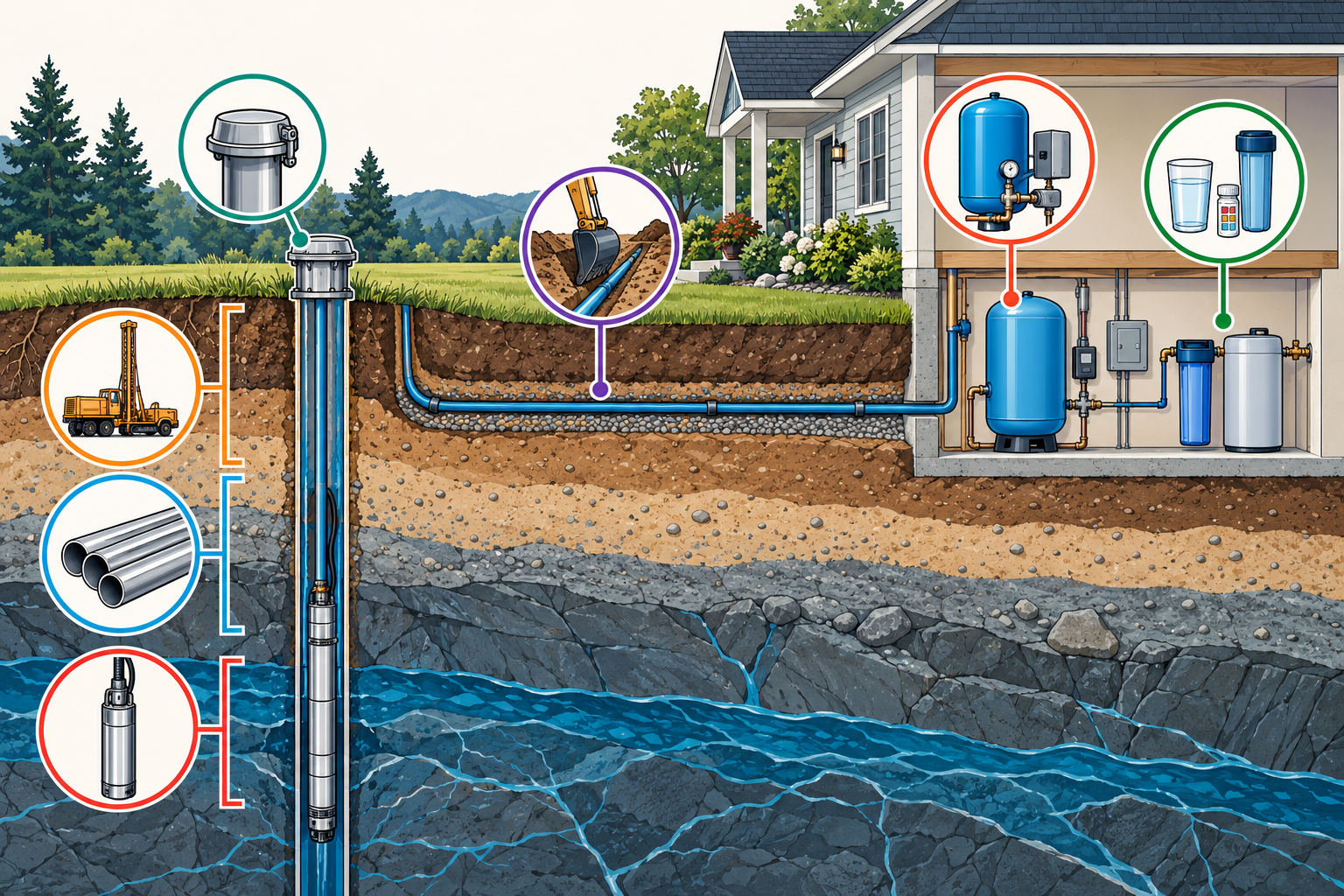
What a complete project includes
The finished system may include site layout, drilling, casing and screen or other well-completion work, a sanitary wellhead, pump, drop pipe, controls, pressure tank, pressure switch, gauges and valves, electrical work, trenching, house connection, testing, disinfection when required, permits or records, surface restoration, and treatment selected after the water is tested. A new well can also require storage or a booster arrangement if the source produces enough over time but not enough during peak demand.
Ask the driller to identify which of these are included. “Well drilled” may mean a hole and casing. “Complete well” may still exclude the pump, electrical service, connection to the house, water-quality testing, or treatment. The two totals are not comparable until their boundaries match.
How the price is built
Most proposals combine one or more of these pricing structures:
- a mobilization or site setup charge;
- drilling priced by foot, by formation, or as a defined allowance;
- casing, screen, grout, sealing, and completion materials;
- a pump and pressure system priced by equipment specification;
- labor for installation and commissioning;
- trenching, boring, electrical, and interior connection work;
- testing, disinfection, inspection, permits, and records;
- allowances for difficult access, extra depth, or additional casing.
Per-foot pricing makes depth visible, but the final depth is uncertain. A lump sum can make budgeting easier, but it should state the depth, casing, completion, and dry-hole or low-yield terms. If a quote changes after a geological condition is encountered, it should state the authorization point and unit basis.
Why depth and geology matter so much
The depth to a usable water-bearing formation is not the same as the depth at which a driller begins. Rock hardness, unstable formations, lost circulation, water quality, casing requirements, and the need to continue drilling after a low-yield result can change labor and material use. A deeper well can also require a different pump, more drop pipe, more cable, and more difficult servicing.
A shallow, accessible drilled system with predictable formation and nearby utilities is a relatively simple case. A deep system on a sloped or remote site may carry several interacting costs: mobilization takes longer, every added foot uses more casing and drilling time, and future pump removal becomes more involved. Do not interpret the equipment price as independent of well depth.
Drilling, casing, and completion are different lines
The casing maintains the opening and helps keep undesirable water out; screens and completion details control how water enters the system. Diameter and material affect the pump that can fit, the amount of material used, and the available service options. A wellhead cap or seal is part of protecting the opening, not merely a cosmetic finish.
The exact construction method and minimum requirements depend on local geology and governing rules. The US Environmental Protection Agency describes drilled, driven, and dug or bored wells as different types and recommends checking state and local requirements. That overview is not a universal construction specification, and Canadian requirements differ by province or territory.
Pump, pressure, and house connection
The pump converts the source into household supply. The pressure tank and controls manage the pressurized side of the system. A pump quote should identify the proposed type and capacity, well depth assumption, drop pipe, wiring, controls, pressure tank, and service access. Sizing should follow the well’s tested production and the home’s demand; house size alone is not enough.
Trenching from the well to the house, passing beneath driveways, crossing rock, restoring landscaping, and bringing electrical power to the equipment may be separate projects. A driller’s total can therefore be reasonable while still being incomplete for the property owner. Have bidders state the connection point and who owns the remaining work.
Testing and treatment are post-drilling decisions
EPA recommends regular private-well testing for a baseline group of indicators and additional testing when local conditions, flooding, construction, repairs, or changes in taste, odor, or color create a reason. Test with the laboratory and local authority appropriate to the location. Do not select a filter from a sales diagnosis or from the mere fact that the water is from a well.
The new source may need no treatment, a single device, or a treatment train. Treatment cost depends on the contaminant, concentration, flow, household demand, and water chemistry. Keep a separate allowance for testing and possible treatment rather than burying it inside an unexplained “commissioning” line.
Three budget cases
Simple case: The drill rig can reach the site, the formation is predictable, utilities are close, and the well is completed at the planned depth. The quote includes casing, pump, pressure equipment, testing, and connection assumptions.
Typical case: Depth or formation varies, access needs preparation, the trench or electrical run is nontrivial, and the water test leads to modest treatment or additional plumbing. The owner needs allowances for casing, restoration, and treatment rather than a single drilling number.
Difficult case: Equipment mobilization is restricted, deeper drilling or additional casing is needed, the yield is low, or the source requires substantial treatment or storage. The project can become several linked scopes, and a low initial drilling price does not protect the final budget.
Permit, contractor, and quote questions
The permit, setback, reporting, licensing, inspection, and well-record rules are jurisdiction-specific. Confirm them with the responsible authority. EPA recommends checking local requirements and verifying contractor licensing or certification where required. Ontario and British Columbia provide examples of licensed or registered professional involvement and well information requirements, but neither is a Canada-wide rule.
Before signing, ask:
- What depth, diameter, casing, and completion does the base price assume?
- What happens if the well is dry, low-yield, or requires more casing?
- Is the pump, pressure system, electrical work, trench, and house connection included?
- Who performs and pays for the water test and any disinfection?
- What is excluded: treatment, storage, permits, restoration, access, or disposal?
- How are changes authorized and priced?
- What construction records, test results, equipment details, and warranties will be delivered?
US and Canadian planning
US specialist figures are useful for understanding the breadth of ordinary market pricing, not for predicting a property-specific total. Comparable Canada-wide pricing was not established in the available evidence, so do not convert a US figure using an exchange rate. Obtain local CAD quotes and verify provincial or territorial requirements, especially where construction, water quality, records, and licensing are involved.
The project is ready to compare when every bid describes the same completed system, carries a visible assumption for uncertain depth or yield, and separates optional treatment from required source construction. A per-foot price may still be attractive—but only after you know what it leaves for the rest of the water supply.
Decide what the first contract is meant to buy
Before comparing proposals, define whether the immediate goal is a water source, a completed water-supply system, or a connection ready for occupancy. Those are different handoff points. A drilling-only contract may be appropriate when another provider will complete the pump and connection, but it should not be compared with a turnkey proposal as though the totals describe the same result.
The contract should also say what information is delivered if the result is disappointing. A dry or low-yield hole may still produce records of depth, formations encountered, casing, water levels, and tests that inform the next decision. Ask who owns those records, when a change order is authorized, and whether the contractor will help price a pump, storage, treatment, or replacement source. Paying for a clear stop point can protect more value than accepting a low initial unit price.
Plan the site handoff as part of the budget. The owner may need a protected route for future service, a documented wellhead location, drainage that directs surface water away from the opening, and access for testing or pump work. If the well is near septic, driveways, structures, or future additions, confirm the layout with the responsible local authority and qualified professionals before drilling. A complete quote ends with a usable, documented system—not merely a hole that produced water once.
How to normalize a drilling proposal
Put each bid into the same sequence: site and access, drilling, casing and completion, pump and drop assembly, pressure equipment, electrical, trench and connection, testing, treatment allowance, permits and records, restoration, and warranty. Mark each line as included, allowance, unit-priced, excluded, or conditional. This makes a cheap drilling-only proposal visibly different from a complete-system proposal.
Ask how the contractor handles the point where drilling stops. A useful agreement identifies the authorized depth or a change-order rule, the casing and completion included, the treatment of a dry or low-yield result, and the records delivered even when the outcome is disappointing. Without that rule, the owner may be committed to more drilling before knowing whether the source can serve the property.
The ownership decision also includes future service. A pump that is inexpensive to install but difficult to pull, a wellhead buried beneath a finished surface, or a treatment room without drain and bypass access can make later repairs more expensive. Compare access and documentation as part of the system value. Keep the final depth, static and pumping information, casing, pump, pressure settings, test results, and equipment models for the next service provider.