
Sand, grit, cloudy water, or recurring sediment can justify filtration, but sediment is a symptom rather than a complete diagnosis. A damaged screen, casing, wellhead, pump condition, or changing source can be sending particles into the home. A filter may protect fixtures and downstream treatment while the source problem continues. The current US treatment-system market orientation is broadly $1,200–$3,600 for many installed systems, but simple prefilters and complex backwashing systems fall at different scales and Canada is not covered by that range.
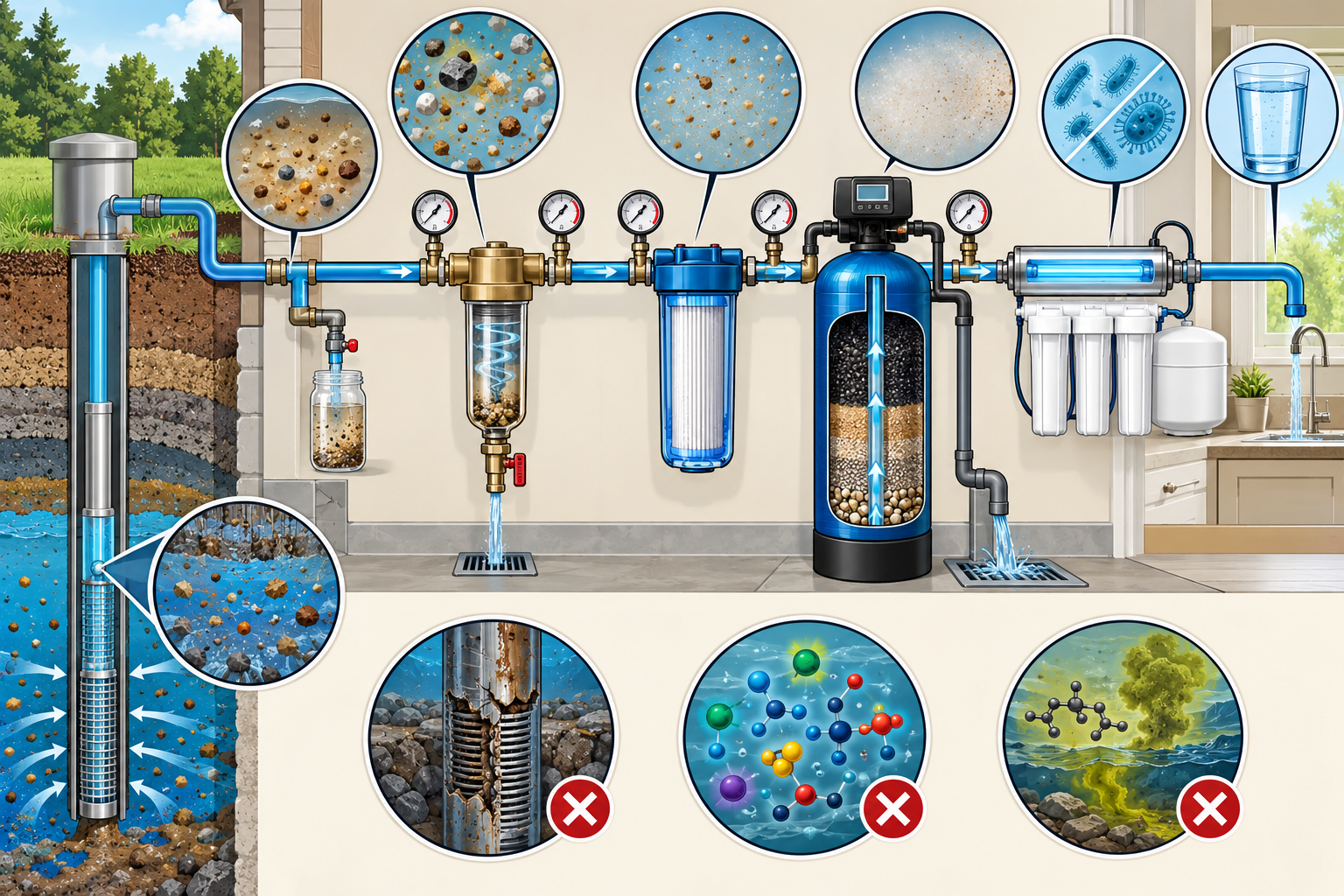
Check the source first
EPA recommends additional private-well testing after changes in taste, odor, or color, flooding, construction, or repair. Inspect the well and test the water before assuming a cartridge is the solution. Sudden sand after work or a change in well performance deserves a well-condition investigation.
Also distinguish suspended particles from dissolved iron, manganese, or other contaminants. A particulate filter does not automatically remove dissolved health contaminants. The device’s rating and certified claim must match the target.
Filtration choices
Spin-down or coarse prefilter: Captures larger particles and can protect downstream equipment. It may be economical when the load is coarse and the housing is accessible, but it does not solve a high fine-sediment load by itself.
Cartridge filtration: Uses replaceable filters with a chosen rating. The housing, cartridge size, flow, pressure drop, bypass, and replacement access control the real cost. A fine cartridge can clog rapidly when the well is shedding particles.
Backwashing or media filtration: Uses a larger tank and control valve to clean the media, reducing manual cartridge changes in some applications. It requires adequate flow, drain capacity, space, electricity, and maintenance.
Cost drivers
- particle size and load;
- well condition and whether source repair is needed;
- required household flow and peak demand;
- filter rating and replacement frequency;
- tank, media, control valve, and backwash requirements;
- pressure loss and pump capacity;
- plumbing bypass, drain, electrical supply, space, and access;
- protection of UV, RO, softener, or other downstream equipment;
- testing, service, cartridges, and media.
The smallest filter is not always the cheapest system. Frequent cartridge changes, pressure loss, and pump stress can make a larger system or source correction better value.
Pretreatment for other systems
Sediment can interfere with UV performance and clog RO or other treatment stages. A prefilter may therefore be required even when the homeowner does not care about visible particles. The quote should identify whether sediment filtration is a standalone objective or pretreatment for another device.
Do not add stages without mapping each one to a result or equipment requirement. NSF certification categories are claim-specific and do not transform a sediment filter into a universal contaminant treatment.
Three scenarios
Light intermittent sediment: A serviceable prefilter or cartridge housing with accessible replacement can be appropriate after source and water checks.
Heavy or fine load: A higher-capacity or backwashing system may reduce manual work, but it needs flow, drain, space, and maintenance planning.
New or worsening sediment: Investigate casing, screen, pump, or well performance before committing to downstream filtration. A filter-only quote can hide a source-repair decision.
Maintenance and quote questions
Ask how often the cartridge or media is expected to be replaced under the measured load, what pressure drop is acceptable, where the bypass sits, who changes the filter, and how the backwash or discharge is handled. Include service and disposal where relevant.
Ask the installer:
- What test or inspection identifies the particles?
- Is the source itself sound?
- What rating, flow, and pressure assumptions apply?
- Is this a prefilter for UV, RO, or another treatment?
- What are the cartridge, media, electricity, drain, and service costs?
- How will performance be verified?
US price context should not be converted into CAD. The economically sound filter is one that addresses the measured particle load without causing a pressure problem or postponing necessary well repair.
Interpret a filter quote by its operating point
Ask for the rated flow, pressure drop when clean and loaded, particle size or rating, housing or media capacity, and expected replacement interval under this well’s load. A filter that works at a showroom flow may restrict the house during simultaneous use. A larger housing or backwashing unit may cost more initially but reduce cartridge labor and pressure problems.
If sediment is pretreatment for UV or RO, the quote should state the protection requirement of the downstream equipment and how failure is detected. If sediment is a symptom of casing, screen, pump, or source change, price inspection and repair before committing to recurring filtration. A filter can protect the house while that investigation happens, but it should not be presented as source correction.
Ownership comparison
Build a simple annual model for cartridges, media, backwash water, electricity, service, testing, and pressure-related pump work. Compare it with the cost of correcting the well. The appropriate choice may be a focused prefilter, a larger media system, a source repair, or a staged combination. The answer follows the measured load and the ownership horizon, not the number of filter stages.
Separate protection from correction
A temporary prefilter can protect a new UV, RO, or softener while the source is investigated. The proposal should say whether that is the intended role and what evidence permits the owner to move to a permanent system. If the sediment load grows, the filter may become a recurring symptom-management expense rather than a solution.
Ask how the system behaves at the household’s peak flow and after the cartridge or media is loaded. Include sample points, pressure gauges, drain and backwash discharge, safe bypass, replacement access, and the labor of changing heavy media. For a remote home, stock and travel can matter as much as the cartridge price. A clear maintenance plan is part of the installed cost.
Use the first replacement cycle as a test of the economic model. Record pressure, cartridge life, particle load, and downstream effects, then compare the actual cost with the source-repair alternative. If the result is materially different from the quote assumption, revise the treatment rather than accepting indefinite pressure loss or frequent emergency replacements.
Define what “sediment” means in the quote
Make the operating result measurable. Record clean and loaded pressure, expected flow, cartridge or media life, and the effect on downstream UV, RO, softening, or fixtures. If those values are unknown, the first purchase may be a diagnostic or a temporary protective stage rather than a permanent treatment system.
Use a low case for a stable source with occasional cartridge changes, an expected case with regular labor and pressure monitoring, and a difficult case where source loading grows or damages downstream equipment. If the difficult case is plausible, the quote should include a source investigation or a clear stop point rather than assuming the owner will accept indefinite filter work.
A visible particle problem may originate at the well, in the pressure system, after construction, or in interior plumbing. Ask whether the provider is pricing a protective filter, a source correction, or both. The selected filter should be tied to the particle load, flow, pressure tolerance, treated outlets, and disposal or backwash method. A fine element can protect downstream equipment while creating an unacceptable service burden if the source load is not addressed.
For a new or recently disturbed well, include follow-up sampling and inspection rather than committing immediately to permanent filtration. For a stable source with predictable loading, compare cartridge replacement and labor over the ownership horizon with a reusable media system or source work. The lower initial price is not the lower cost if the filter becomes a hidden weekly task.