
Orange, black, or metallic staining can make iron or manganese treatment seem obvious, but appearance alone does not identify the concentration, form, co-contaminants, or best equipment. A current US specialist orientation places many whole-home treatment systems around $1,200–$3,600, but an iron or manganese project can fall outside that range when pretreatment, oxidation, backwashing, plumbing, or difficult chemistry is involved. Canadian prices must be obtained independently.
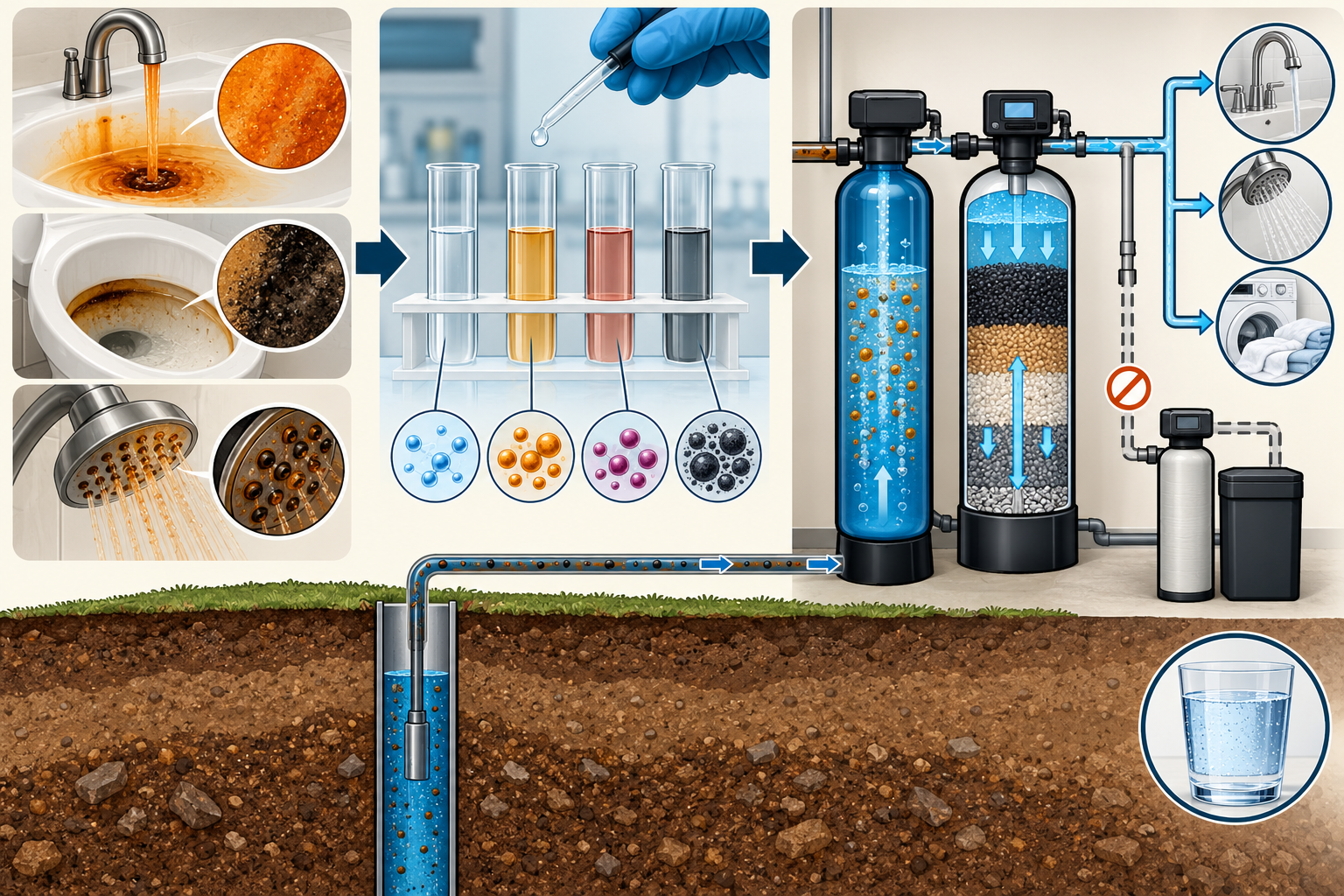
Test before selecting a system
Test the raw water for iron and manganese and consider the other chemistry that affects treatment. Dissolved and oxidized forms behave differently; sediment, pH, hardness, sulfur, and flow can change the equipment choice. Staining is a useful reason to investigate, not a treatment specification.
The treatment objective also matters. A homeowner may want to protect fixtures and laundry, improve taste or appearance, or address a health-sensitive result under applicable guidance. Keep aesthetic and operational goals separate from health claims, and use a certified product claim that matches the actual contaminant and conditions.
Treatment families
Depending on the result, a system may use oxidation followed by filtration, a media filter, catalytic or specialty media, or a softener for a limited hardness-related application. A softener is not automatically suitable for all iron or manganese forms and concentrations. NSF explains that standards cover different categories and that certification does not mean one device removes every contaminant.
Pretreatment can be the largest hidden cost. Air or chemical oxidation, contact time, sediment removal, pH adjustment, a backwashing filter, drain capacity, and control valves add equipment and maintenance. A quote with one tank and a broad promise needs more scrutiny than a quote that maps each stage to a measured result.
Installed cost drivers
- iron and manganese form and concentration;
- raw-water pH, hardness, sulfur, and sediment;
- household peak flow and treatment capacity;
- oxidation or chemical-feed equipment;
- media tank, control valve, backwash drain, and electrical supply;
- main-line plumbing and bypass;
- access, floor drainage, freeze protection, labor, and travel;
- media replacement, salt, electricity, and service;
- post-installation water testing.
Whole-home treatment is common when the goal is to prevent staining at multiple fixtures, but point-of-use treatment may be more appropriate for a narrow drinking-water objective. Let the result and exposure or operational goal decide the boundary.
Three scenarios
Moderate, chemistry-compatible problem: Testing supports one appropriately sized media or filtration system with nearby plumbing and drain. Installation and recurring media are the main budget lines.
Complex raw water: Iron or manganese arrives with sediment, low pH, sulfur, or high hardness. Pretreatment and a treatment train raise the initial price and the maintenance burden.
Source or equipment problem: Sudden sand, color, or staining follows a well repair, casing issue, pump change, or disturbance. Investigate the well and retest before purchasing downstream filtration.
Maintenance and verification
Backwashing uses water and requires a suitable discharge. Media may need replenishment or replacement; controls and valves need service; and electricity or chemical feed adds operating cost. The interval depends on water chemistry, use, and equipment design. Budget actual manufacturer requirements rather than a generic promise.
Test the treated water when the treatment objective is consequential or the system’s performance can change with exhausted media. Keep inlet and outlet results with the equipment record. A clean fixture after installation is not proof that every target has been reduced.
Quote questions
- What laboratory result and contaminant form support the design?
- Which stage addresses iron, which addresses manganese, and which is pretreatment?
- What flow, pressure, drain, and electrical assumptions apply?
- Is a softener being proposed, and what limitation applies?
- Which certified claim matches the exact equipment?
- What media, salt, chemicals, electricity, backwash, and service costs recur?
- How will performance be verified after installation?
Do not infer a universal health risk from a stain, and do not infer a universal treatment from a color. Obtain a local US or Canadian quote based on tested chemistry. The economical system is the smallest design that addresses the actual result without shifting the problem to pressure, plumbing, or maintenance.
Make the treatment claim reviewable
Ask the provider to name the iron and manganese result, the form or chemistry considered, the design flow, the media or oxidation method, and the post-treatment test. If the system backwashes, verify drain capacity and discharge requirements. If it uses a softener, ask which portion of the result it is expected to address and which portion remains outside its scope.
The household may value fewer stains, less laundry damage, better taste, or protection of appliances. State that objective separately from any health-sensitive claim. A system that meets an appearance goal may still need another treatment for a different laboratory result. That distinction prevents the homeowner from paying for a broad promise that the equipment cannot make.
Distinguish the visible symptom from the design load
A stain may occur at a lower or higher concentration than another property’s stain because water chemistry, fixture material, temperature, and time differ. The installer should identify dissolved and particulate forms where relevant, the flow at which treatment is expected to work, and whether the media needs oxidation, contact time, or backwashing. This is why two homes with similar laundry marks can receive different proposals.
Ask what a failed or exhausted system looks like and how it will be detected. A bypassed or exhausted filter can return the symptom while the owner assumes treatment is operating. Include sample ports, service access, media replacement, drain capacity, and inlet/outlet testing where the result warrants it.
Repair or filter?
If the problem begins suddenly after a well repair, pump change, flood, or casing disturbance, investigate the source before installing a permanent filter. If the source is sound and the chemistry is stable, downstream treatment may be the lower-disruption choice. If a system protects appliances, price the avoided repair and replacement effects over the ownership horizon, but do not claim a specific payback without property data.
Match the design to the household’s use
The treatment load is not the same for a seasonal cabin, a family home, and a property with irrigation or livestock. A system sized only for a laboratory sample may lose pressure or exhaust media when several fixtures operate together. Ask for the design flow, peak demand assumption, backwash or drain requirement, and what happens when the media is near exhaustion. If pretreatment is needed, include its cartridges, valves, controls, and service space rather than treating them as optional accessories.
Also separate appearance from protection. Iron or manganese staining may justify an economic comparison with appliance cleaning and replacement, but a cosmetic improvement does not prove that every water-quality concern has been addressed. The quote should identify each claimed result and the test that will verify it.
Compare source work with treatment work
A sudden increase in sediment, staining, or metallic taste can signal a change in the well or pumping system rather than a stable chemistry that should simply receive more media. Ask whether the provider has reviewed the well record, recent repairs, water levels, and sample history. If the source is sound, a treatment system may be the lower-disruption choice; if the source is changing, recurring media replacement may only hide a larger repair decision.
Define the result in terms the household can verify: lower measured iron or manganese at the treated outlet, less staining, an acceptable pressure and flow range, or protection of a downstream appliance. Keep aesthetic improvement separate from health or regulatory claims, and do not assume one technology applies to every chemical form or concentration. The proposal is strongest when it explains the test, the treatment claim, the operating load, and the maintenance cost together.