
Low-pH water can make corrosion and fixture or appliance damage part of the economic decision, but pH alone does not fully describe corrosivity or select one universal remedy. A treatment project may use a neutralizing media system, chemical feed, contact equipment, or a combination chosen from the water chemistry and flow. The available evidence supports the decision structure but not a universal pH threshold or national installed range.
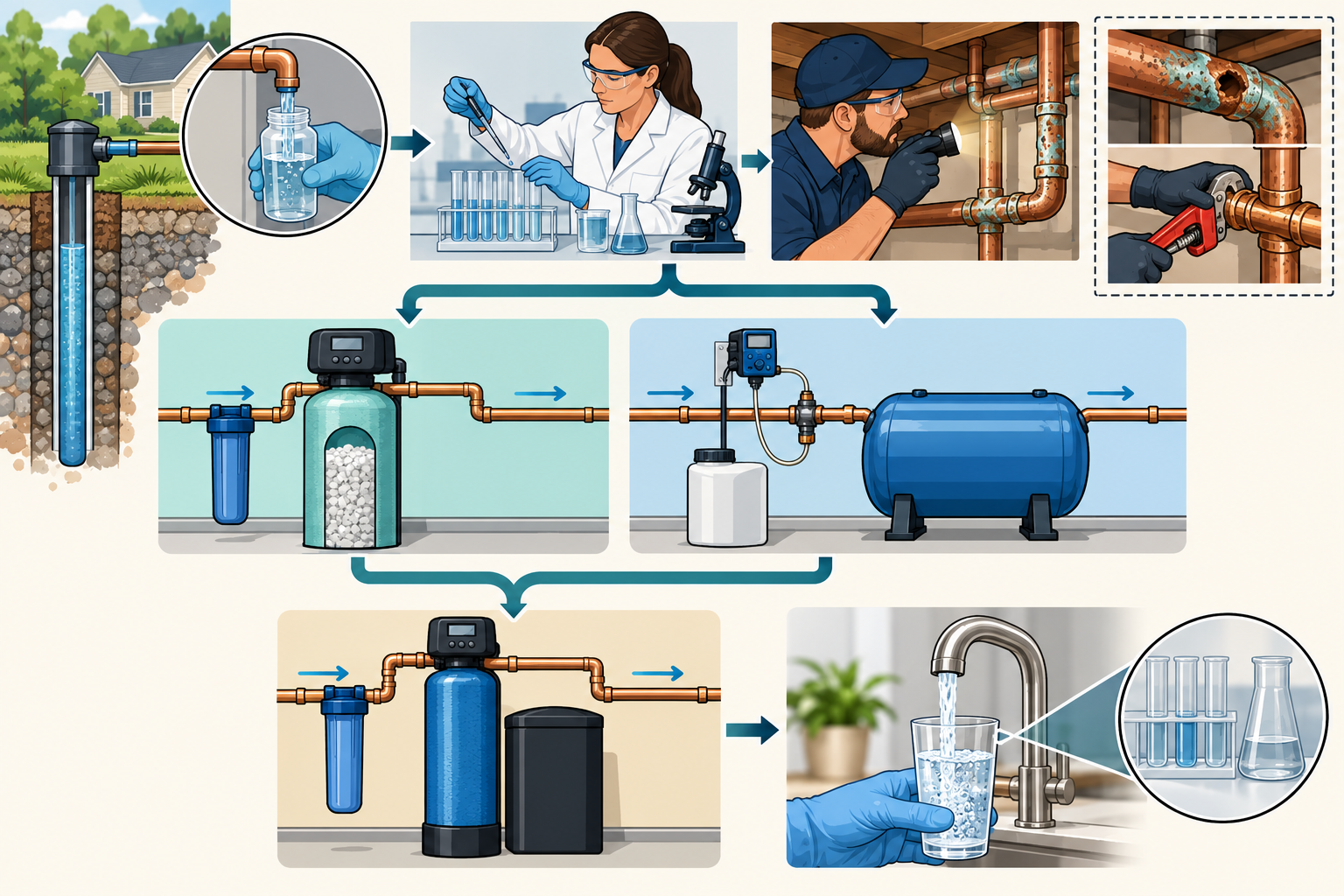
Confirm the condition and consequence
Test the raw water with a suitable laboratory and consider related chemistry such as alkalinity, hardness, dissolved metals, and other indicators relevant to corrosion. CDC identifies pH and total dissolved solids as context-dependent indicators; they do not by themselves diagnose every water problem.
Then document the consequence: pinhole leaks, blue-green staining, metallic taste, damaged fixtures, water-heater issues, or only a laboratory result without a visible symptom. Treatment belongs to this category. Repairing corroded interior plumbing or an appliance belongs to the related plumbing or equipment scope.
Common treatment architecture
A neutralizing media filter passes water through material that changes the water chemistry. Depending on the media, the system can add hardness or alter other chemistry, which may create a need for softening or another downstream decision. A chemical-feed or contact arrangement may be selected where a media approach does not fit the result. The exact design is professional and chemistry-specific.
Treat these as system choices, not product names. Ask what the equipment changes, how it handles the household flow, how it is regenerated or replenished, and what happens if it is exhausted.
Installed cost drivers
- measured pH and the rest of the raw-water chemistry;
- flow rate, pressure, and peak household demand;
- neutralizer tank, media, control valve, and backwash drain;
- chemical-feed equipment, storage, and contact time where used;
- additional softening or filtration created by the treatment;
- plumbing bypass, electrical supply, floor drainage, space, and access;
- media or chemical replenishment, electricity, and service;
- inlet/outlet testing and plumbing repair outside the treatment system.
A broad US treatment-system orientation of $1,200–$3,600 can help describe ordinary scale, but it is not a low-pH price and should not be converted to CAD. A complex chemistry or corroded-plumbing case can exceed it.
Three cases
Laboratory result, limited consequence: A focused neutralizer with nearby plumbing and adequate drain may be the complete project, provided the design fits the chemistry and flow.
Low pH plus hardness or metals: Treatment can become a train. The quote should map the neutralizer, softener, filter, and verification to separate results instead of calling everything one “water conditioner.”
Existing plumbing damage: The treatment may stop or reduce ongoing corrosion, but it does not repair leaks or replace damaged pipe. Price the treatment and interior repair separately and consider the disruption and ownership horizon.
Operating and verification cost
Media may need replenishment or replacement, systems may backwash, chemical feed needs supplies and service, and control valves use electricity. The actual interval depends on use and raw water. Test treated water to confirm the desired chemistry and keep the results with the maintenance record.
NSF certification is claim-specific. Do not assume a general filtration or softening certification proves correction of corrosivity. The installer should identify the actual treatment objective and any manufacturer limits.
Quote checklist
- What laboratory results support the design beyond pH?
- What corrosion consequence is the system expected to address?
- What neutralizing media or chemical approach is proposed and why?
- Will treatment increase hardness or create another water-quality issue?
- Are flow, pressure, backwash, drain, electrical, and space requirements included?
- What maintenance, media, chemical, and verification costs recur?
- Which pipe, fixture, or appliance repairs remain outside the quote?
Use local authority and professional guidance for consequential water-quality decisions. The best budget connects measured chemistry to treatment and future plumbing exposure; a pH number alone cannot do that.
Compare treatment with the cost of corrosion
If testing shows a stable low-pH condition but no visible plumbing damage, the decision may be a focused treatment and monitoring project. If fixtures, copper lines, water heaters, or appliances are already affected, treatment and repair need to be sequenced. Replacing damaged pipe without correcting the water can repeat the expense; treating water without repairing a leak leaves the owner with both problems.
Ask the provider to state the treated-water target, the measurement used to verify it, and what chemistry may change after neutralization. A neutralizer that adds hardness can create a softening or scale-control decision. A chemical-feed system can add storage, controls, consumables, and service. These interactions explain why a small tank price is not the complete budget.
Control future uncertainty
Include sample points, bypass access, media or chemical monitoring, drain capacity, and records. For a property sale, disclose the original result, treatment, subsequent tests, and plumbing work rather than describing the system only as a “filter.” For a long-term owner, model media, chemical, service, and testing costs alongside avoided corrosion work without claiming a guaranteed payback.
What a complete quote should prove
The proposal should connect the measured chemistry to a treated-water target, name the proposed media or feed system, state the flow and pressure basis, and identify how the result will be checked. It should also identify whether hardness, iron, manganese, or sediment changes after neutralization. Those details explain why two neutralizer quotes can differ without one contractor simply charging more for the same work.
If a home already has corroded plumbing, ask whether a temporary water arrangement, access opening, or repair sequencing is required. The treatment can reduce future exposure but cannot restore a pipe that has already failed. Keep treatment, plumbing repair, and appliance replacement as separate decisions so the homeowner can see what the water correction actually buys.
Recheck after installation
The owner should retain the raw-water result, treatment model, media or chemical record, treated-water result, and any plumbing-repair invoice. A later change in pH, flow, well production, or household demand can change the design load. The next quote is more reliable when the provider can see what the original system was designed to correct.
Do not confuse a neutralizing stage with a complete answer
Before authorizing a larger treatment train, identify which plumbing or appliance damage is already present and which future damage the treatment is intended to reduce. This prevents an owner from treating a neutralizer as a promise to restore failed components. It also makes the avoided-cost discussion more honest: the value may be risk reduction and longer service life rather than a predictable payback.
The decision threshold is practical: proceed when the proposed treatment matches the measured condition, the owner can maintain it, and the avoided corrosion or water-quality risk matters over the chosen horizon. Pause when the result, design load, or downstream repair scope is still unclear.
A neutralizing treatment may address acidity while leaving other tested conditions, sediment, metals, or bacteria unchanged. Conversely, corrosion damage may already exist in fixtures, plumbing, or treatment equipment even after the water result improves. Ask for the inlet result, target outcome, treated flow, media or chemical replenishment, drain requirements, and post-installation test. The quote should separate source investigation, treatment, and repairs caused by earlier corrosion.
Use a low case for a clear result and accessible installation, an expected case that includes consumables and verification, and a difficult case involving multiple treatment stages, damaged plumbing, or recurring chemistry changes. That structure is more useful than a universal equipment price because the economic risk is often the interaction between water chemistry, flow, and existing materials.