
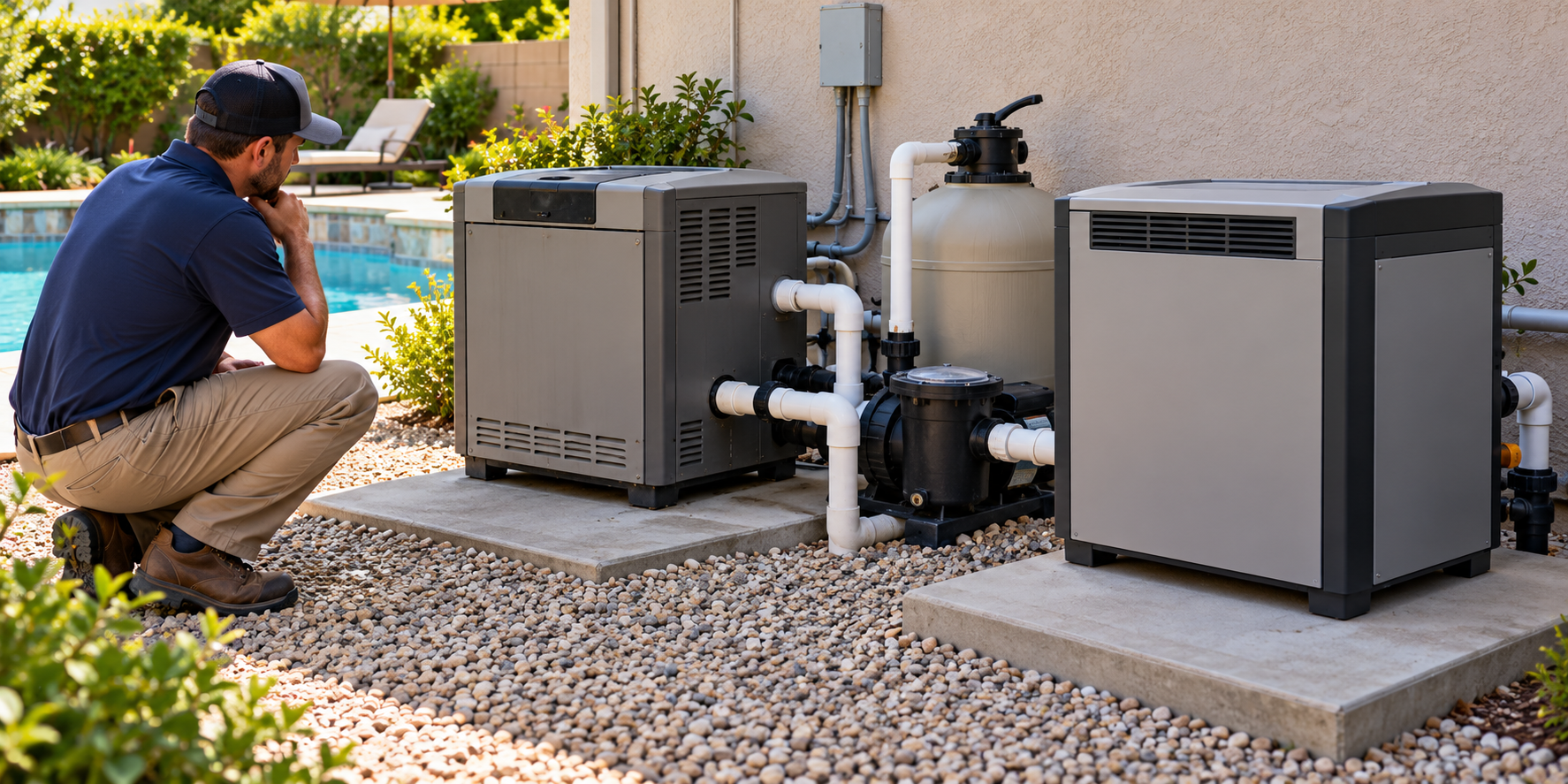
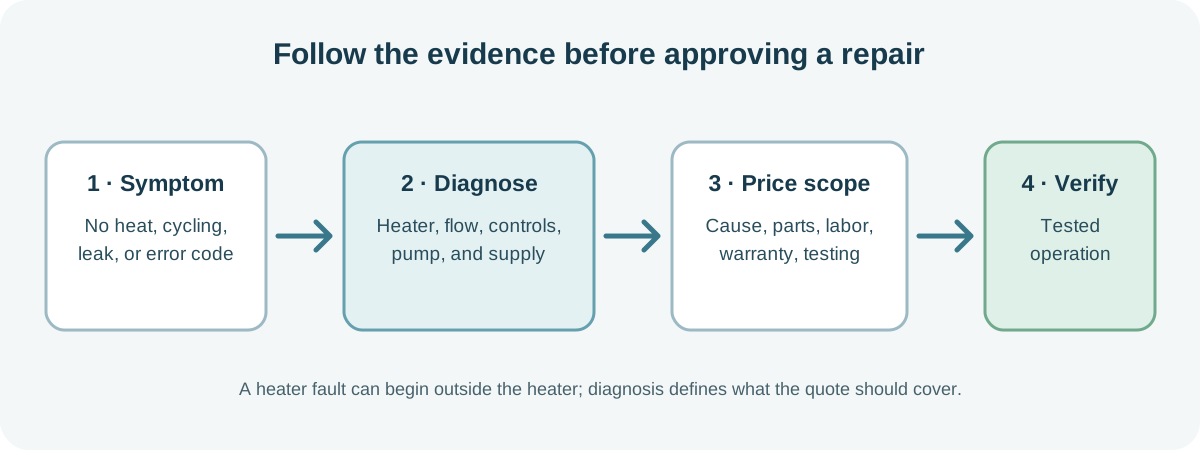
A heater symptom is not a diagnosis. No heat, short cycling, a leak, or an error code may involve the heater, controls, water flow, pump, plumbing, fuel or electrical supply, or another system condition. A qualified technician should identify the cause before the owner compares repair with replacement.
Define the repair scope
Ask for the model and fuel or heating type, the reported symptom, tests performed, confirmed failed component, parts availability, labor, startup and testing, warranty, and any unresolved condition. For gas equipment, keep combustion, venting, fuel, and live electrical work with qualified technicians. For heat pumps or solar systems, ask about the separate circulation, controls, and site dependencies rather than assuming the heater alone caused the problem.
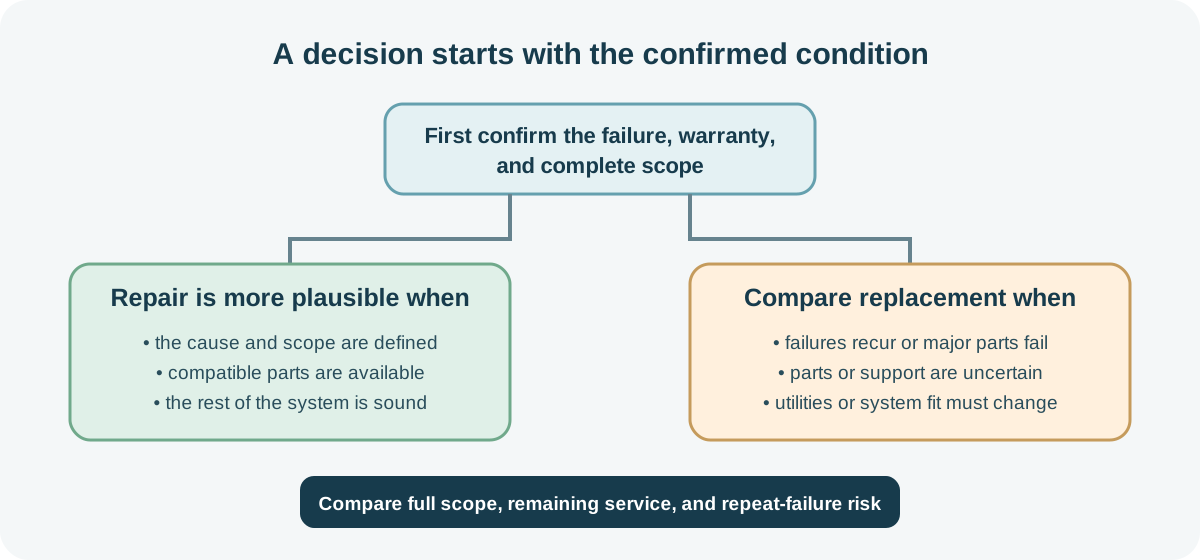
A repair can be reasonable when the failed part is established, other equipment is in suitable condition, compatible parts are available, and the repair has a useful expected service horizon. Replacement becomes more attractive when a major component is unavailable, failures recur, the unit is poorly matched to the current system, or repair cost approaches the complete replacement scope. No single repair-to-replacement ratio settles every case.
Common cost categories differ by technology. Gas-heater work may involve ignition, sensors, a heat exchanger, venting, fuel or control issues; a heat pump may involve a fan, compressor, sensor, refrigerant circuit, or electrical controls; solar work may involve collectors, plumbing, roof or ground access, and controls. These are categories for a qualified technician to assess, not homeowner troubleshooting steps.
What pool-heater repair may cost
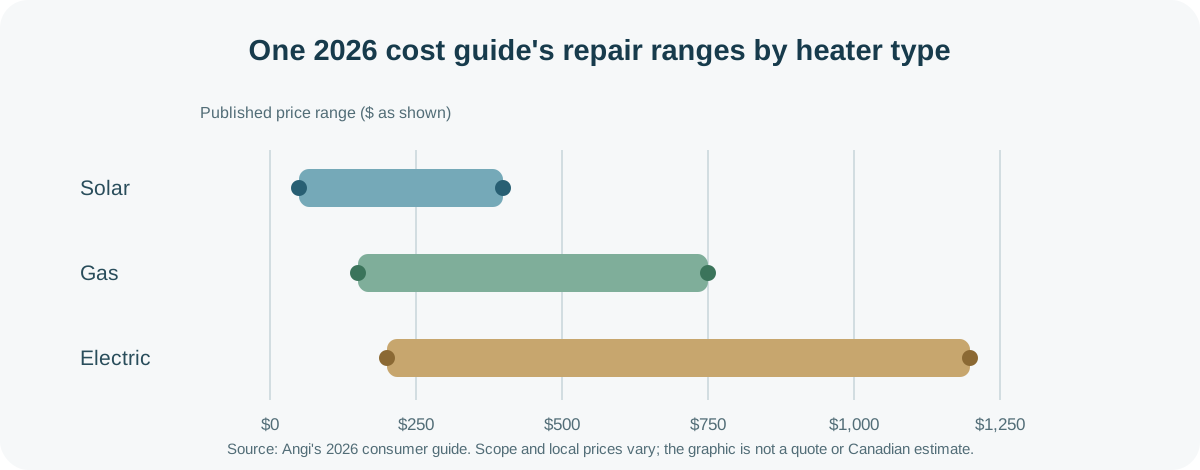
Angi’s 2026 guide reports an average repair cost of $477 and a usual range of $166–$799, based on 1,403 Angi Pro projects. It lists broader ranges of $150–$750 for gas-heater repairs, $200–$1,200 for electric heaters, and $50–$400 for solar systems. These are one consumer cost guide’s estimates; the sample method, exact service scope, model mix, and Canadian market are not established. Use them as an initial comparison point, not a quote or a guaranteed range for a particular failure.
Regional provider listings show why the bill needs to be separated into diagnosis and repair. ACE Pool Repair & Remodel publishes a $150 equipment diagnostic credited toward repair if work proceeds, plus a $350–$1,200 heater-repair range for its Orange County and parts of Los Angeles County service area. Sparkle Water Management lists heater-troubleshooting calls at $180 for weekly-service customers and $200 for others, credited toward labor if a repair is performed. 911 Pool Care lists a $150 diagnostic with $50 credited toward approved work in Central Texas, but does not publish a repair schedule. Each is a single provider’s local offer; the dollar sign is reproduced as published, and the amounts are not a matched regional or national survey.
| Price reference | Published amount | What it tells you |
|---|---|---|
| Angi 2026 repair estimate | $166–$799 usual range; $477 reported average | A broad U.S.-oriented consumer estimate based on reported Angi Pro projects, not a property-specific quote |
| ACE diagnostic and repair listing | $150 diagnostic; $350–$1,200 repair range | One Southern California provider; diagnostic credited when repair proceeds |
| Sparkle heater-troubleshooting visit | $180 or $200 service call | One California provider’s client-specific diagnostic fees; credited toward labor if work is done |
| 911 Pool Care heater diagnostic | $150, with $50 credit toward approved work | One Central Texas diagnostic listing; repair price is not published |
The figures describe different services and should not be added together or treated as competing quotes. A diagnostic fee may include testing or only a visit, and a credit may apply only if the homeowner approves work. Ask for the charge if no repair follows, what tests are included, whether a return visit costs extra, and whether the estimate covers parts, labor, tax, startup, and follow-up testing. One DMV-area guide from Beltway Pools also publishes overlapping and inconsistent figures for gas-valve work in its table and FAQ; because the source does not reconcile them, they are not a dependable single repair range.
The provider prices are unverified market observations: the listings show what those businesses publish, but they do not establish typical local charges or a complete job total. Confirm current service-area eligibility and written scope before using any listing to compare bids.
The cost of the failed part alone does not describe the job. A sensor or igniter may involve a narrower repair than a damaged heat exchanger or compressor, but the final charge also reflects diagnosis, access, labor, model-specific parts, and testing. A low quote that excludes the cause of repeat failure can leave the homeowner paying twice. A higher proposal may include a more complete system assessment or warranty, so compare what is delivered rather than only the headline number.
Ask whether diagnostic labor is billed separately, whether a service call includes testing or only inspection, and whether the fee is credited if a repair is approved. If a fault is intermittent, ask what conditions the technician needs to observe and whether a second visit is likely. A clear diagnostic invoice can prevent a part replacement from being mistaken for a confirmed repair.
Compare replacement as an installed project
HomeAdvisor’s U.S. specialist page reports a 2026 pool-heater installation range of $1,864–$4,348, with a reported average of $3,094. This is an installation signal, not a repair price or a quote for a specific property. Pool size, heater type, utility hookups, permits, and tie-in to the existing pump or plumbing change the scope.
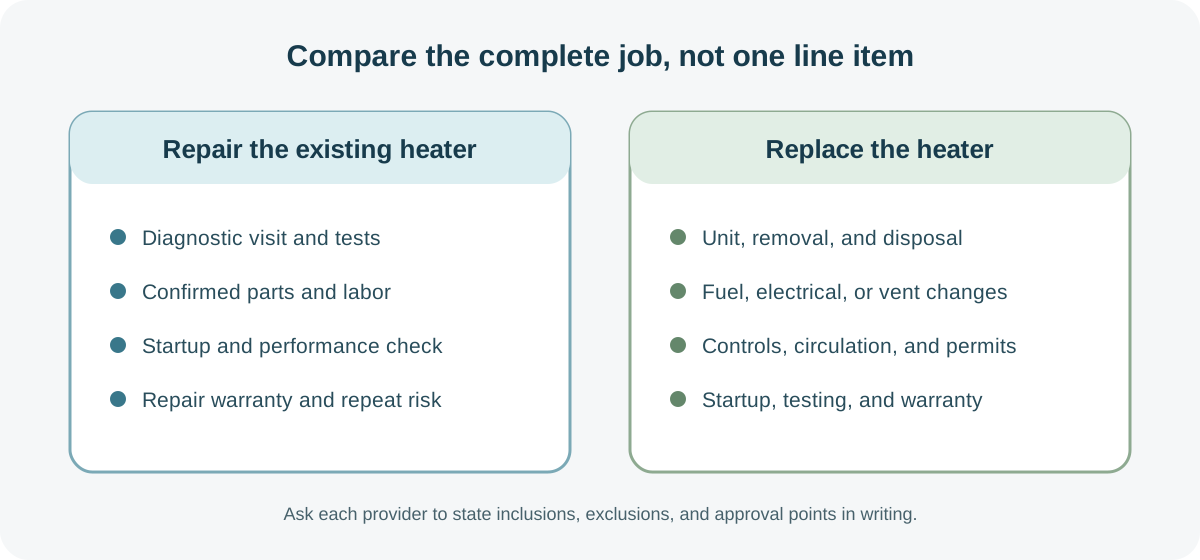
These repair and replacement figures come from different sources and scopes. Angi’s reported $477 repair average and HomeAdvisor’s $3,094 installation average are not a like-for-like local comparison, and neither establishes when a particular heater should be replaced. The gap is useful for deciding what information to collect: first confirm the failure and realistic repair total, then obtain an installed replacement quote using the same heating type and pool requirements. A large repair can still make sense when the rest of the unit is in good condition and the work restores a useful service horizon. A smaller repair can be poor value if the unit has recurring failures, uncertain parts, or a separate system problem that remains unresolved.
Request a replacement quote that separates the unit, removal and disposal, fuel or electrical connection, venting or clearance changes, circulation and controls, permits, startup, testing, warranty, and restoration. Compare the same heating objective: expected season, temperature, pool size, utility rate, and use. An alternate heater type may change operating cost and infrastructure, so do not compare the product price alone.
Check the exact model for current notices
CPSC’s September 17, 2026 recall is narrowly limited to Hayward Universal-HC Series HDFS400 400,000-BTU dual-fuel gas pool heaters. CPSC states that the named model may produce high carbon-monoxide levels and directs owners to stop using it immediately and contact Hayward for a free in-home inspection and repair by a qualified technician. The notice’s product sales price is not a repair or replacement estimate. Confirm the nameplate and current remedy status; the notice does not establish a defect in other Hayward heaters or in pool heaters generally. CPSC recall notice
Understand how heater type changes repair economics
A gas heater may involve an exchanger, ignition, sensor, venting, fuel connection, controls, or water-flow condition. A heat pump may involve a compressor, fan, sensor, refrigerant circuit, control, or electrical supply. Solar heating has its own collector, plumbing, controls, roof or ground access, and weather dependence. These examples help an owner ask what the provider diagnosed; they are not instructions to open, test, or repair the equipment.
Parts availability and warranty can be as important as the failed component. Ask whether the part is original or compatible, whether it is stocked, whether labor is covered, whether a repair resets or preserves a warranty, and what the service interval is after work. Corrosion, water flow, chemistry, air circulation, and installation conditions may explain a repeat failure. A proposal that replaces one part without discussing a known contributing condition may not resolve the ownership problem.
Identify the stopping point and safety responsibility
Agree when the technician will pause and seek approval: a failed heat exchanger, evidence of corrosion, an unsafe fuel or vent condition, a control fault, an unavailable part, or a mismatch between the existing plumbing and proposed heater. Ask which finding requires a separate trade and who coordinates it. If the exact failure cannot be confirmed on the first visit, keep the diagnosis stage and the repair authorization separate.
For the recalled Hayward model, follow the current CPSC product notice; ordinary repair economics do not override a product-specific stop-use action. For other heaters, do not infer a recall or defect from one notice. The service provider should identify the exact installed model, serial details if relevant, and applicable warranty or safety information.
Replacement can change the surrounding system
A new heater may not connect to the same utilities, venting, electrical supply, controls, or plumbing as the old unit. Confirm clearances, required utility work, circulation, bypass or control arrangements, permit and inspection responsibility, startup, and disposal. If the owner is changing heating technology, ask how the pool’s use period, temperature goal, weather, and utility rate affect operation. A replacement quote that omits these interfaces may not represent a usable installed system.
Repair timing can also matter. If the existing heater is usable but fails near the planned end of the season, compare the cost of a diagnostic repair now with a planned replacement before the next season. This is a scheduling choice, not a reason to operate a heater that a qualified professional or current notice says must remain off. Clarify lead time, parts availability, temporary loss of heat, and whether winterization or return service is affected.
The owner should receive the old and new model information, work order, test results, warranty registration, operating instructions, and unresolved limitations. Keep the service invoice separate from pool maintenance records so a future failure is not confused with normal water-care service.
Key points
- Diagnose the heater and related flow, control, and utility systems before choosing a remedy.
- Compare repair with a complete installed replacement scope.
- Current safety notices apply to exact models and must be checked by nameplate.
- Do not troubleshoot combustion, fuel, or live electrical systems from cost guidance.