
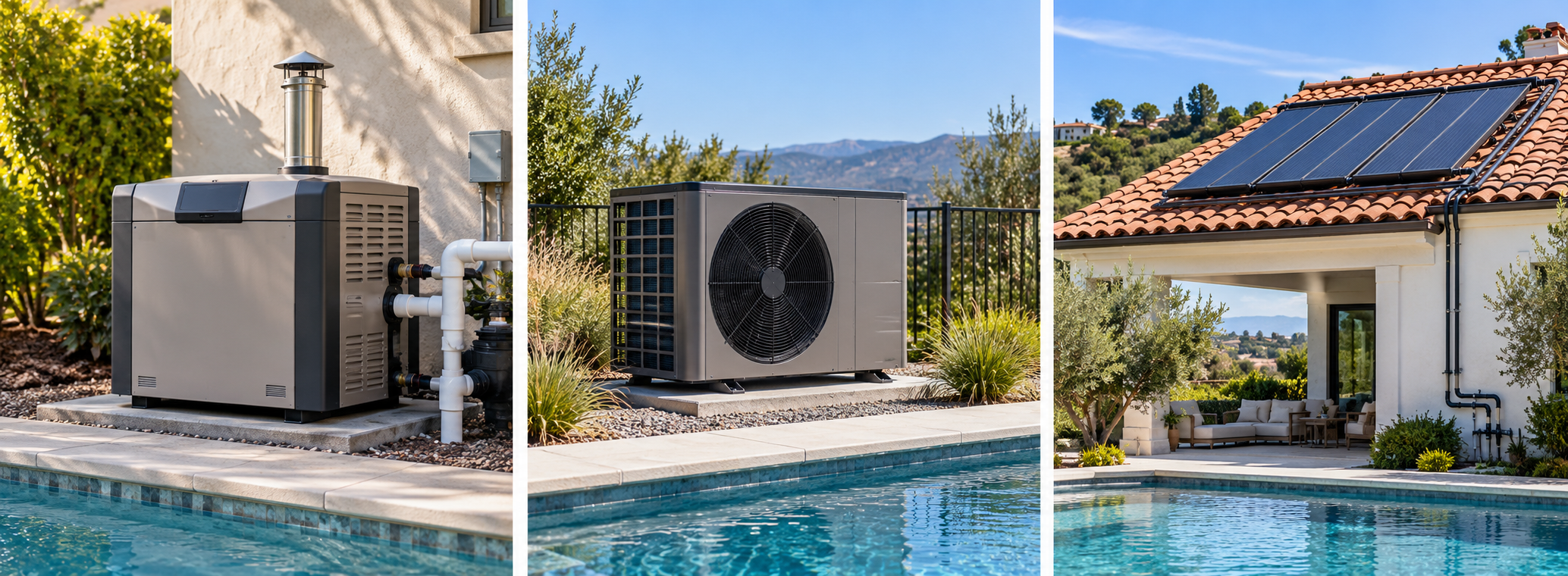
The best pool-heating choice depends on how quickly the pool must heat, the climate and season, available utilities, cover use, installation site, and how long the owner expects to operate the system. There is no universal payback or cheapest technology.
Cost orientation
Use the U.S. heater-installation observation of roughly $1,864–$4,348 as a broad starting scale for a conventional installation, not as a price for every technology. Gas, heat-pump, and solar systems may require different utility, pad, controls, plumbing, or collector work. Build a local scenario with installed equipment, cover use, expected season, energy rates, maintenance, and site prerequisites instead of claiming a universal payback.
Compare the technologies by the job they must do
Gas, heat-pump, and solar systems can all be reasonable in the right setting, but they solve different heating problems. Gas is often considered when faster recovery or occasional high-output use matters. The relevant quote questions include fuel availability, capacity, venting, controls, and local approvals. A gas option can be a poor fit when the fuel connection is expensive or the operating pattern does not justify it.
Heat pumps depend on outdoor conditions, electrical supply, airflow, and the temperature the owner wants to maintain. The comparison should identify the expected performance conditions rather than relying on a single efficiency label. Placement matters: restricted airflow, noise sensitivity, or a poor drainage arrangement can affect the practical result. Solar heating depends on collector exposure, available area, plumbing route, controls, and the season in which the pool is expected to be warm. It may be attractive for a seasonal pattern but less suitable when the owner expects consistent heating through low-sun periods.
Use scenarios instead of a generic payback
For frequent warm-season use, compare installed cost, cover performance, expected runtime, utility rates, maintenance, and how the system behaves during the shoulder season. For occasional use, include response time, standby exposure, controls, and whether a large fixed installation is worthwhile. For a cold or shaded property, ask the contractor to explain the effect of weather and the realistic swimming window. For a pool-and-spa system, make sure the bid states whether the heating objective is the pool, the spa, or both and whether the equipment can support the requested operating modes.
The cover is part of this decision. Heat lost while the pool is uncovered can overwhelm the apparent difference between technologies. A cover that is damaged, poorly used, or absent should be identified as a separate ownership issue. The comparison should also include opening, closing, freeze protection, and access for future service.
Questions for comparable bids
Ask each installer to state the design assumptions, target temperature, season, cover condition, utility basis, equipment capacity, site prerequisites, controls, permits, startup, warranty, and exclusions. Ask what happens if the required fuel, electrical capacity, collector area, airflow, or plumbing route is not available. Do not treat an estimated payback as portable from one property to another; the number depends on local climate, rates, use, and installation scope.
Decide when payback is unknowable
An estimated payback depends on local climate, energy rates, runtime, cover use, starting water temperature, maintenance, and installation conditions. If those inputs are not available, preserve the uncertainty instead of publishing a universal result. Use the U.S. installation observation as a broad scale marker only; it is not a technology-specific Canadian price. Obtain local quotes in the relevant currency.
Before choosing, ask for product documentation, compatibility, warranty, utility requirements, controls, commissioning, exclusions, and the condition that triggers added work. The best option is the one that meets the use pattern and can be supported by the site and owner.
Keep the comparison measurable
At handoff, retain the chosen technology, model, capacity, utility or collector assumptions, controls, cover assumption, startup, warranty, and maintenance contact. After use begins, record runtime, cover use, target temperature, weather, energy or fuel, recovery behavior, and actual swimming season. These records show whether the decision met the owner’s need without turning one property into a universal recommendation.
If performance is different from the proposal, first check the stated assumptions and qualified service path. Do not change fuel, electrical, controls, or system settings from generic cost guidance. A future replacement or upgrade should use the original installed record and local operating history.
Compare the tradeoffs by operating objective
| Owner objective | Questions that shape the estimate |
|---|---|
| Fast recovery for occasional use | Is fuel available, what startup time is assumed, and what venting or control work is included? |
| Frequent warm-season use | What local utility rate, weather range, runtime, cover practice, and target temperature drive the estimate? |
| Seasonal solar contribution | What collector area, site exposure, plumbing route, controls, and usable season are assumed? |
| Pool and spa share equipment | Which operating mode is prioritized and what happens when both heating demands overlap? |
These are comparison prompts, not predictions about which option will perform best. A provider should use the actual property, pool, climate, and product documentation. Keep product capacity separate from energy cost, and identify any infrastructure upgrade needed before the selected system can operate.
A homeowner can reject a proposal that lacks the assumptions needed for comparison without rejecting the technology itself. Ask for a revised estimate with the same target season and use case as competing bids. If the provider cannot support a precise energy or payback claim, preserve the unknown rather than choosing a technology from an unsupported savings promise.
Key points
- Compare complete installed and operating scenarios, not equipment labels alone.
- Gas, heat pump, and solar systems have different site and utility prerequisites.
- Cover use, climate, temperature, and schedule can outweigh the headline technology choice.
- Avoid universal payback claims without local assumptions.