
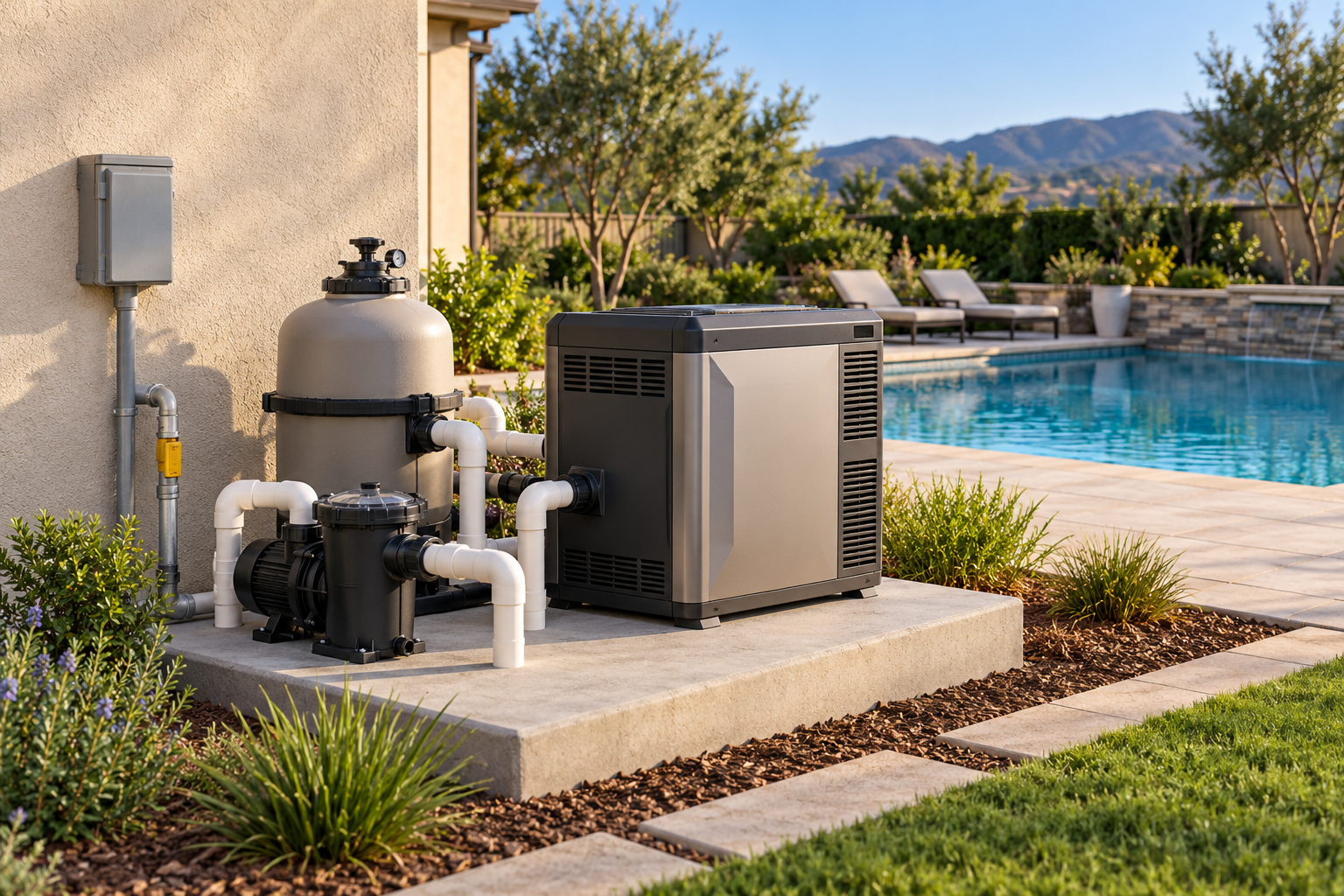
Installing a pool heater is an equipment and utility project. The heater itself may be only one quote line; plumbing, controls, electrical or fuel work, equipment-pad changes, venting, access, cover use, and startup can control the final scope.
U.S. and Canada
Utility, fuel, electrical, permit, and inspection requirements are local. Ontario homeowners, for example, should use the Electrical Safety Authority’s guidance and a Licensed Electrical Contractor for applicable pool work; that guidance is not a Canada-wide code or price schedule. Confirm the rules for the actual property.
Cost orientation
A current U.S. specialist observation places pool-heater installation around $1,864–$4,348. Treat that as an installation signal with uncertain inclusions, not a universal installed total. Confirm whether heater, plumbing, gas or electrical work, venting, pad changes, controls, commissioning, permits, inspection, cover coordination, and disposal are included. Canadian fuel, utility, permit, and labor costs require local quotes.
Build the installation around the site
The equipment choice is only one part of the installation decision. The contractor should confirm where the heater will sit, how service clearances will be maintained, whether combustion air or airflow is adequate, and how water will move through the heater without creating an unsuitable pressure or bypass condition. A replacement in an existing pad can be more involved than a new installation if the connections, controls, or clearances do not match.
Utility scope deserves its own review. A gas or propane heater may need a fuel-line assessment, regulator or meter capacity review, venting, and local approval. A heat pump may need a new or upgraded circuit, disconnect, grounding and bonding interfaces, and a placement that does not obstruct airflow or create a nuisance. Solar work may add collector, roof, structural, plumbing, and control questions. These are examples of scope to verify with qualified trades, not instructions for homeowner installation.
Size for the intended use
The relevant question is not simply whether a heater can raise the water temperature. Ask the installer to describe the target season, desired temperature, pool and spa use, cover habits, wind and shade exposure, and expected recovery time. A system intended to maintain a temperature for frequent use may be evaluated differently from one used for occasional weekend heating. If the pool and spa share equipment, request separate assumptions for each operating mode.
Operating cost should be shown as a scenario, not a promise. Include expected runtime, utility rate or fuel basis, cover use, maintenance, winterization, and likely replacement exposure. A heater that is rarely used may not justify extensive utility work, while a frequently used pool may justify better controls or a cover upgrade. The most useful quote makes those assumptions visible so the owner can change them.
A practical quote review
Before comparing bids, ask whether each includes the same heater capacity and technology, pad and connection work, controls, utility work, permits, inspection, startup, training, disposal, warranty, and weather protection. Confirm who is responsible for coordination when more than one trade is involved. Ask what is excluded if the site assessment finds inadequate electrical, fuel, drainage, airflow, or structural support. Keep any local legal conclusion tied to the actual jurisdiction; general standards and manufacturer requirements do not automatically establish local law.
Retain the commissioning record
Keep model, capacity, utility assumptions, connections, controls, startup, permits, warranty, cover assumptions, and service information. Compare actual runtime, recovery, energy, noise, and access after the first season. If the result differs from the proposal, obtain qualified review rather than altering utility or controls from generic guidance.
Ask which work is required before the heater can be ordered
A site assessment can identify utility and placement constraints before a product is purchased. Confirm the equipment-pad location, service clearance, drainage, access route for removal, connection points, and how the selected heater will be controlled by the existing system. For fuel-fired equipment, the fuel professional should confirm the property’s supply and venting requirements; for electric equipment, the qualified electrical professional should confirm the available supply and required work. The installer should identify any prerequisite rather than treating it as a small allowance after delivery.
The quote should show a dependency sequence: site and utility confirmation, product selection, permit or inspection steps, equipment and connection work, commissioning, and owner orientation. If an inspection or utility change can delay startup, state who coordinates the visit and whether a return trip is included. These scheduling details have cost consequences when the pool’s planned opening date is fixed.
If replacing an existing heater, photograph or document the current connections and model before removal. This does not prove the new unit is compatible, but it gives the installer a record of what was present and helps distinguish a like-for-like connection from a redesign. Keep any change to controls, pump settings, cover or automation as a separate decision.
Verify the connection between heater and pool controls
A replacement unit can fit the pad but still need changes to the circulation or control arrangement. Ask how the pump, bypass or valves, temperature sensor, automation panel, and heater communicate or operate together. The installer should identify whether the proposed scope is a direct replacement, a change in heating technology, or a new operating mode. If a pool and spa share equipment, make the control and heating assumptions for each mode explicit.
For a new installation, the plan should account for water routing, equipment clearances, airflow or venting, drainage, sound, and service access. The selected product manual and qualified trades determine the actual requirements; a general cost article cannot size a heater or approve an electrical or fuel connection. A quote should explain what happens if the site visit finds inadequate supply, a blocked service path, or a need to move adjacent equipment.
At commissioning, the owner should receive the model, settings, operating instructions, warranty registration, startup or inspection records, and service contact. Ask who explains the relationship between the heater, cover, schedule, and intended temperature. The documented setup becomes the baseline for comparing actual energy and performance after the first season.
Key points
- Budget heater, connections, controls, commissioning, and permits as separate layers.
- Technology choice changes the utility and installation requirements.
- Cover use and climate affect operating economics.
- Do not publish or approve a heater size without qualified system assessment.