
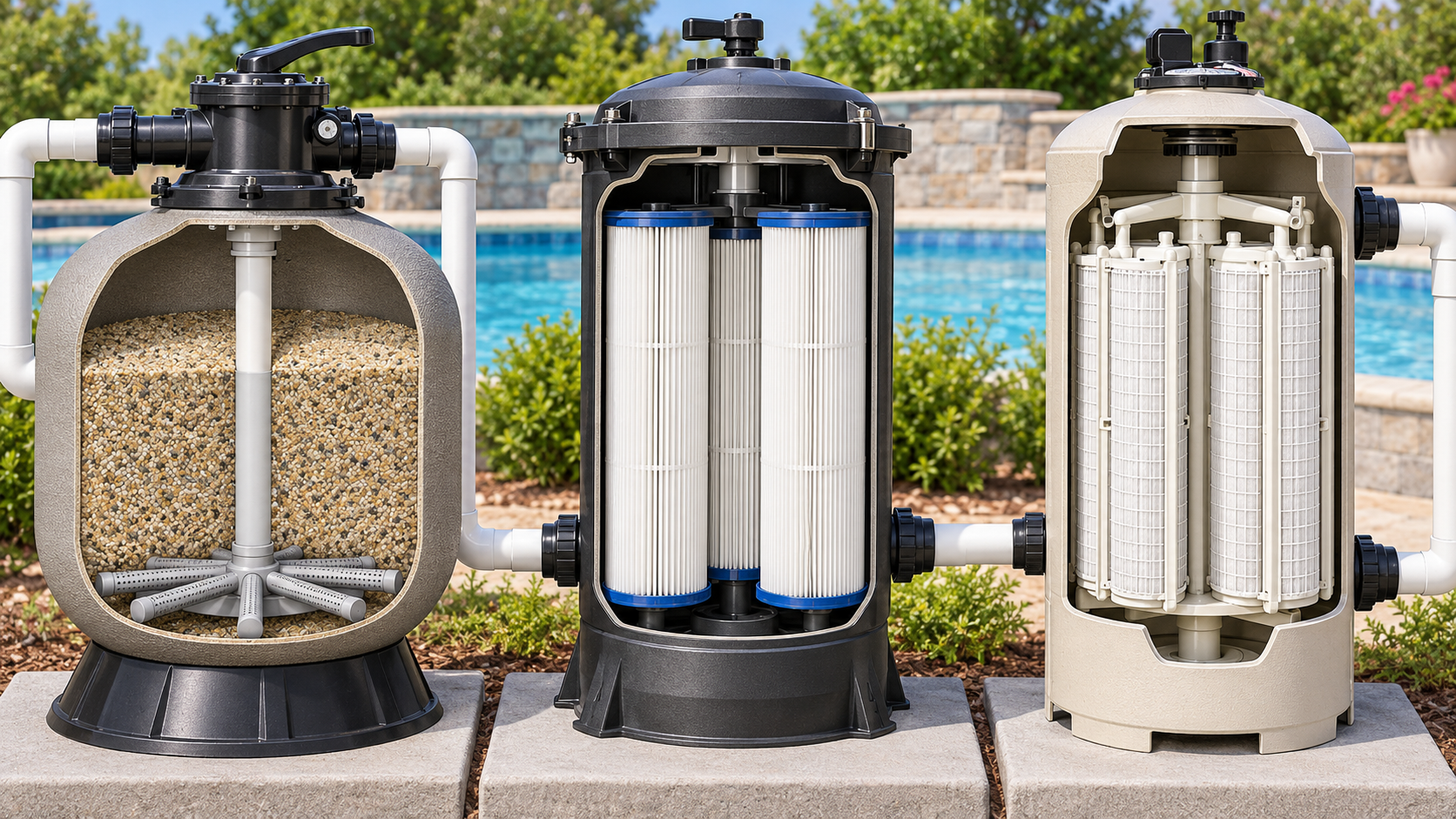
Filter choice is an ownership decision. The least expensive equipment may not be the least expensive or least disruptive option once cleaning labor, media, water, discharge, equipment footprint, and compatibility are included.
How the systems differ
| Filter type | Ownership pattern to compare | Questions for the quote |
|---|---|---|
| Sand | Vessel, sand or other media, valve, periodic cleaning, and media service | What backwash or discharge arrangements are allowed locally? |
| Cartridge | Vessel, cartridge cleaning or replacement, water handling, and access for removal | What cartridge size, replacement cost, and cleaning service are expected? |
| DE | Vessel, DE media, cleaning, handling, and product-specific maintenance | What media, disposal, safety, and local discharge rules apply? |
The exact filter, pump, valve, and hydraulic arrangement must be matched to the pool. Manufacturer and qualified technical information should control performance and compatibility claims.
Cost orientation
The U.S. specialist observation of roughly $250–$2,000 for filter installation gives a broad equipment-changeover scale, not a guaranteed price for each filter type. Compare vessel, media, valves, plumbing, access, disposal, water use, cleaning labor, and local discharge requirements. A lower purchase price can shift cost into maintenance or water handling; ask for an installed quote and an annual ownership scenario.
Match the filter to the operating pattern
The right comparison starts with how the pool is used and how the equipment pad can be serviced. A frequently used pool may make cleaning labor and recovery after heavy use more important than the initial vessel price. A lightly used seasonal pool may place more weight on storage, opening and closing service, and the owner’s willingness to perform periodic maintenance. Neither pattern makes one filter type universally correct.
Access is a practical cost issue. The vessel, lid, valve, cartridge, or media must be reachable without dismantling unrelated equipment. A filter that fits on paper may be expensive to service if the pad is crowded, the cover cannot be removed safely, or discharge must be carried through the house or across finished landscaping. Ask the installer to show where service access and removed media will be handled.
Water, media, and disposal decisions
Backwash, rinse, cartridge-cleaning water, and DE handling are different ownership tasks. Local rules may restrict where water can go, and the property may not have a convenient discharge point. A proposal should identify the intended method rather than assuming a generic backwash arrangement. For DE, ask what product is used, how spent material is contained, and who handles disposal. For cartridge systems, ask whether cleaning is included in a service plan and how a replacement cartridge will be identified. For sand systems, clarify the media type, change interval assumptions, and valve maintenance.
The filter should also be considered with the pump and sanitizer. Flow demand, pressure behavior, automation, heater requirements, and the condition of existing plumbing can change the value of a filter change. If a contractor recommends a larger or different filter, ask what problem it solves and what operating evidence supports the recommendation.
Review the first year as an ownership test
After a season, record cleaning time, water handling, media or cartridge use, pressure changes, service visits, discharge constraints, and any pump or circulation issue. The result can show whether the selected filter suits the owner’s routine even if the initial installation was sound. A filter comparison should therefore include a simple process for updating the annual maintenance assumption.
If the owner changes service provider or sells the property, retain model numbers, media or cartridge information, valve details, cleaning method, and any local discharge requirement. These records prevent a future replacement from being chosen solely by appearance or vessel size. They also help distinguish a filter problem from a pump, plumbing, sanitizer, or water-quality problem.
Compare ownership tasks over a full season
The practical difference among filter systems is who does what and where the by-products go. A sand system may place attention on valve operation, backwash water, media service, and periodic vessel access. A cartridge setup places more attention on removal, rinsing or cleaning, drying, storage, and cartridge replacement. A DE system adds product handling and spent-media disposal. Follow each manufacturer’s current instructions and local discharge rules; those tasks are not a performance ranking.
For each option, ask a service provider for the time and materials associated with a normal cleaning visit, the price of media or cartridges, and the additional charge when the filter needs deeper service. A self-managing owner should consider access and safe handling as well as purchase cost. A service company should specify whether filter work, media, and wastewater management are part of its annual price.
At the start of the season, record filter model, initial pressure or other baseline, media type, and service condition. After the season, compare cleaning frequency, water use, service visits, media cost, and any recurring circulation symptom. If the experience is poor, assess pump, valves, water chemistry, and hydraulic design before assuming a different filter type is the only remedy.
Key points
- Sand, cartridge, and DE systems have different labor, water, media, and disposal profiles.
- Local discharge rules can change the practical economics.
- Compare changeover plumbing and pump compatibility, not just filter prices.
- Use product and qualified technical information for performance and sizing.