
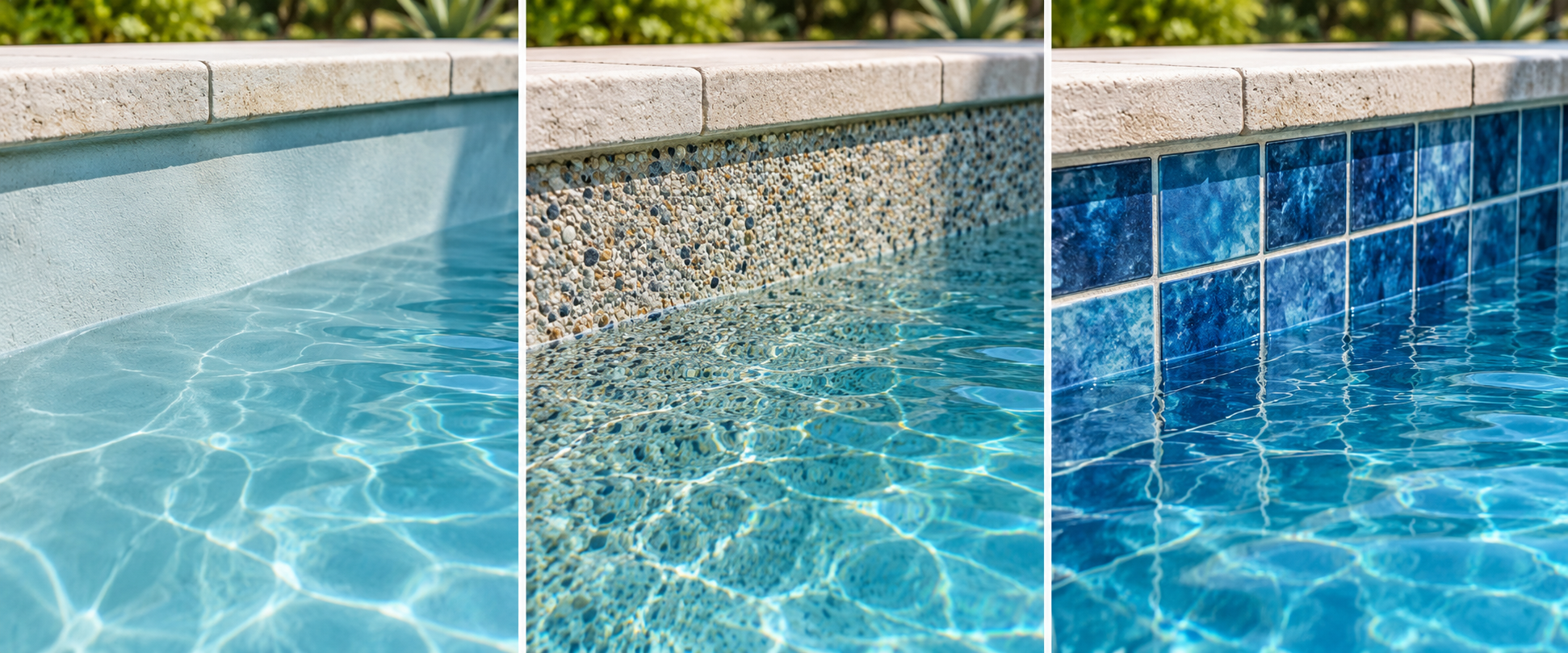
Finish choice changes the initial resurfacing scope, texture, appearance, repair approach, and future maintenance. It should be compared as an installed system, not as a material sample or a fixed lifespan promise.
How the options differ
Plaster is a cementitious interior finish that may offer a comparatively straightforward resurfacing scope when preparation and shell condition are suitable. Pebble or aggregate finishes add selected aggregate and a different texture and appearance; the installation and preparation details matter. Tile can be a waterline detail, feature, or extensive interior finish, with material, layout, substrate, and labor premiums that vary widely.
These labels do not establish quality, comfort, or service life by themselves. The PHTA plastering standard is the appropriate technical source class for cementitious finish work; the market sources show that installed ranges and inclusions vary.
Cost orientation
Use the U.S. resurfacing observation of about $6,000–$15,000 as a broad finish-project scale marker, not as a price for every plaster, aggregate, or tile choice. Tile-heavy work, preparation, coping, waterline details, access, and shell-related repairs can change the scope substantially. Compare complete installed finish options and future maintenance in local currency; do not mechanically convert the U.S. signal for Canada.
Compare the installed system, not the sample
The material sample is only one part of the decision. Compare the preparation, draining, access, application, waterline details, fittings, steps, shelves, coping, refill, startup, and warranty for each option. A less expensive finish can become a more expensive project when the scope excludes preparation, perimeter work, difficult access, or repairs that the alternative includes.
Also separate the finish from the shell. Plaster, aggregate, and tile are interior systems; they do not by themselves establish the condition of the vessel or supporting structure. Movement, recurring water loss, displaced coping, or a damaged substrate should be evaluated before an owner chooses a new finish.
Choose for the use and the site
An owner prioritizing a straightforward renewal may prefer a finish with a simpler installed scope when the shell and preparation are suitable. An owner prioritizing texture, appearance, or a feature may accept more specialized labor and matching risk. Extensive tile may be appropriate for a design goal or selected feature, but it should not be compared with a basic finish using material price alone.
Access, climate, pool shape, waterline detail, attached spa, deck condition, and the ability to protect finished surfaces during installation affect all three choices. If a future renovation will disturb the coping, lights, fittings, or automation, coordinate that work before the finish is installed.
Three comparison scenarios
In a simple scenario, the shell is stable, the surface is accessible, the measured area is known, and each bidder prices the same finish boundary, refill, startup, and warranty. In a typical scenario, the owner compares preparation, steps, benches, tile, coping, access, and future spot repair while keeping the pool’s core equipment unchanged. In a complex scenario, movement, water loss, extensive tile, difficult access, or deck and drainage work controls the decision before finish selection.
Use the U.S. resurfacing observation of approximately $6,000–$15,000 only as a broad finish-project scale marker. It is not a price for every material and does not establish Canadian cost. Request local U.S. or Canadian proposals that identify the actual finish, labor, preparation, features, waterline work, and startup.
Compare how each finish changes repair options
The economic difference is not limited to what is installed on day one. Ask whether a local provider can repair the selected surface in a limited area, how visible a patch may be, and whether the material, color, or texture is likely to remain available. A surface that can be matched from a recorded product specification gives the next contractor more information than a finish described only as “pebble” or “premium.” Availability can vary by manufacturer and region, so treat it as a local service question.
For plaster or another cementitious finish, ask how the quoted preparation and application relate to the existing substrate and the technical requirements used by the contractor. For aggregate, clarify which aggregate, texture, and exposure are included, and what appearance variation is acceptable. For tile, distinguish an accent or waterline from a tile-dominant interior; area, layout, substrate, grout, and replacement matching all affect future work. These distinctions help explain the estimate without claiming a guaranteed life for any system.
Create a comparison row for the same pool that records: selected finish; measured area; preparation; steps and shelves; waterline and coping; startup; local repair provider; warranty; and exclusions. A bid that prices a small sample or material allowance cannot be compared with one that includes the complete installed system. Keep shell movement and water loss as separate assessment questions rather than assuming the most expensive finish resolves them.
The choice should reflect the owner’s preferred appearance and maintenance routine as well as installation cost. If the owner is likely to change the pool or coping soon, a finish that will be disturbed by that work may be a poor sequence even if its initial price is attractive.
Treat installation quality and water care as part of the economics
The material label does not predict the result by itself. Compare the contractor’s preparation and installation scope, product documentation, startup plan, and the maintenance expectations the owner can realistically follow. If a bidder claims that one finish tolerates a water condition or needs less care, ask for the specific product instructions and the conditions behind that claim rather than generalizing to every plaster, aggregate, or tile system.
Repairability is a separate lifecycle variable. Ask whether the selected product remains locally available, whether a small damaged area can be treated independently, what color or texture mismatch could result, and whether the contractor has a process for documenting the installed system. Extensive tile, accent tile, and a basic interior finish have different repair areas and interfaces; the comparison should name what is installed rather than rely on a broad material category.
Keep installation and water-care responsibility clear. The contractor should state when the owner may return the pool to service, what startup tests or care instructions apply, which products or readings affect the warranty, and whom to contact if the finish changes during the initial period. Do not invent an expected lifespan to rank the options; compare documented product terms and local serviceability.
Key points
- Finish categories have different installed scopes and maintenance tradeoffs.
- Plaster, aggregate, and tile should not be compared by material price alone.
- Installation quality, preparation, chemistry, and hidden movement affect lifecycle results.
- A finish selection cannot substitute for a shell or substrate assessment.