
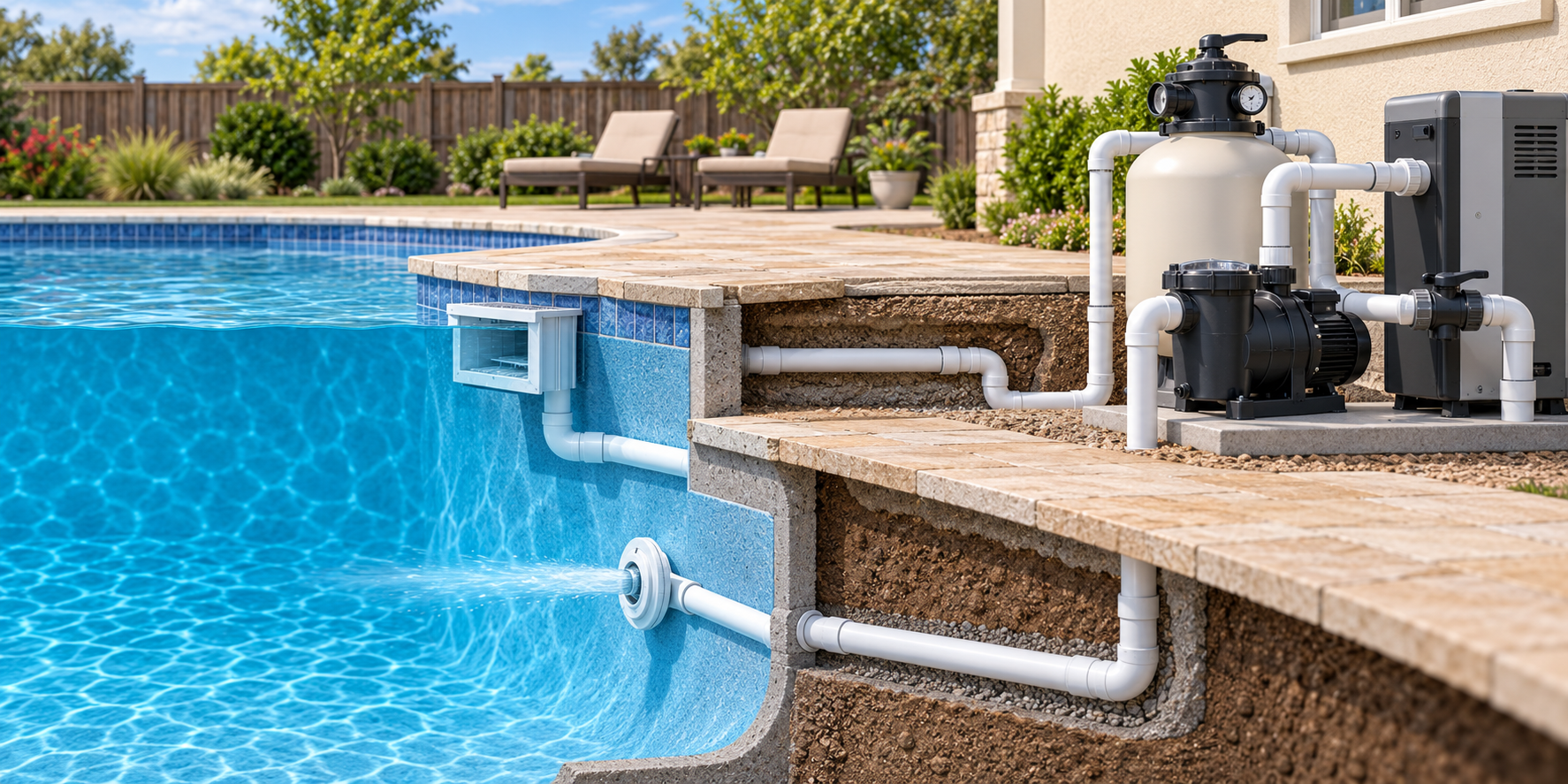
Pool hydraulic plumbing includes skimmers, drains, returns, suction and pressure lines, valves, equipment-pad piping, and interfaces with pumps, filters, heaters, and sanitation equipment. It is related to household plumbing but is not the same decision.
Cost orientation
Component observations help show why pool-plumbing quotes vary. Current U.S. specialist signals place pump replacement around $700–$4,000 and filter installation around $250–$2,000; neither is a buried-line repair price. A plumbing quote should identify testing, excavation, pipe or fitting work, backfill, surface restoration, startup, and warranty separately. Use local site-specific pricing, especially in Canada, rather than converting these equipment figures.
Map the hydraulic system before pricing it
Pool plumbing is connected, so a visible symptom may not identify the failed part. Share the pool type, equipment models, recent repairs, wet areas, water-level history, and whether the symptom changes with pump operation or valve setting. That helps a professional choose a visual inspection, leak detection, pressure test, equipment diagnosis, or access plan.
For future service, keep a simple as-built sketch that distinguishes confirmed line routes from assumptions. Note which branch, fitting, or equipment area was tested and where an excavation or surface repair stopped. A diagram can reduce repeat diagnostic work, but it is not a substitute for pressure testing or a complete system assessment.
Accessible, fitting, and buried scopes
An equipment-pad repair may involve a union, valve, gasket, pipe section, pump connection, filter, heater bypass, or control-related flow issue. It can be relatively contained when the cause is clear and the surrounding components are dry and serviceable. Ask whether the quote includes disconnection, replacement parts, reconnection, leak verification, startup, and cleanup.
A skimmer, return, drain, or wall fitting involves the pool interface as well as the pipe. The work may require lowering the water, removing a faceplate or fitting, repairing the surrounding material, and restoring the finish or liner. A fitting that appears loose can also reflect movement or a damaged surrounding surface, so a part-only price may not be a complete scope.
A buried line creates a different project. The contractor may need to locate the line, isolate the suspected section, test it, excavate, repair the pipe or fitting, backfill, and restore a deck, patio, planting bed, or other surface. Access equipment, disposal, soil, groundwater, and the length of the repair route can matter more than the pipe material. Ask for a provisional allowance rather than treating an uncertain buried-line diagnosis as a fixed repair.
What testing can and cannot establish
Pressure or leak testing can help narrow the problem, but the result depends on the system configuration and the test performed. Ask which line or component was isolated, what was observed, what remains uncertain, and whether the test includes the equipment pad, attached spa, water feature, or other branches. A test that identifies one leak does not prove that a second problem is absent.
Keep suction and pressure work with a qualified pool professional. Do not alter drain covers, block lines, make improvised connections, or operate equipment that is visibly damaged or leaking. Safety-related concerns require current product, standard, and local review.
Cost scenarios
The simplest scenario is an accessible valve, union, gasket, or short pipe repair with a confirmed cause and no surface restoration. A moderate scenario may add draining, a skimmer or return fitting, equipment disconnection, testing, refill, and startup. A complex scenario includes buried access, deck or landscape restoration, multiple lines, freeze damage, uncertain leakage, or coordination with structural or electrical work.
These are scope patterns rather than universal prices. The pump and filter market observations sometimes used for context do not price pool plumbing, excavation, or restoration. Use local U.S. or Canadian quotes and keep any market signal tied to the work it actually describes.
When another project becomes dominant
Pool-specific hydraulic work remains here when the recreational-water system is the main decision. Independent household plumbing belongs in the plumbing category. Broad excavation, deck or hardscape replacement, major demolition, insurance restoration, or electrical infrastructure may need separate scopes when they become the dominant project. Ask the pool contractor to identify those interfaces so the complete budget does not disappear between bids.
Close out hydraulic work with testing records
The owner should receive the affected line or fitting, parts used, test method and result, leak verification, startup condition, photographs where access was opened, warranty, and any unresolved branch or surface issue. If excavation or a skimmer or return fitting was involved, retain restoration records and note which areas were not opened.
Ask what to monitor after the repair: water level, pressure, air, flow, wet areas, equipment noise, or a return of the original symptom. Monitoring is not a substitute for qualified service, but it helps identify whether the repair resolved the expected problem. Keep suction, drain, pressurized, electrical, and structural boundaries with the appropriate professional.
Match the repair method to the pipe location
An equipment-pad connection may be visible and reachable without opening a deck, but its cause can still involve a valve, seal, pump connection, heater bypass, or a control-related flow condition. A skimmer or return is different because the pool wall or liner interface may need repair as well as the pipe. A buried run can be longer than the spot that is ultimately repaired, and the route may cross more than one finished surface. These scopes should be identified separately before the owner compares labor or material amounts.
Ask whether the provider will test a line before excavation, how the line is isolated, and what the result says about adjacent sections. If a contractor offers a fixed excavation price, clarify how length, depth, soil, groundwater, and a hardscape crossing affect the amount. A written change process is especially useful where the repair could extend under a deck or planting area.
After work, keep the line identification, fitting or valve part, test conditions, leak check, backfill, restoration, and warranty. Note any section that remained buried and untested. If a later contractor sees air, weak flow, wet soil, or water loss, this record narrows the next assessment without implying that every branch is known.
Key points
- Pool plumbing is a specialized hydraulic system, not ordinary household plumbing.
- Buried-line access and restoration can dominate the quote.
- Ask what was tested, what was located, and what is still uncertain.
- Do not make suction, drain, or pressurized-system changes without qualified assessment.