
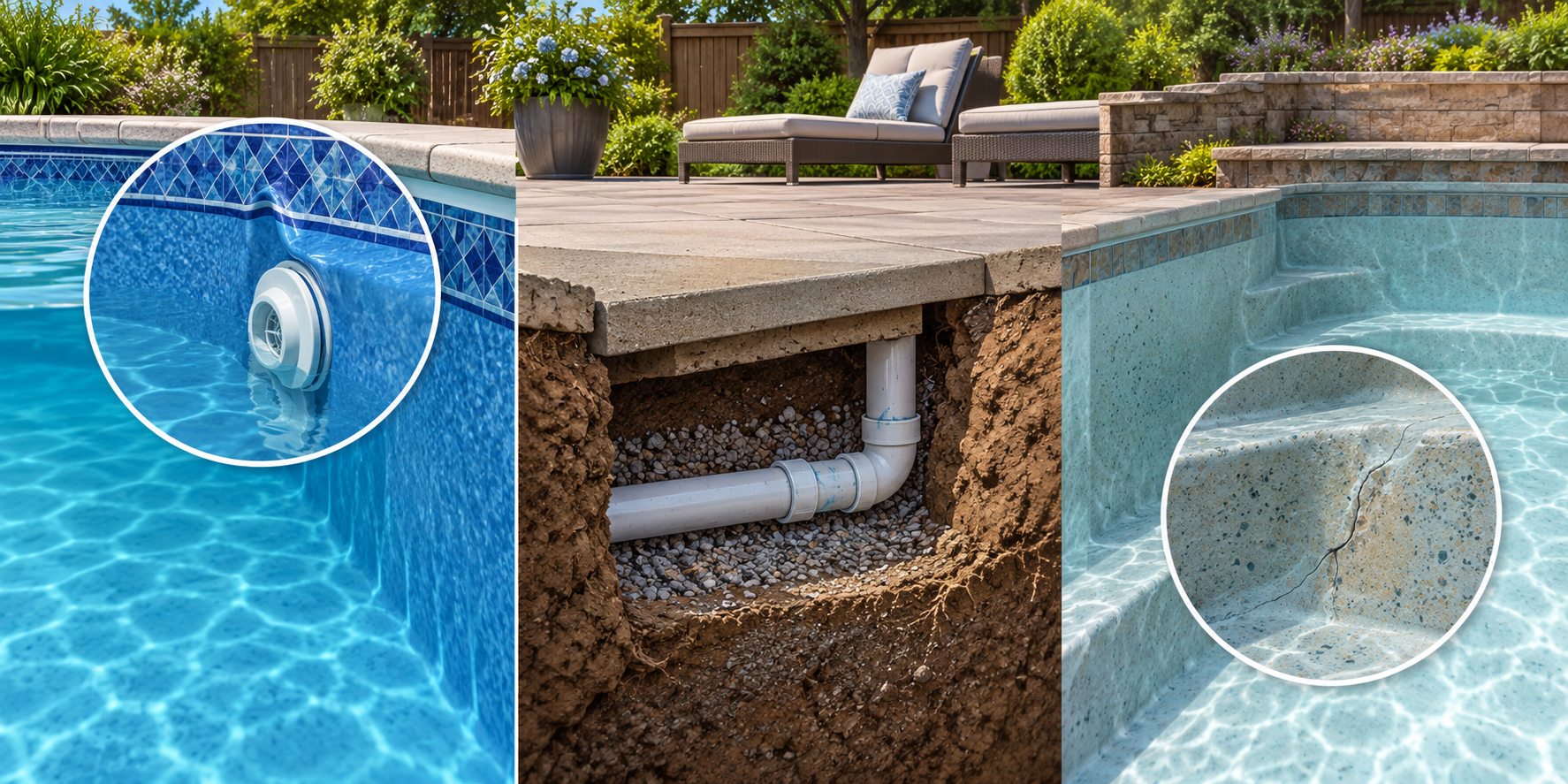
Once water loss is confirmed, the repair budget depends on location, access, and what must be opened or restored. Water loss does not by itself prove that the shell is cracked or that the buried plumbing has failed.
Safety boundaries
Do not improvise suction fittings, drain covers, electrical connections, gas work, or structural shell repairs. Use a qualified professional when the leak involves those systems or when repressurization could expose hidden damage.
Cost orientation
Use leak detection as the first cost marker: a current U.S. specialist observation is about $100–$1,000, before repair. The repair itself cannot be responsibly represented by one range because an accessible fitting, equipment-pad leak, buried line, liner, and shell-related problem require different access and restoration. Compare a confirmed repair scope with allowances for excavation, deck or landscape restoration, and follow-up testing. Canadian pricing must come from local quotes.
The location determines the repair path
Once water loss is confirmed, the next decision is where the system is losing water and whether the location explains the full symptom. A visible fitting, equipment-pad connection, liner puncture, buried return or suction line, shell crack, overflow, or attached feature can require different labor, access, testing, and restoration. Water loss alone does not establish that the shell has failed.
Compare common repair scopes
Liner or accessible fitting: The quote may include water handling, a patch or fitting, gaskets and faceplates, local preparation, refill, and startup. Ask whether the liner is otherwise sound and whether the repair is expected to be temporary.
Equipment-pad leak: A valve, union, pump connection, filter, heater interface, or pressure-side component may be accessible, but surrounding equipment can also be affected. Separate the failed part from electrical, control, plumbing, testing, and cleanup work.
Buried line: A buried return or suction repair may require locating, pressure or other testing, excavation, pipe or fitting work, backfill, deck or landscape removal and restoration, and a final leak check. The pipe itself may be only one part of the project.
Shell-related leak: A concrete, fiberglass, or other vessel concern needs a qualified assessment before repair. The scope may include draining, access, crack or vessel work, structural or soil evaluation, resurfacing or refinishing, refill, and restoration. Do not accept a cosmetic patch as proof that movement or the cause of water loss has been addressed.
Repair, broader renovation, or replacement
A localized repair is more defensible when the vessel, surrounding system, and access are sound and the cause is clear. Broader renovation may be sensible when the leak coincides with an already planned finish, liner, equipment, coping, or safety project and combining the work avoids repeated disruption. Replacement or reconstruction deserves comparison when the leak is one of several signs of movement, systemic aging, obsolete equipment, or an unsuitable layout.
Do not use a fixed percentage of a new pool cost as a universal repair threshold. Consider the immediate repair, the probability of repeat access, the remaining condition of related components, the owner’s intended time in the home, and the complete alternative project. Canadian homeowners should compare local CAD proposals; U.S. market observations are not currency-conversion inputs.
Make the repair proposal follow the evidence
The repair estimate should carry forward the detection record: tested area, observed water behavior, method, limitations, location confidence, and any branch or feature not included. The provider should identify which result supports the proposed work and what remains an allowance rather than a confirmed defect.
Authorize the next step in stages when access may reveal more work. State the price and approval point for testing, draining, excavation, repair, refill, and restoration; ask the contractor to pause before extending the opened area or replacing another system component. Completion should include the agreed verification and a clear statement about any continued water loss. This keeps the owner from paying twice for an unexplained symptom while also avoiding a promise that one repair proves the whole pool is leak-free.
Compare the repair boundary with the evidence that located the leak
A confirmed repair estimate should identify whether the evidence points to a liner, fitting, equipment-pad connection, buried pipe, shell, overflow, or attached feature. The owner should be able to connect the diagnosis to the repair line. If testing only identified a leaking branch, the exact break length or restoration may remain uncertain; if a fitting is visible, nearby line condition may still be untested.
For each proposed scope, ask how water level, draining, refill, treatment, and post-repair verification are handled. A repair that requires lowering water may need a qualified determination of the level and duration for the actual pool. Excavation should identify the access path and surface restoration boundary. A vessel or shell repair should identify who provides any structural opinion and whether a finish or liner is included.
If the same area was repaired before, provide the invoice and test result. Ask what changed in the new diagnosis and whether the previous work is still under warranty. A repeated symptom may justify further assessment before a second patch, but it does not automatically prove that the previous repair or the entire pool has failed.
Key points
- Location and access control the repair scope more than the symptom label.
- Excavation and surface restoration can exceed the cost of the pipe or fitting.
- Shell, liner, equipment, and buried-line causes require different evidence.
- Separate confirmed repair from allowances and future renovation choices.