
Angi’s current U.S. page displays two unreconciled broad termite-treatment estimates: $75–$1,750 in Cost Insights and $263–$1,033 as the typical range based on 7,800 verified Angi Pro projects, alongside a reported $621 average. The page does not explain how these figures relate, so they are source-specific planning context rather than one reliable national range or average. A separate frequency estimate reports $200–$1,000 for a one-time treatment. Canadian homeowners need a local CAD quote because termite distribution, products, contractor practice, and treatment economics differ by region.
Inspection comes before method selection
Termite treatment is not chosen from a photograph or a generic “termite package.” A professional should identify the likely termite group, accessible activity, building construction, moisture and soil conditions, affected areas, and whether the evidence is active or historic. Ask what the inspection actually established before approving a method.
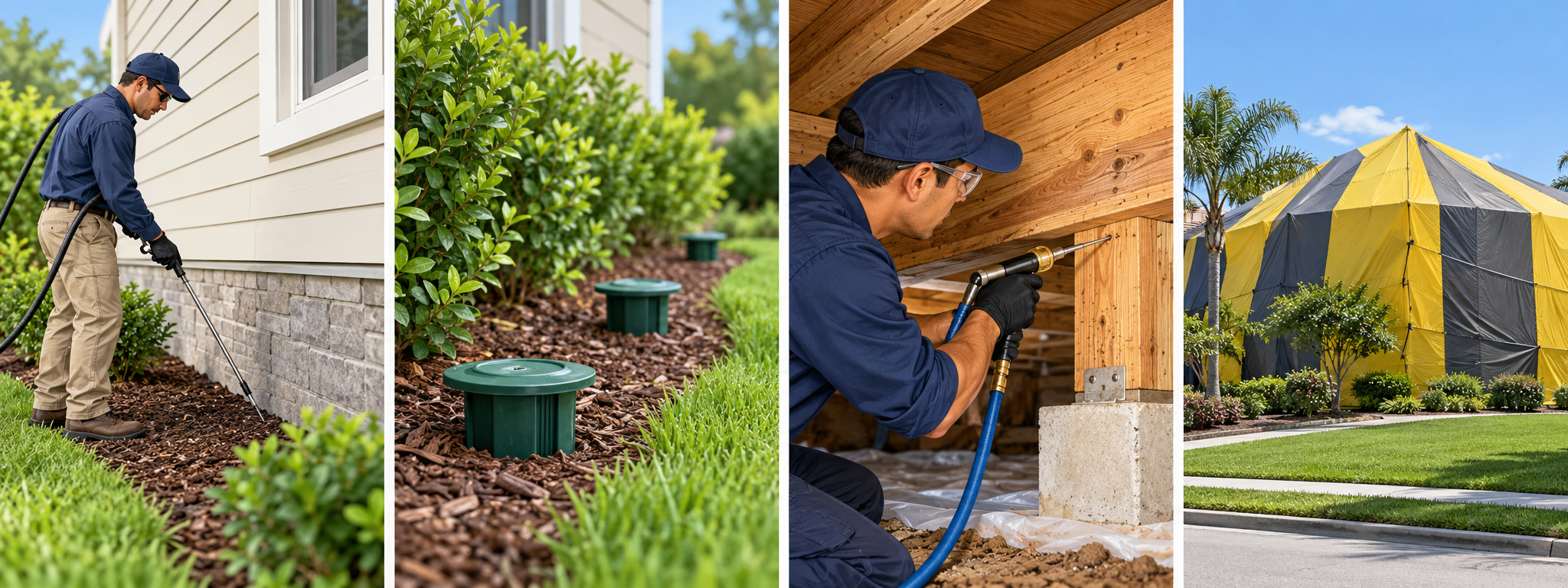
The main treatment paths
EPA guidance describes several broad approaches:
| Method | Economic shape | Important limitation |
|---|---|---|
| Liquid termiticide | Often priced by treated perimeter, zones, or a project total; may involve soil or foundation access | Product label, construction, site, and applicator requirements control |
| Bait system | Installation plus ongoing monitoring and replacement or replenishment where needed | The service plan and follow-up schedule are part of the cost |
| Wood treatment | Focused work on infested or exposed wood | Does not automatically address a colony elsewhere or future access |
| Physical or nonchemical barrier | Construction-specific prevention or control | Usually applies only where the building and installation allow it |
| Fumigation or whole-structure treatment | Large, coordinated scope with preparation and temporary displacement | Applies only to particular species, structures, and jurisdictions |
Market observations report chemical treatment around $3–$16 per linear foot, bait around $8–$12 per linear foot, and tenting/fumigation around $5–$20 per linear foot in the U.S. These units are not interchangeable: verify whether a provider means treated perimeter, structure length, square footage, or a flat project price.
What changes the total
The major cost drivers are:
- termite type and local prevalence;
- localized evidence versus a broad or concealed problem;
- home perimeter, additions, slabs, crawlspaces, basements, and access;
- drilling, trenching, soil disturbance, or treatment around hardscape;
- number of visits and monitoring period;
- warranty or protection-plan terms;
- repair of damaged wood, drywall, flooring, or moisture conditions;
- travel and labor-market conditions.
Home size matters, but it is not a complete proxy. A small home with difficult access or extensive concealed activity can cost more than a larger, accessible property with a bounded treatment area.
Follow-up is not an optional footnote
Ask whether the proposal is a single intervention, a treatment plus reinspection, or an ongoing protection agreement. A bait system usually has a monitoring component. A liquid treatment may have retreatment terms. A warranty may promise retreatment without covering structural damage. Read termite protection plans separately from the treatment price.
EPA also recommends care with pesticides: the product label controls application, and U.S. state licensing or Canadian product and provincial requirements may apply. Do not compare methods by chemical name alone or attempt to reproduce a professional application.
Treatment does not repair damage
The pest-control invoice may exclude weakened framing, flooring, trim, drywall, insulation, or moisture correction. Current U.S. market observations place termite damage repair around $600–$3,000, with severe structural repairs potentially reaching about $6,000, but actual cost depends on what is exposed after treatment and who evaluates it. Use a structural professional for load-bearing concerns and separate finish or moisture work into its own quote.
How to compare proposals
Ask each provider to state the suspected termite type, treated area, method, product or system category, preparation, number of visits, monitoring, warranty, exclusions, and damage-repair responsibility. Confirm whether the inspection fee is included or credited. A low treatment total that omits follow-up, access restoration, or repair may not be the lower total project cost.
Three treatment-cost scenarios
A localized, accessible infestation may need a focused treatment and a limited follow-up. A typical project can involve a perimeter or soil treatment, baiting or wood treatment, inspection of crawlspaces or basements, a warranty, and monitoring. A complex project may include difficult access, multiple structures, drywood or other geographically uneven termite conditions, fumigation, extensive preparation, or damage that must be repaired afterward.
Ask the provider which scenario the quote assumes. Home size alone is not enough. Perimeter length, slab or crawlspace configuration, soil and drainage, construction details, termite type, treatment history, and access can matter more than square footage.
Compare method and service obligation
The proposal should identify the treatment method, area, products or system category, preparation, drilling or trenching if relevant, monitoring, follow-up, warranty, and exclusions. A bait system may have a recurring monitoring obligation. A liquid treatment may have site and application constraints. Wood treatment may address a particular material rather than the whole structure. Fumigation is a separate specialized question.
Do not choose a method solely because it has the lowest installation price or uses less visible work. Ask what the method is intended to control, what it cannot establish, and how the provider handles a new or different species.
Budget the work after treatment
Termite control does not restore weakened framing, subfloor, flooring, drywall, trim, or finishes. It also does not automatically correct moisture, drainage, or wood-to-soil conditions. Read termite damage repair cost and price those items separately when the inspection identifies them.
What a strong treatment proposal explains
Ask the provider to connect each recommendation to an inspection finding. The proposal should identify the termite or WDO question, the structures included, the treatment boundary, the method, access conditions, preparation, monitoring, retreatment, warranty, and exclusions. If a price is based on perimeter length, home size, linear feet, stations, or another unit, ask for the measured quantity and the assumptions behind it.
Compare the first-year cost with the expected service period. A treatment with stations may include future inspections or monitoring. A soil or liquid program may include a warranty with annual inspection or retreatment conditions. A wood treatment may be narrower than a whole-structure program. Fumigation, where locally applicable, is a distinct high-consequence decision with displacement and re-entry work.
Treatment does not answer every building question
An inspection can find termites without proving that visible damage is active. It can find damaged wood without determining its load-bearing capacity. It can find a conducive condition without pricing moisture or drainage correction. Ask the provider to state what is known, what is suspected, and which specialist should answer the next question.
If a quote recommends drilling, trenching, removing finishes, or opening a cavity, ask who restores those surfaces. If it recommends structural repair, engineering, or replacement, obtain a separate proposal. Keeping those boundaries visible prevents a treatment allowance from becoming an unexplained whole-house budget.
U.S. and Canadian uncertainty
Termite distribution, methods, product availability, licensing, inspection conventions, and labor markets differ across the United States and Canada. A U.S. market observation can provide scale but cannot establish a Canadian price or local method. Request local CAD or USD quotes and verify the applicable product, professional, and transaction requirements.
A practical approval sequence
First confirm the inspection and the termite or WDO question. Then request a method-specific proposal with measured scope, access assumptions, first-year and later-year cost, warranty, and repair exclusions. Finally, obtain separate quotes for structural, moisture, finish, or access work identified during the inspection. This sequence keeps a treatment decision from becoming a substitute for a building diagnosis.
Make the proposal measurable
Ask the provider to state the treated area, method, access, first-year follow-up, renewal obligations, warranty, retreatment terms, and repair exclusions. If the recommendation depends on species, construction, soil, moisture, or an inaccessible crawlspace, those assumptions should be written down. Request a separate line for drilling, trench restoration, bait monitoring, interior access, or damage repair when applicable. A measurable proposal lets the homeowner compare methods and revisit the decision if inspection evidence changes.
Confirm the service endpoint
Ask what the provider will inspect after treatment, when retreatment is available, and whether the warranty covers only termite activity or also repair. Include the cost of required access, monitoring, renewal, and restoration in the comparison. If the proposal depends on a report, species identification, or an inaccessible area, keep that condition explicit. The goal is a treatment decision that can be checked later, not a one-time invoice that leaves the homeowner unsure what result was purchased.
Bottom line
Treat Angi’s displays as unreconciled U.S. specialist context, not one dependable market range, average, or bid. Method, perimeter, construction, species, access, follow-up, and damage repair control the real price. In Canada, obtain independent local CAD pricing and verify the treatment and licensing rules that apply to the property.