
Bait systems and liquid treatments are different termite-control strategies, not two labels for the same service. A U.S. market observation reports roughly $8–$12 per linear foot for termite bait and $3–$16 per linear foot for chemical termiticide, but these figures use provider-specific units and should not be treated as interchangeable bids. The relevant question is which method fits the identified termite, structure, site, product label, and follow-up plan.
How the approaches differ
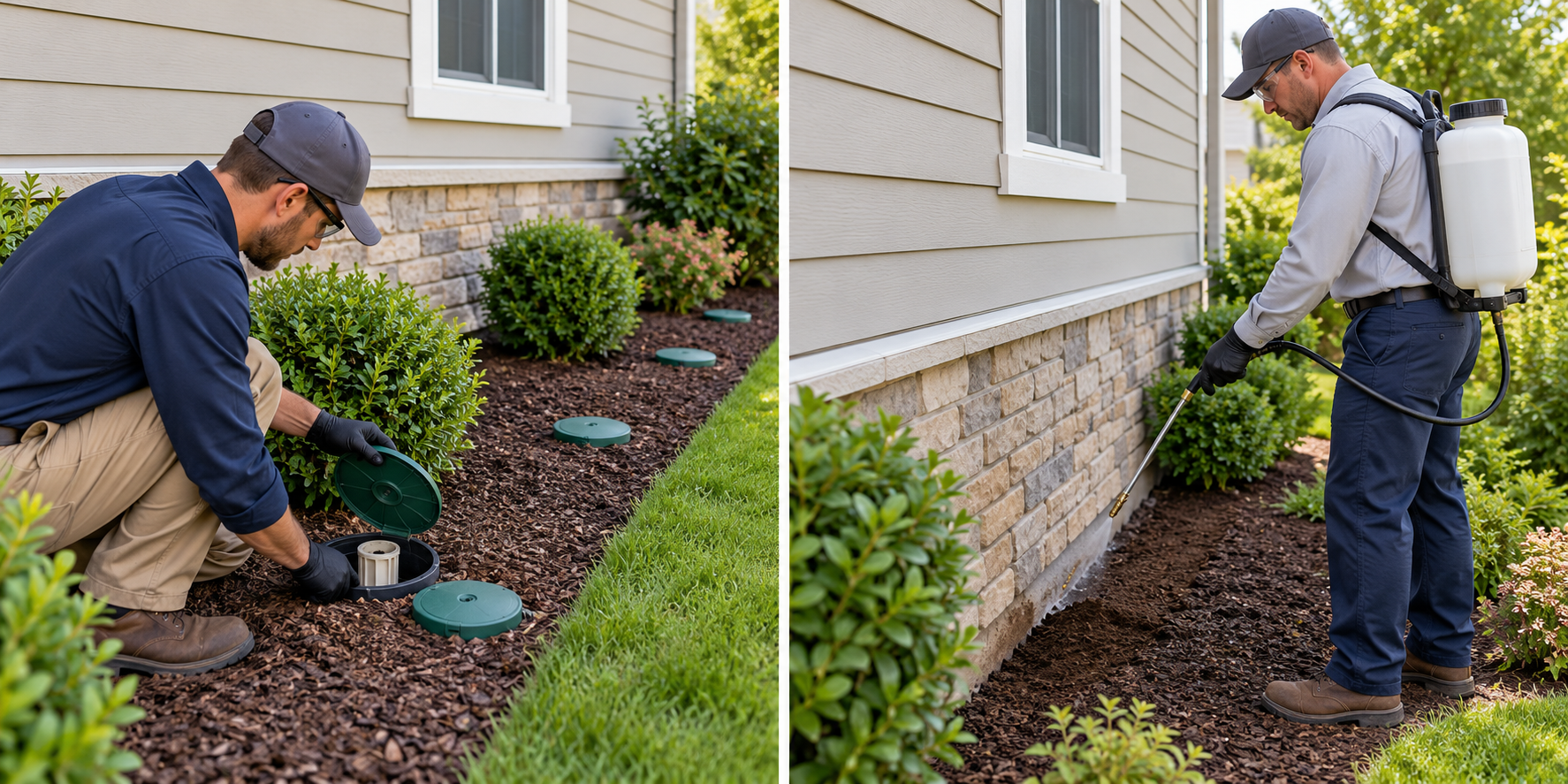
EPA describes liquid termiticides as a barrier or treated zone approach and bait systems as a monitored bait approach. The practical economic difference is the point at which labor and risk are paid for:
| Decision factor | Bait system | Liquid treatment |
|---|---|---|
| Initial work | Install stations in planned locations and establish monitoring | Treat soil, foundation interfaces, or other approved areas |
| Ongoing cost | Inspection visits, monitoring, and bait replacement where applicable | Retreatment, inspection, or warranty terms vary |
| Access issue | Yard layout and station access matter | Slabs, hardscape, foundation type, utilities, and soil access matter |
| Disruption | May avoid some drilling or soil treatment, depending on design | May require access work defined by the product and property |
| Decision pace | A monitoring strategy is built into the service | The chosen treatment is applied to the defined area |
| Guarantee | Often tied to monitoring and contract conditions | Often tied to treated areas and retreatment conditions |
Neither column is automatically safer, cheaper, faster, or more effective for every termite or building. Suitability requires inspection and professional judgment.
Compare total cost, not the installation line
For a bait proposal, add installation, scheduled monitoring, replacement or replenishment, emergency visits, and renewal. For a liquid proposal, add inspection, preparation, access restoration, drilling or trenching where applicable, retreatment terms, and any excluded repairs. Ask whether the quote is priced per linear foot, a treated zone, a square foot, or a flat project.
Angi’s termite-cost page gives $200–$1,000 as a one-time treatment estimate, while its other displays show $75–$1,750 in Cost Insights and a $621 average / $263–$1,033 typical range in the narrative, based on 7,800 verified Angi Pro projects. The page does not reconcile these measures, so treat them as source-specific context rather than one dependable one-time price. Recurring-service figures use separate annual, quarterly, or monthly units; compare the actual contract over the same period.
Questions about the site
Ask the provider how the method responds to:
- a slab, crawlspace, basement, addition, or inaccessible perimeter;
- patios, decks, irrigation, landscaping, wells, drains, and utility lines;
- construction joints, penetrations, or areas where the soil cannot be treated as proposed;
- termite type and geographic applicability;
- previous treatment, visible damage, and unknown concealed areas.
Do not accept a recommendation that skips the site explanation. A method may be suitable in principle but not in the proposed location or at the quoted scope.
Chemical and regulatory boundaries
The product label controls where and how a termiticide or bait may be used. In the U.S., state licensing requirements apply to pest-control firms; Canadian product registration and provincial or territorial rules may also govern service. A homeowner should not infer application rates, drilling patterns, or re-entry rules from a cost article.
What neither method includes automatically
Both strategies can leave separate work: repairing moisture, replacing damaged wood, restoring drywall or flooring, improving an entry condition, or evaluating a structural member. Treatment controls termites; it does not prove that damage is repaired or that a source condition has disappeared. Read termite damage repair cost before comparing a “complete” package.
Compare the first year and the service period
For baiting, ask whether the quote includes station installation, initial inspections, monitoring visits, replacement or repair of stations, and action if activity is found. For liquid treatment, ask about the treated perimeter or areas, access, drilling or trenching, restoration, follow-up, and warranty. A lower installation price can become less economical if required monitoring, repairs, or repeat treatment are omitted.
The cost comparison should use the same time horizon. Put the first-year total, later-year inspection or monitoring cost, warranty conditions, and excluded structures side by side. Do not treat a warranty as a promise that all future damage or treatment is covered.
Site conditions may decide before preference does
Construction, soil, slab and crawlspace layout, landscaping, drainage, access, treatment history, termite type, and product label can limit the available methods. A homeowner preference about chemical quantity or visible disturbance is relevant, but it cannot replace the provider’s inspection of suitability.
Ask whether drilling, trenching, interior access, landscaping disruption, or finish restoration is expected. Ask who repairs holes or disturbed surfaces and whether the quote includes detached structures, garages, additions, or inaccessible areas.
What to ask about performance
Neither method should be sold as a universal answer. Ask what evidence the provider will monitor, how quickly a response is expected, what triggers retreatment, and what happens if the inspection identifies a different termite type or a separate wood-destroying organism. Keep structural damage, moisture correction, and finish repair outside the method comparison unless expressly included.
A homeowner decision worksheet
Write the proposed termite type, affected structures, inspection findings, treatment boundary, first-year service, later-year service, access assumptions, restoration, warranty, and exclusions in separate rows. Then ask the provider to explain which row is different between baiting and liquid treatment. This prevents a comparison from collapsing into “chemical versus no chemical” when the actual decision is perimeter coverage, monitoring, disruption, or site suitability.
Also ask whether the quote assumes a crawlspace, slab, basement, addition, garage, or detached structure. A method that fits one part of a property may not fit another. Confirm whether the service includes those structures or leaves them outside the warranty.
What to do when the methods are not comparable
Sometimes one proposal is for an initial liquid treatment and the other is for a monitoring plan. They are not competing bids until the provider explains the different service obligations. Ask for an alternative quote with the same time horizon and the same included structures. If a provider cannot offer the other method, ask why it is unsuitable rather than treating availability as a performance ranking.
Termite treatment also does not answer whether damaged wood is safe. If the inspection identifies weakened framing, flooring, or finishes, obtain those repair scopes separately.
The choice may be mixed or deferred
Some properties require a different method, a staged inspection, or a combination across structures. If neither proposal explains suitability for the actual termite type and building, defer the method choice until a qualified professional supplies that information. Do not treat a marketing preference as a technical conclusion.
Make the recommendation auditable
Ask the provider to connect the recommended method to the termite type, construction, access, soil or wood condition, and treatment objective. Ask what observation would cause the method to change. A recommendation that cannot explain its applicability is difficult to compare even when the price is clear.
Account for disruption and ownership preference
Drilling, trenching, landscaping disturbance, station visibility, monitoring visits, indoor access, and future service obligations can matter as much as the treatment material. Ask which disruption is temporary, which remains part of ownership, and which restoration is included. A method can be economically attractive for one property and impractical for another without being universally better or worse.
Compare the ownership burden
Ask how each method changes access, landscaping, interior disruption, inspections, retreatment, warranty conditions, and the work required if activity continues. Include the time needed for monitoring and the cost of restoring drilled, trenched, or disturbed areas. A lower initial price may require more recurring attention; a higher initial price may still exclude repair or future service. The provider should explain the assumptions behind the recommendation and identify the observation that would trigger a different method. Keep the comparison tied to the diagnosed termite question and property construction rather than to a universal ranking.
Confirm the follow-up promise
Ask how often the property will be inspected, what counts as a retreatment, whether stations or treated areas remain part of the service, and what access the homeowner must provide. Include landscaping restoration, drilling repairs, monitoring visits, and contract renewal in the ownership comparison. A treatment method is not a complete solution if its warranty depends on inspections that never occur or conditions the owner cannot maintain. Price the service over the period you expect to own the property.
Bottom line
Choose after inspection, not from a generic bait-versus-liquid ranking. Compare the initial method, access, monitoring, retreatment, warranty, contract exclusions, and building repairs over the period you expect to own the home. Use local U.S. or Canadian quotes in the provider’s own units and verify the rules that apply to the actual property.