
Termite control and building repair are separate purchases. Treatment addresses the pest; it does not restore weakened wood, flooring, drywall, trim, or framing. Current U.S. market observations put termite damage repair around $600–$3,000, with severe repairs to structural components potentially reaching about $6,000. Those figures are broad specialist estimates, not a diagnosis or a Canadian price list.
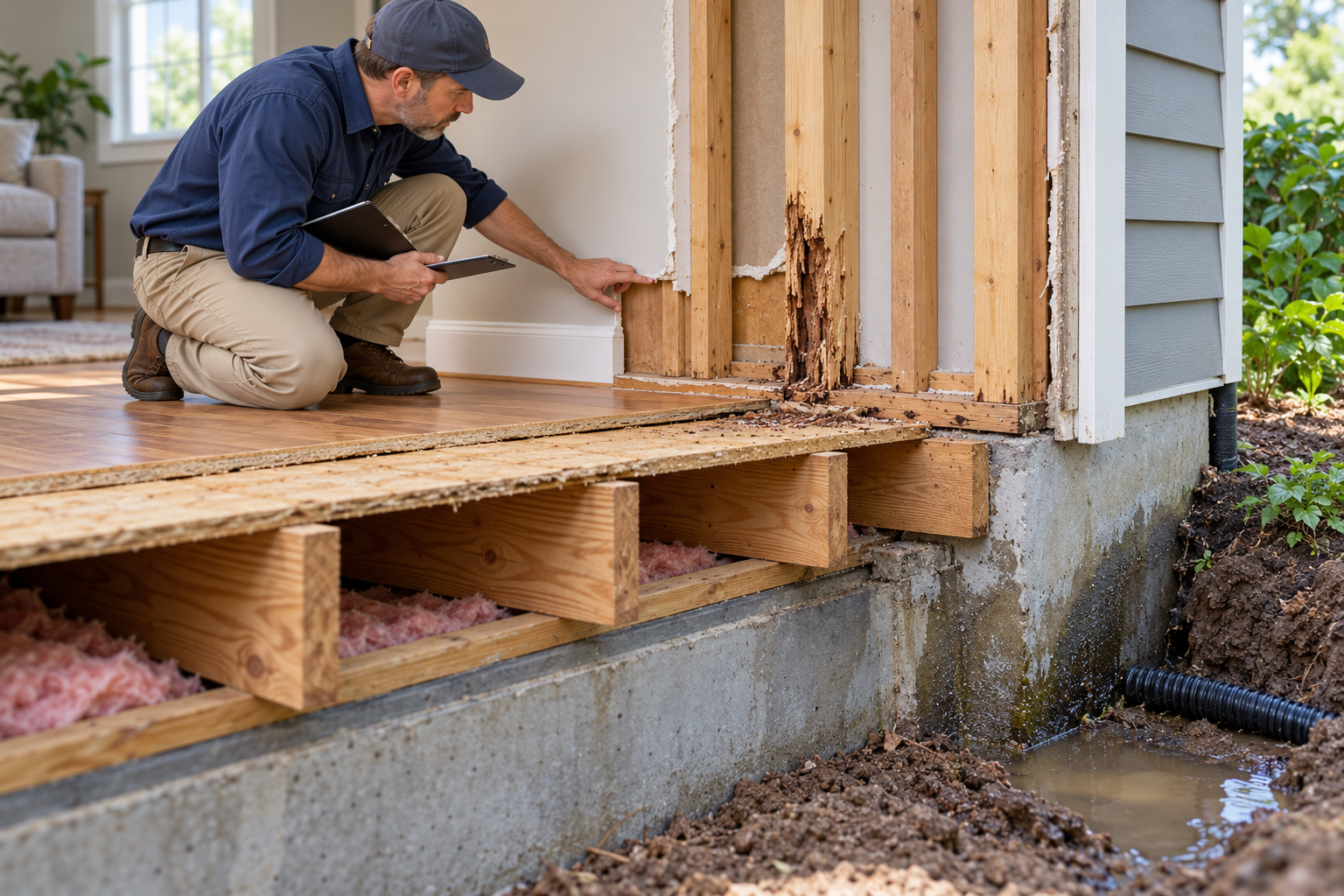
Start with an active-versus-historic assessment
Visible holes, hollow-sounding wood, discarded wings, mud tubes, or buckled finishes can justify an inspection, but they do not reveal the complete repair scope. A professional needs to distinguish active infestation, old damage, moisture decay, and damage from another wood-destroying organism. Do not approve demolition or structural replacement solely from a photograph.
The repair layers
| Layer | Possible work | Who may own it |
|---|---|---|
| Finish wood | Trim, baseboards, doors, casing, or small boards | Carpenter or finish contractor |
| Floor system | Subfloor, flooring, joists, or localized support | Flooring contractor; structural professional when needed |
| Wall assembly | Open wall, repair framing, replace drywall, paint | Carpenter, structural professional, and finish trades |
| Roof or exterior wood | Rafters, sill, fascia, siding, or other exposed material | Roofing, siding, or structural contractor |
| Primary structure | Beam, post, load-bearing wall, sill, or extensive framing | Structural professional and qualified contractor |
| Source condition | Leak, damp crawlspace, soil contact, or damaged envelope | Moisture, foundation, plumbing, or envelope trade |
The pest provider may identify the need but not perform every repair. Ask who will design, permit, open, protect, and close the building.
Price access as part of the repair
The damaged piece may be inexpensive while the access and restoration are not. A repair behind drywall, below flooring, inside a crawlspace, or at a roof edge can require demolition, temporary protection, matching finishes, debris handling, and a second inspection. Ask for a minimum repair scope and a clear unit price for concealed damage rather than an unlimited allowance.
Sequence work carefully
The appropriate order depends on the evidence. In many projects, the infestation must be controlled before enclosed repairs are finalized, and the moisture or access condition needs correction before restoration. But do not leave a structural or weather-exposed hazard open while waiting for a later phase. The pest professional and building contractor should agree on temporary protection and the handoff.
Treatment is not proof of structural safety. If a joist, sill, beam, wall, or floor has lost capacity, use a qualified structural professional. Detailed structural repair belongs to the building’s structural scope rather than a pest-treatment quote.
Ask what the termite warranty does not cover
A protection plan may include retreatment but exclude damage repair, pre-existing conditions, moisture, inaccessible areas, finishes, or a newly discovered species. Read the terms before treating the plan as a repair budget. Keep inspection photographs and invoices so the repair contractor can understand what was found and what the treatment did.
Low, typical, and complex repair scenarios
A low-complexity repair may involve trim, a small finish area, or localized non-structural wood. A typical project may include subfloor, flooring, drywall, insulation, or limited framing access after treatment. A complex project may involve joists, beams, sill plates, wall framing, concealed damage, temporary support, engineering, demolition, moisture correction, and restoration across several rooms.
The categories are not determined by the amount of visible evidence. A small opening can reveal a larger hidden condition, while widespread old exit holes may not require replacement if activity is no longer present and the wood remains sound. Ask the inspector to distinguish active pest evidence, historic damage, moisture decay, and structural capacity.
Build a handoff between professionals
The pest provider should state what was treated and what material may remain affected. The repair contractor should inspect the material and price demolition, access, replacement, temporary protection, disposal, and restoration. A structural professional may need to design or review a repair when load-bearing members are involved. The finish contractor may not be qualified to decide structural adequacy.
Sequence matters. Treatment may need to occur before concealed repairs are closed, but an exposed or unsafe condition may need temporary protection immediately. Ask the contractors to agree on who opens, who documents the condition, who repairs, and who verifies the handoff.
Repair, moisture, and warranty boundaries
Replacing damaged wood without correcting a leak, drainage problem, or wood-to-soil condition can leave the building vulnerable. A termite protection plan may promise retreatment while excluding damage, moisture, finishes, or pre-existing conditions. Read the contract and keep treatment, source correction, structural repair, and finish restoration as separate budget lines.
How hidden conditions create change orders
Opening one damaged area may reveal additional framing, a wet sill, a disconnected floor system, or finishes that cannot be matched without expanding the work. Ask the repair contractor to state the assumed opening size, unit rates for concealed conditions, temporary support, debris handling, and the decision point for engineering. A clearly bounded allowance is easier to manage than an unlimited “termite repair” line.
Photographs and the pest report help, but they do not replace an inspection of the material. Keep the original condition documented before demolition and ask whether the repair contractor will preserve samples or records needed for an insurance, warranty, or sale question.
Sequence without losing the building
The pest professional and repair contractor should agree on when treatment, demolition, drying, moisture correction, structural stabilization, replacement, and finish work occur. An exposed opening may need temporary weather protection. A contaminated or weakened area may need controlled access. Do not close a cavity simply because the pest visit is complete if another professional has identified an unresolved structural or moisture condition.
Questions for the repair quote
Ask the contractor to state the affected members, opening and demolition, temporary protection or support, replacement material, disposal, engineering, moisture correction, finish restoration, and allowance for concealed conditions. Compare that scope with the pest report and do not treat a generic repair average as a property-specific estimate.
Do not let the pest invoice define the repair
The treatment provider may have the best evidence about the pest but not about structural capacity, moisture, finishes, or code-triggered work. Ask each trade to state the condition it is qualified to assess. That division can make the quote process longer, but it prevents a generic pest allowance from being treated as an engineering or restoration decision.
Keep cost ranges descriptive, not universal
The U.S. market observation is useful only as broad orientation because it may mix cosmetic, finish, and structural work. Use the inspection to convert the generic category into a measured scope: affected member, access, demolition, replacement, engineering, disposal, and restoration. Canadian homeowners should obtain local CAD pricing rather than translate a U.S. average.
Before approving a repair allowance
Ask the repair professional to identify the observed damage, the material or member affected, the access needed to verify it, and the condition that would expand the work. A small visible repair can conceal a larger moisture or framing question, while a large pest-control quote can include damage that is cosmetic or historic. Request photographs and measurements where practical, and ask whether demolition, engineering, permits, disposal, drying, or finish matching is included. If a wall, floor, roof, or load-bearing member is involved, keep the structural decision with the qualified trade rather than accepting a pest provider’s estimate as proof of severity. This turns a broad reserve into a decision-ready scope.
Confirm the repair endpoint
Ask whether the proposal restores appearance, replaces damaged material, restores structural capacity, or only makes an opening accessible. Those endpoints can require different trades, permits, engineering, and finish work. Keep moisture correction and future monitoring visible when the damage is associated with a leak or recurring condition. A repair invoice should identify what was actually changed and what remains unverified, so a completed pest treatment is not mistaken for a completed building repair.
Keep the completion record
Retain the inspection photographs, repair scope, invoices, permits, and any warranty with the pest-treatment records. Future owners and contractors need to know what was opened, replaced, reinforced, or left unverified. A complete record can also prevent a later estimate from treating historic damage as new without evidence.
Bottom line
Budget termite damage repair separately from treatment. Use the U.S. $600–$3,000 observation only as a broad starting point, then obtain a scoped inspection and repair proposal. Keep cosmetic, finish, moisture, and structural work distinct so that the total project reflects the actual condition rather than a generic “termite damage” allowance.