
Powderpost-beetle cost is difficult to quote from exit holes alone. Several beetle groups are described by that common name, and the project may involve identification, activity testing, localized treatment, removal or replacement of infested wood, and monitoring. U.S. routine pest market observations are not a reliable price for this specialty work; obtain a scoped inspection and local quote.
Identify the beetle and the wood
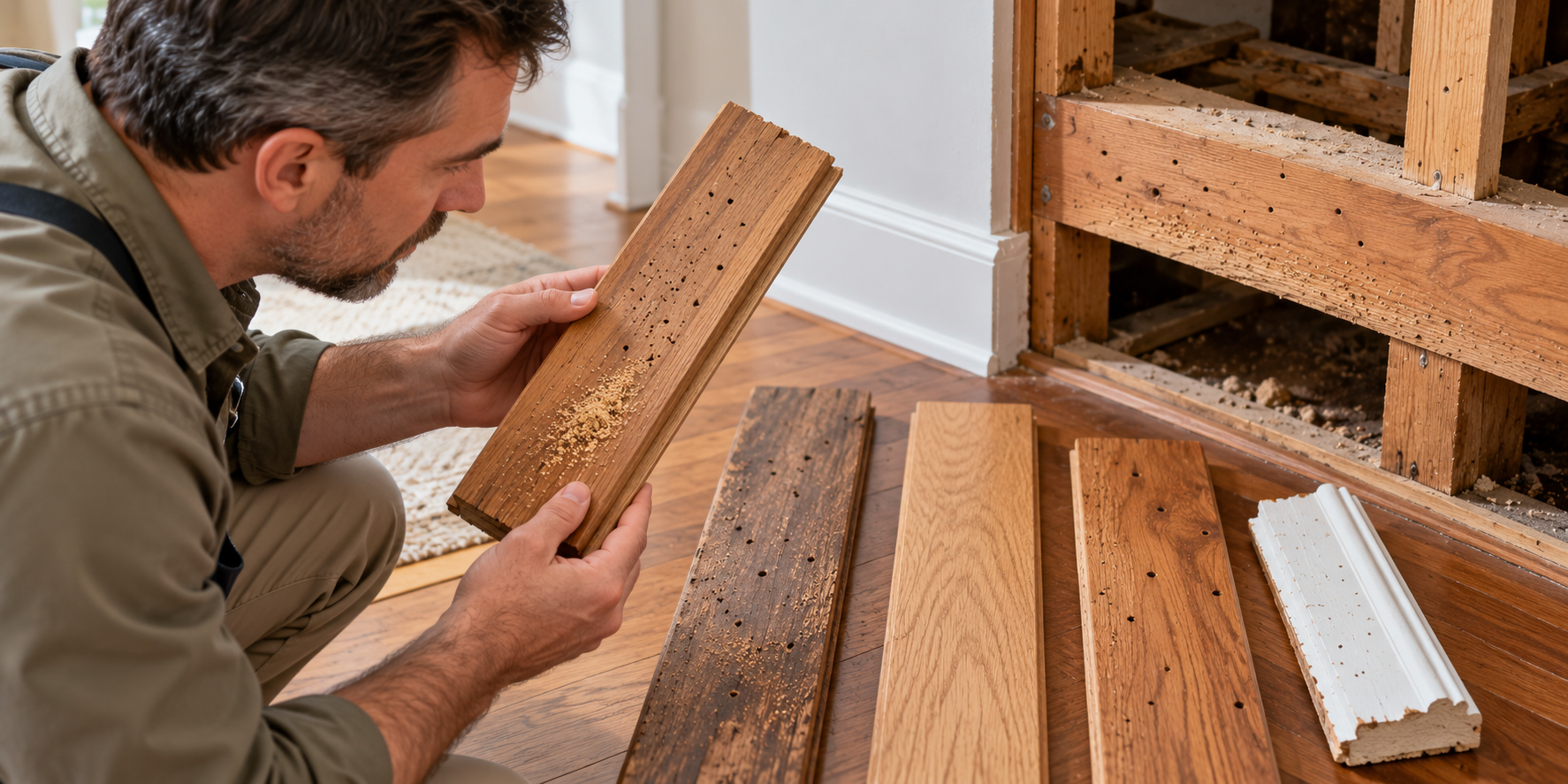
Penn State Extension describes powderpost beetles as insects that develop in dead, dried hardwood and may be found in lumber, rafters, joists, floors, finished wood, furniture, or other materials. Small holes and powder-like frass can be clues, but historic holes may remain after activity has stopped. A professional should consider the beetle group, wood species, age of the material, moisture, location, and whether fresh frass or new holes are present.
The main question is not “How many holes are there?” It is “Is there an active, consequential infestation, and what material is affected?”
The possible project scopes
| Scope | What you are paying to decide or do |
|---|---|
| Inspection | Identify likely beetle group, activity, wood, and affected boundaries |
| Localized treatment | Treat an appropriate accessible area under a suitable label or professional method |
| Material removal | Remove infested boards, flooring, furniture, or other replaceable pieces |
| Structural evaluation | Determine whether joists, rafters, beams, or framing need engineering or repair |
| Broad treatment | Address a wider assembly only when evidence and method justify it |
| Prevention/monitoring | Control moisture, inspect introduced wood, and watch for new activity |
Replacement may be more economical than treating a small removable item. Conversely, removing historic wood without confirming activity can destroy sound material and still fail to address an infested source elsewhere.
What changes cost
The largest drivers are the amount and location of wood, access, whether finishes must be opened, the need for a second specialist, treatment method, disposal, repair, and the time required to distinguish active from old damage. Reclaimed or imported wood can add identification uncertainty. A crawlspace, finished floor, furniture collection, or concealed framing requires a different scope than exposed boards in an unfinished area.
Build an evidence record before choosing a treatment
Ask the inspector to identify the beetle group as far as the evidence permits, note the wood and finish, map the affected pieces, and explain why the activity is considered current or historic. Fresh powder, new holes, live insects, age of the material, and timing of observations may inform the assessment, but the homeowner should not diagnose activity from one sign alone. Imported or reclaimed lumber deserves a clear note because its origin, species, storage history, and installation date may affect the identification question.
| Material or evidence | Scope question to ask | Possible budget effect |
|---|---|---|
| Small removable furniture or trim | Can the item be assessed and treated or replaced separately? | May avoid treating an entire room or building. |
| Finished flooring or many boards | Which boards are included, and what finish restoration follows? | Removal and matching finish work can exceed pest-control labor. |
| Joists, rafters, or framing | Is activity confirmed, and who assesses structural capacity? | A structural assessment and repair estimate may be separate. |
| Reclaimed or recently installed wood | Is the beetle group or source material still uncertain? | Additional identification or monitoring may be more useful than immediate broad work. |
Fumigation can eliminate life stages in an appropriate project, but Extension evidence emphasizes that it does not protect the wood from future attack. Fumigation is therefore not a complete prevention or repair plan and may be inappropriate for the property.
Avoid unsupported pesticide instructions
Treatment products and application methods depend on the identified pest, location, label, and local regulations. EPA guidance says pesticide labels provide essential safety and use information. Do not apply a product to structural wood, furniture, occupied rooms, or an enclosed space merely because the label name appears in an online discussion. A qualified provider can explain the proposed scope and precautions.
How to request a useful quote
Provide photos without scraping away evidence, note when frass or new holes appeared, identify the wood if known, and disclose renovations or imported/reclaimed material. Ask the provider to state whether activity is confirmed, which material is included, how the boundary will be checked, whether removal or replacement is included, and what monitoring follows treatment.
If the report identifies possible structural weakening, use a structural professional. If it identifies moisture, route that correction separately. A pest quote should not make an unsupported structural or moisture diagnosis.
Escalate only when the scope supports it
For an accessible, bounded area, a localized approach may be less disruptive than treating an entire structure. If the affected pieces can be removed, replacement may be easier to price than treatment. A broad method such as fumigation belongs only in a property-specific proposal that identifies the insect, material, building suitability, preparation, re-entry, and separate repair requirements. It does not protect wood from future attack or restore damaged material. See whole-house termite fumigation cost for the distinct preparation and displacement decision; that guide does not establish that fumigation is appropriate for powderpost beetles.
Ask what follow-up will demonstrate: reduced new activity, completion of a bounded treatment, or a repair handoff. Keep photographs and the provider’s marked locations with the report so later inspections can distinguish new observations from the original condition.
Price the after-treatment outcome
Ask whether the price ends when the application or removal is complete, when the affected wood is replaced, or after a period of monitoring. The provider should state what new activity would trigger another visit and which locations remain inaccessible. Where old holes are already present, a simple baseline record of their location and condition can help a later inspector distinguish them from changes. Keep the report and photographs with the property file rather than relying on memory.
Treatment does not answer every repair question. A pest professional can define the suspected affected area, while a structural professional decides whether a framing member retains capacity. A carpenter or flooring contractor prices replacement and finish restoration. If the infestation is no longer active but damaged wood remains, selective repair may be more useful than more treatment; if evidence is inconclusive, another inspection may be better than demolition. Ask whether moisture was observed or only suspected, and price its correction separately. For new or reclaimed lumber, disclose its origin and storage history.
Stage the price when activity is uncertain
When the report cannot distinguish old holes from active infestation, ask for a defined inspection or monitoring price before authorizing broad treatment. The first phase should identify the likely beetle group, the specific wood being assessed, the evidence considered current, and the areas that remain inaccessible. If the provider recommends another phase, it should name the new finding that triggers it and whether that phase means treatment, material removal, or a structural assessment.
This approach can prevent two opposite costs: replacing sound historic wood because holes look alarming, or paying for a localized application that misses a confirmed source. Photograph and mark the observed holes before work, then keep the provider’s location map with the property record. A later visit can compare new evidence with that baseline instead of pricing the project from an undifferentiated hole count.
For bids, request separate alternatives when the affected material is removable: one for appropriate treatment, one for removal and replacement, and one for any finish restoration. For finished flooring or framing, include the access and close-up work in the comparison, not only the insect-control charge. A structural professional determines whether a member is compromised; the pest estimate should not quietly substitute for that assessment.
Ask whether any follow-up is included in the original price or starts a new service charge, and whether the report will identify the locations used as a baseline. If a proposal uses a broad treatment method, it should explain why that method fits the material and building rather than imply that the largest scope is necessarily the safest purchase. Keep monitoring, repair, and future prevention visible as different outcomes.
Bottom line
Powderpost-beetle cost follows identification, activity, access, and the wood involved more than a standard pest-service rate. Confirm that the infestation is active and bounded before treating or replacing material, then use a local, itemized proposal.