
Carpenter-ant work is priced around the search for a colony and the building conditions supporting it, not simply the number of ants seen. A U.S. market observation places ordinary ant treatment around $100–$500, but a carpenter-ant project can move higher when the nest is concealed, access is difficult, moisture-damaged wood needs correction, or repair follows. Canadian pricing should be obtained from local providers in CAD.
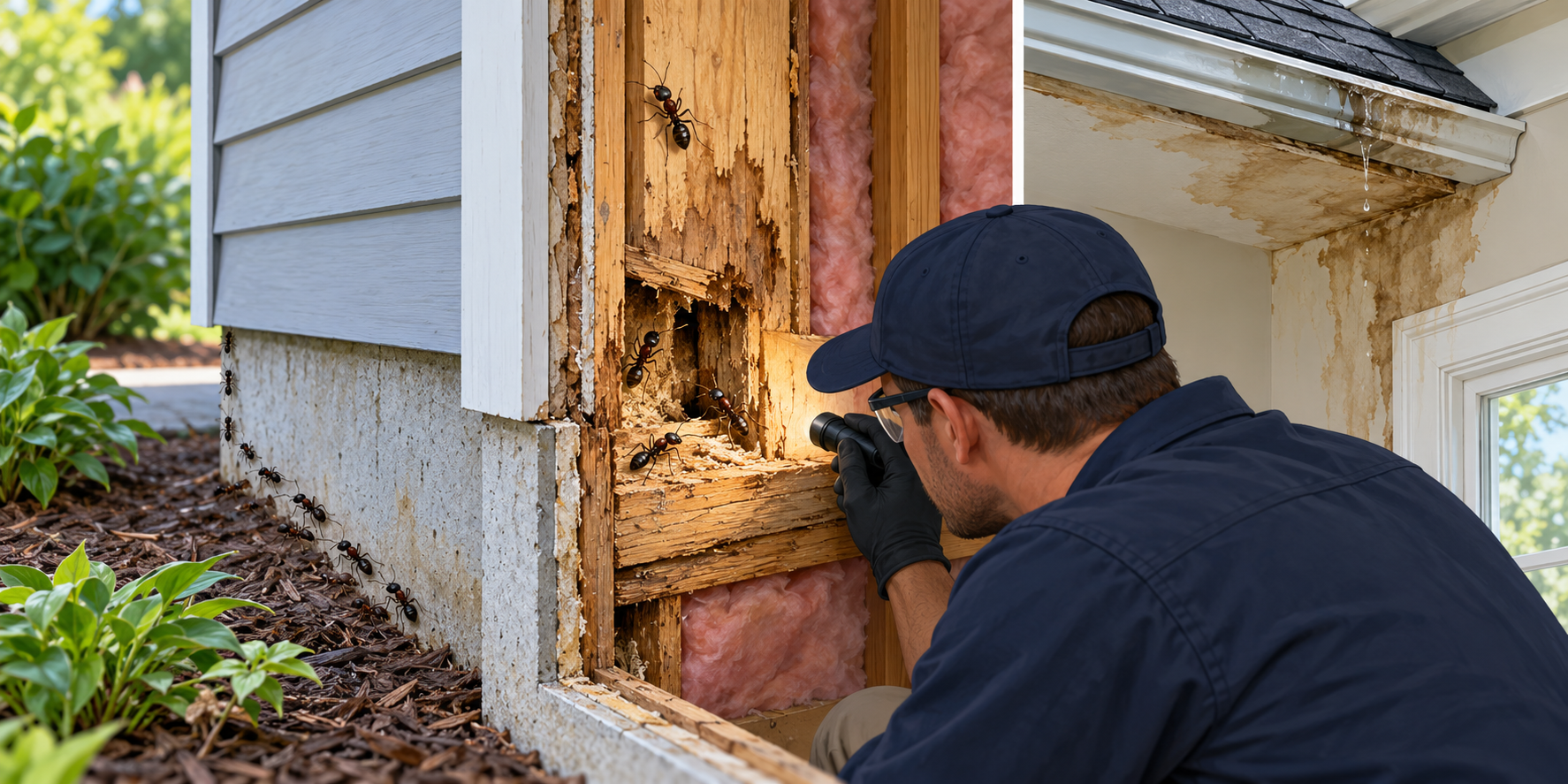
Confirm carpenter ants first
Carpenter ants are not the same economic problem as ordinary nuisance ants. Health Canada distinguishes them as wood-damaging pests associated with moisture or decay conditions. Visible workers may be foraging from an exterior colony, or they may indicate a nest or satellite nest inside a wall, attic, subfloor, or other concealed space. Identification and inspection should precede a treatment decision.
What the treatment scope can include
The provider may price:
- inspection and species confirmation;
- trail and nest-location work;
- treatment of an accessible nest or colony;
- follow-up to determine whether activity has stopped;
- exclusion and correction of likely entry paths;
- moisture or decayed-wood investigation;
- repair of damaged wood by another contractor.
Spraying visible ants can lower activity without addressing a concealed nest or the condition that made the wood suitable. Ask what the treatment is intended to control and how the provider will verify the result.
Moisture is a cost driver, not proof of structural failure
Carpenter ants are often associated with wet or decaying wood, but their presence does not establish a specific structural defect. A leak, condensation, poor drainage, or long-term dampness may need attention. The moisture source belongs with the appropriate plumbing, roofing, site, or building-envelope trade. A structural professional should evaluate a beam, joist, sill, or wall when damage could affect capacity.
Keep the budgets separate:
| Scope | Example question |
|---|---|
| Pest control | Was the colony found and controlled? |
| Moisture correction | What is keeping the wood damp? |
| Exclusion | Where can ants enter or continue to forage? |
| Wood repair | What material is damaged, and is it cosmetic or structural? |
| Follow-up | What evidence will show that activity has stopped? |
What changes the price
Expect more labor when the nest may be in a wall, attic, crawlspace, or subfloor; when multiple colonies or satellite nests are suspected; when stored contents limit access; or when the provider must coordinate with another trade. Follow-up visits, warranties, and a broader exterior inspection also affect the total.
EPA’s integrated pest-management guidance supports reducing food, water, shelter, and access opportunities alongside appropriately selected treatment. That may mean storing food, correcting a leak, removing damp debris, trimming vegetation, or repairing a gap. It does not mean indiscriminately sealing or applying products where a building opening has another function.
Compare a treatment proposal
Ask whether the price includes an inspection, nest search, treatment method, follow-up, and a description of excluded moisture or repair work. Confirm whether the company is treating only an active location or offering a preventive perimeter service. Read the guarantee for what happens if activity continues and what homeowner actions it requires.
Do not infer that a higher price means the infestation is structurally severe, or that a low price proves the problem is minor. The key uncertainty is often location and cause, not treatment material.
Ask whether the estimate assumes one nest or more
A useful inspection records where ants were seen, which routes were followed, whether a nest was located, and what areas could not be checked. Ask whether the proposal assumes a single exterior colony, an indoor nest, or several suspected satellite locations. If the nest remains unlocated, ask what the initial fee buys: a focused inspection, monitoring, or a treatment visit based on a provisional hypothesis. Agree on the finding that would trigger a second visit or an expanded search before work starts.
| Finding or assumption | Quote question | Why it changes the budget |
|---|---|---|
| Workers on an exterior route | Does the scope address the route and likely outside source? | A visible trail may not mean there is an indoor nest. |
| Activity in a wall, attic, or subfloor | What access or follow-up is included to locate the source? | Concealed inspection and additional visits can add labor. |
| More than one suspected nest | What evidence supports each location and how many are included? | Multiple locations can change treatment and monitoring effort. |
| Damp or decayed wood | Is this an observation or a diagnosis of the moisture source? | Pest service and moisture/repair work may belong to different trades. |
Compare treatment, follow-up, and the callback promise
Ask whether the proposal uses a targeted nest treatment, a barrier, bait, or another method, why that method fits the observed activity, and which visits are included. Do not assume a visible-worker spray addresses a nest that has not been found or a route that remains open. Where a pesticide is proposed, use the current label and local requirements as the boundary; this guide does not give application instructions.
Get the follow-up interval and result in writing. Ask what counts as continued activity, how a callback differs from a new infestation, and whether monitoring stations or a second inspection have another fee. A lower first-visit price may be more expensive if it excludes follow-up needed to determine whether the source was controlled. If a cavity will be opened or closed, agree on the treatment and repair sequence; a plumber, roofer, or structural professional should price its own work.
Read the broad ant range as an orientation only
The $100–$500 U.S. observation above describes ordinary ant treatment generally; it is not a carpenter-ant quote or a reliable ceiling for a concealed nest search. A basic service may address an accessible trail or known exterior source. The same number can mean something very different when a provider must inspect an attic or wall, locate a nest, return to check activity, or coordinate with a moisture or repair professional. Ask the provider to separate the diagnostic visit from treatment and to state which later work is outside the range.
For an exterior trail with no evidence of an indoor colony, a focused inspection and defined treatment may be enough to price the immediate problem. If ants are found inside a cavity, access and a second visit may become the larger labor items. If damp or decayed wood is also found, that condition creates a separate repair question; neither the ant service nor the sighting alone establishes structural damage. Those three situations should not be compared by the number of ants or holes in the quote.
Set a stop point when the nest is not located
An unlocated nest can make a proposal sound comprehensive while leaving the actual search boundary unclear. Ask how much inspection time is included, which accessible areas will be checked, whether the price assumes opening a wall or floor, and what evidence would justify that step. If a provider recommends a broad treatment before locating the colony, ask whether a narrower diagnostic or monitoring phase can answer the same question first.
Agree on a price trigger before work begins: for example, a second confirmed location, a concealed cavity that cannot be reached visually, or a repair condition that needs a different trade. Ask the provider to pause for approval before exceeding the stated amount. This preserves a way to respond when new evidence appears without approving open-ended searching or demolition in advance.
The quote should also say whether the guarantee follows the treated nest, the property, or only a scheduled callback period. If the colony was not located, ask what result would close the search and whether the provider will recommend monitoring instead of another treatment. A defined endpoint helps compare a single visit with a recurring program and makes clear whether the homeowner is paying for control, continued diagnosis, or prevention.
Some quotes may be for a routine perimeter service while others price a carpenter-ant search or treatment at a specific nest. Ask which pests and locations the recurring service covers, whether a carpenter-ant finding is an included callback, and whether the initial visit includes a concealed-nest search. Those are different service promises even when both are described as “ant control.”
Bottom line
Price carpenter-ant work around identification, nest location, access, follow-up, and any confirmed conducive condition. Keep moisture correction, exclusion, and wood repair visible as separate scopes, and do not expand treatment or demolition beyond the evidence.