
Professional mouse or rat control often starts in the low hundreds of U.S. dollars. Broad specialist observations put many routine pest projects around $200–$600, but a severe infestation, difficult access, exterior or sewer involvement, exclusion, contamination, and repeat visits can raise the total. Canadian homeowners should request local CAD pricing and confirm the products and disposal rules that apply.
Price the problem, not only the first sighting
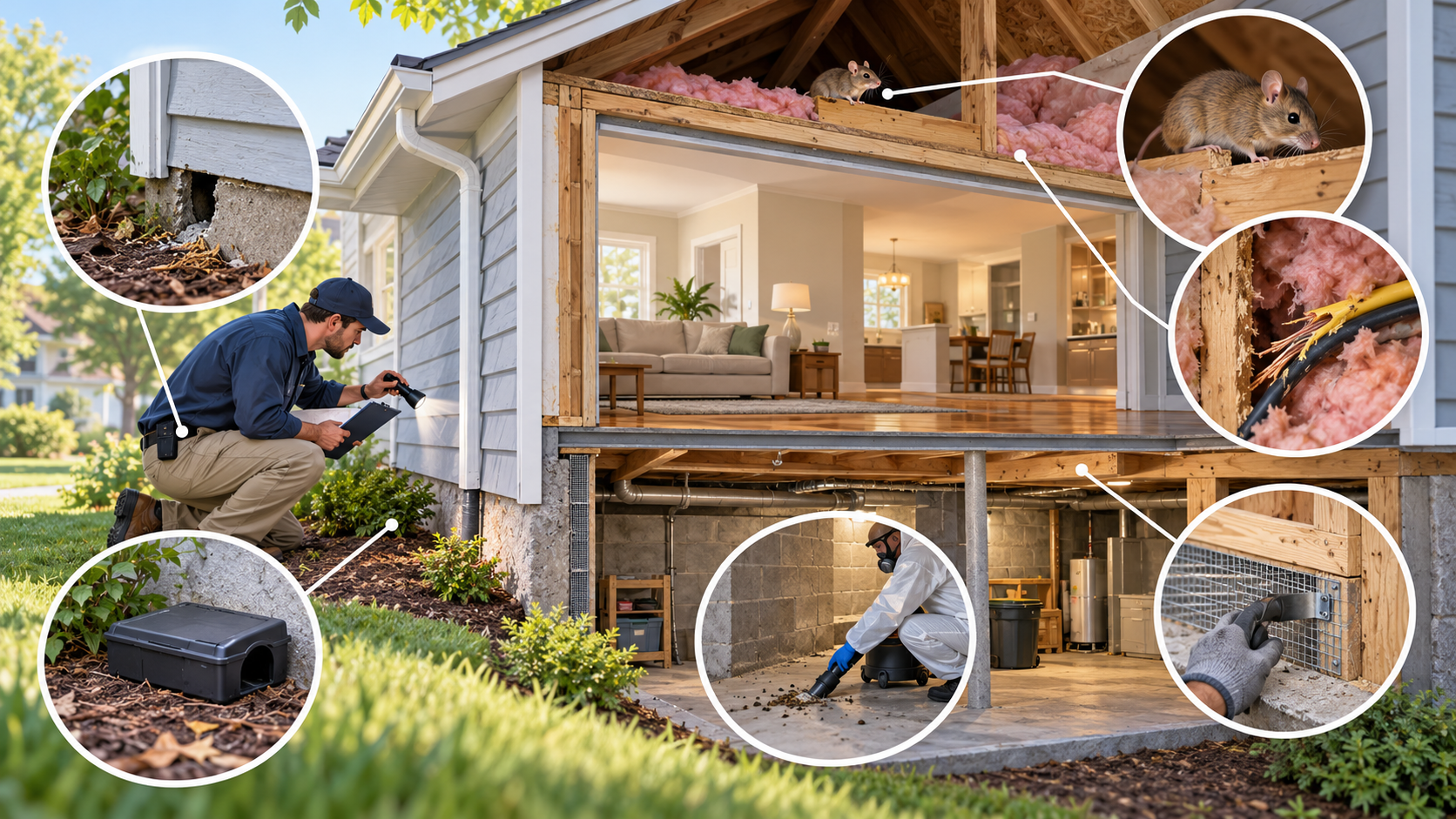
The provider should inspect where activity was found, how long it has continued, and whether signs occur in the attic, crawlspace, basement, garage, wall, kitchen, or exterior. A mouse in a garage is not the same project as rats entering through a sewer or a population nesting above finished ceilings.
Ask the provider to distinguish:
- confirmed current activity;
- old droppings or nesting evidence;
- likely entry routes;
- contaminated or damaged materials;
- locations that could not be accessed;
- work that requires another trade.
Noise, a hole, or droppings can justify an inspection but does not establish species, population, or the full repair scope.
What a control program may include
A professional proposal can include inspection, a control method appropriate to the property and applicable rules, monitoring, follow-up, exclusion, and safe handling of affected material. Health Canada and EPA guidance emphasize prevention and source correction alongside control rather than relying on an unexplained product application.
The quote should state whether it includes:
- one visit or a defined series;
- interior, exterior, attic, crawlspace, or garage areas;
- monitoring and callback terms;
- exclusion or only active control;
- dead-animal removal;
- contaminated insulation or cleanup;
- wiring, duct, drywall, or finish repair;
- travel, access equipment, or emergency attendance.
Trapping, baiting, and other controls require professional judgment and current product or local rules. This guide does not provide placement instructions.
For a Canadian quote using a commercial-class rodenticide, Health Canada limits eligible users to certified pest-control operators, farmers, and people authorized in government-approved programs. Ask who performs the service and what station checks or monitoring are included. The approved product label controls; this commercial-class rule does not apply automatically to every consumer product.
Mice and rats can change the scope
Mice and rats share a broad commissioning journey but may differ in access, damage, activity area, and control complexity. Rats can involve larger openings, exterior infrastructure, garbage, crawlspaces, or sewer-adjacent conditions. Mice may enter through small building gaps and create attic, wall, or pantry activity. The correct response depends on inspection rather than a universal species surcharge.
Ask whether the provider has checked the likely entry route and whether another professional should inspect wiring, insulation, ductwork, or structural material. A pest company may identify damage without owning its repair.
Follow-up and exclusion
Removal or control does not guarantee that the building is closed to new activity. If exclusion is not in the first price, read rodent exclusion cost and ask for a separate proposal. If droppings, nesting, odor, or contaminated insulation are present, cleanup is another scope; see rodent attic and crawlspace cleanup.
A callback guarantee may cover retreatment but exclude building repair, sanitation, or a new infestation. Ask what evidence triggers a return visit and how long the provider monitors before calling the project complete.
Safety and contamination boundaries
Rodent urine, droppings, nesting material, and dead animals can create health and cleanup concerns. CDC guidance calls for careful wet-cleaning practices and cautions against actions that aerosolize contaminated material. For heavy contamination, enclosed spaces, disturbed insulation, or uncertain exposure, use qualified cleanup or public-health guidance rather than improvising.
If someone may have had contact with a bat or other wildlife, rabies and exposure questions belong with public-health or medical authorities. Rodent control does not substitute for that assessment.
Compare quotes
| Quote item | Question to ask |
|---|---|
| Inspection | What evidence confirms mice, rats, or another animal? |
| Active control | What method, area, visits, and monitoring are included? |
| Exclusion | Who seals entry routes, and are ventilation or drainage openings protected? |
| Cleanup | Are droppings, carcasses, insulation, and odor outside the pest scope? |
| Repairs | Who inspects chewed wiring, ducts, framing, drywall, or finishes? |
| Guarantee | Does it cover retreatment, exclusion, or only a callback? |
Three control scenarios
A limited indoor problem may involve inspection, a defined control program, and one or more follow-up visits. A typical project adds entry-route evaluation, monitoring, and a separate exclusion proposal. A complex project may involve rats, several activity areas, an attic or crawlspace, exterior infrastructure, contaminated material, or a shared building.
Ask which scenario the quote assumes and whether the provider has inspected the places where activity was reported. A low price may describe one visit without monitoring or exclusion. A high price may include cleanup or repairs that another contractor should price separately.
Control, exclusion, and cleanup are different purchases
The active-control service addresses the population or animal currently present. Exclusion addresses the building path. Cleanup addresses droppings, urine, nests, dead animals, and contaminated insulation. Electrical, duct, structural, and finish repairs are separate again. Read rodent exclusion cost and rodent attic cleanup cost before assuming the first quote is complete.
Ask the provider what evidence will show that the active problem is controlled. It might be a monitoring period, a follow-up inspection, or the absence of new signs in a defined area. A callback guarantee should identify whether it covers retreatment, monitoring, exclusion, or only a return visit.
Questions about attached and seasonal homes
Shared walls, common areas, vacant periods, stored food, seasonal access, and neighboring construction can change the control plan. Tell the provider whether the home is a condo, townhouse, rental, seasonal property, or detached outbuilding. Do not treat a general service plan as a responsibility or insurance determination.
How to evaluate the proposed control period
Ask how long the provider expects to monitor and what result ends the active-control phase. A single visit may be reasonable for a limited, confirmed event, but a persistent problem often needs a defined follow-up. Ask whether the provider will return for new signs, whether the callback is free, and whether exclusion or cleanup must be completed first.
Keep a simple activity record with locations and dates. It helps the professional decide whether signs are new, but it should not be used to select poison, traps, or other products without qualified guidance. The building, occupants, pets, and local rules affect the safe method.
Budget the risk that remains
After control, ask whether any entry route, damaged material, contaminated insulation, dead animal, or chewed wiring remains. A low treatment quote can be reasonable if those scopes are absent; it is incomplete if the provider identified them and the homeowner has not priced them.
Use the quote to decide what happens next
The best proposal tells you whether the next step is active control, an inspection, exclusion, cleanup, electrical review, or public-health advice. If the provider cannot identify that next decision, ask for a narrower diagnostic scope before authorizing a broad program.
Ask what the provider will not do
The exclusions in the quote matter: roof repair, wiring, insulation, odor, dead animals, major cleanup, and structural work may all be outside active control. Put those items in a follow-on list and do not assume that a callback resolves them.
Ask whether the quote assumes an occupied home
Children, pets, sensitive occupants, food storage, attics, crawlspaces, and shared walls can change the safe and practical control plan. Tell the provider those facts before the price is fixed and ask for written preparation and re-entry instructions.
Make the control endpoint specific
Ask how the provider will establish that activity has declined, how long monitoring continues, and what evidence would trigger exclusion or a new inspection. A trap, bait, or visit can address an immediate sign without correcting the route or the conditions that support recurrence. Ask whether the proposal includes exterior inspection, sanitation advice, follow-up, and safe handling instructions, and list any rooms or occupants that need special consideration. A defined endpoint makes a low initial price comparable with a broader program and keeps cleanup, wiring, insulation, and repairs from disappearing inside “control.”
Confirm the next step after control
Ask for a written endpoint: reduced activity, captured animals, a monitored period, or a completed exclusion. Keep dead-animal removal, contaminated insulation, odor, wiring, and structural repairs out of the control price unless the proposal expressly includes them. If a child, pet, sensitive occupant, or shared wall changes the plan, disclose it before work begins. A scope that records those limits is easier to compare than a low price built on an unspoken assumption.
Bottom line
Use $200–$600 U.S. as a broad routine-control orientation, then budget separately for exclusion, contamination cleanup, access, and repairs. Choose a proposal that explains the evidence, control sequence, follow-up, and building boundaries. Do not select a product or method from a symptom alone.