
Rodent exclusion is the building-access portion of a control project. Broad U.S. market observations support planning bands from a few hundred dollars for a limited seal-up to $2,000 or more for a whole-home, roofline, crawlspace, or repair-heavy project. Canadian pricing should come from local providers in CAD. The actual cost depends on the number, location, accessibility, and function of the openings.
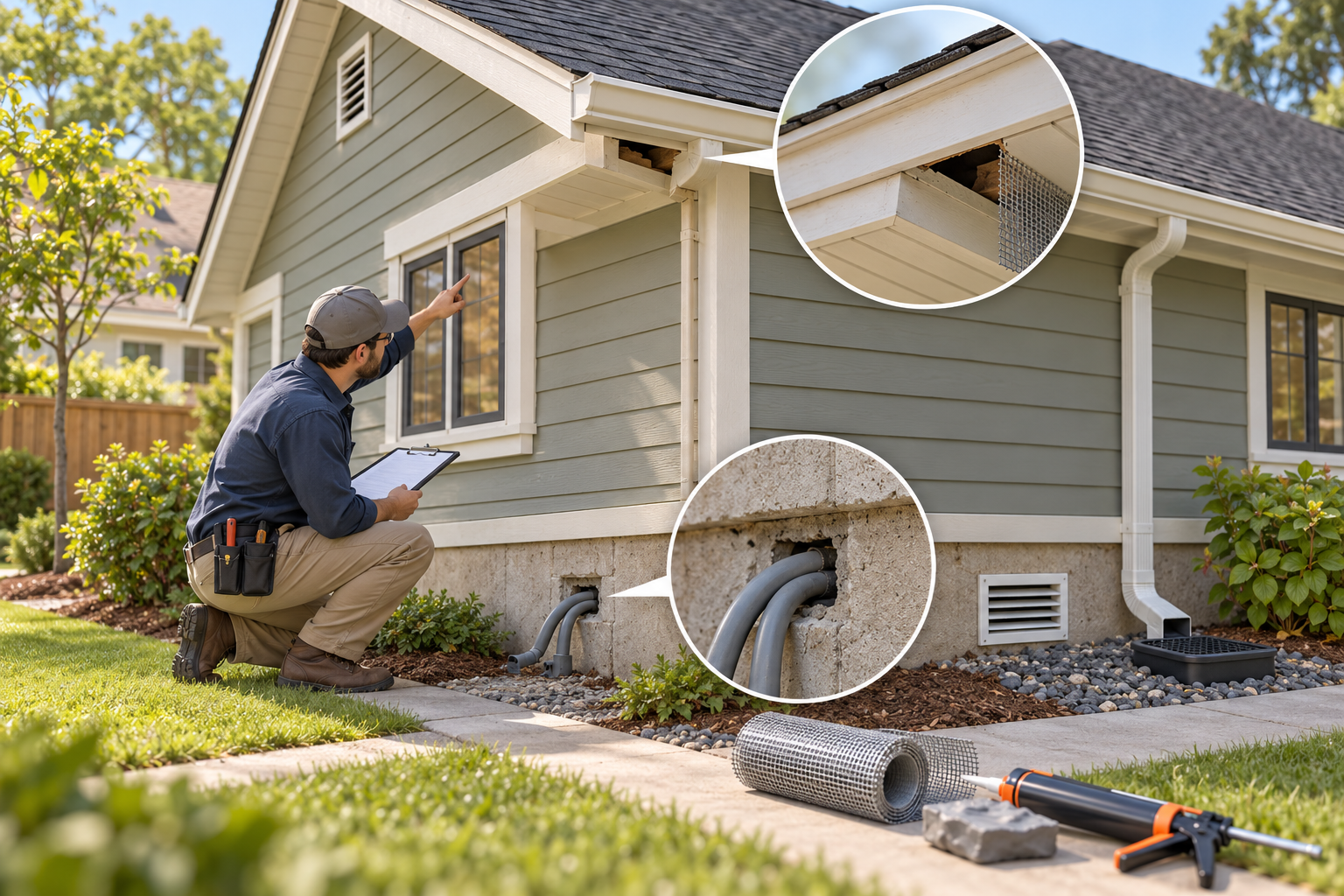
Exclusion is not the same as removal
A provider can control or remove rodents without sealing every route, and a contractor can seal a building while an active population remains inside. The sequence must prevent animals from being trapped in the building and should account for current activity, young animals where relevant, and areas that need monitoring.
Ask whether the proposal includes inspection, active control, exclusion, follow-up, and repairs. Mouse and rat control cost covers the active-control decision; this article focuses on the building correction.
What a rodent-exclusion inspection looks for
Common scope areas include the foundation and sill, rim-joist transitions, utility penetrations, garage-door edges, crawlspace access, vents, roof and eave lines, damaged screens, siding or trim gaps, and openings around pipes or cables. A professional may also check vegetation, stored materials, food sources, and conditions that make an opening more attractive.
The inspection should distinguish a hole that permits entry from a building opening that serves ventilation, drainage, combustion, access, or fire-separation functions. Do not seal an opening simply because it looks like a route. The correction must preserve the building system.
Cost components
| Component | What changes the price |
|---|---|
| Inspection | Size of the property, access, attic or crawlspace entry, and evidence to document |
| Minor seal-up | Number of gaps, materials, door and screen adjustments, and exterior access |
| Roofline work | Height, ladders or lifts, soffit and fascia condition, and weather exposure |
| Foundation and utility work | Masonry, soil contact, pipe and cable details, and the need for another trade |
| Crawlspace work | Clearance, moisture, insulation, contamination, and safe staging |
| Follow-up | Monitoring, warranty terms, and verification after active control |
| Restoration | Siding, roofing, masonry, drywall, trim, insulation, or other repair beyond exclusion |
The materials may be inexpensive while labor and access dominate. A quote that lists only “seal entry points” does not describe enough scope to compare.
Sequence the work
Exclusion usually works best when the provider knows where rodents are and whether they remain inside. A one-way exit or other method may be considered by a qualified professional when lawful and suitable, but the actual method depends on species, location, building configuration, and local rules. This guide does not provide trapping or installation instructions.
After control, a follow-up inspection can check whether new signs appear and whether the repair held. Ask whether the warranty covers only the material installed, the specific openings identified, or a broader recurrence condition. Many providers exclude new damage, inaccessible areas, major carpentry, and unrelated repairs.
When exclusion becomes another category
A small screen repair can remain within pest-service work. Replacing a roof edge, rebuilding a soffit, repairing masonry, changing a vent, replacing insulation, or correcting a structural opening may belong to roofing, exterior cladding, building-envelope, electrical, or structural contractors. Keep the pest quote and the building-repair quote separate so each trade states its assumptions.
Rodent damage to wiring deserves qualified electrical inspection. Contaminated insulation or heavy droppings may require professional cleanup before new material is installed; see rodent-contaminated attic or crawlspace cleanup.
Compare a whole-home proposal
Ask the provider to attach photographs or a location map, identify inaccessible areas, list materials and access equipment, and state whether active control and follow-up are included. Confirm who repairs the surrounding roof, siding, masonry, drywall, or finish and what happens if additional openings are found.
Do not judge a quote by the number of gaps alone. A small number of high, concealed, or weather-exposed openings can cost more than many accessible ground-level repairs. The best scope makes the likely routes, sequence, warranty, and exclusions visible.
Low, typical, and complex exclusion projects
A limited project may correct a garage-door edge, screen, or a few accessible ground-level gaps. A typical project can include a foundation perimeter, utility penetrations, crawlspace access, roofline observations, and follow-up after active control. A complex project may require lifts, roof or masonry repair, extensive carpentry, insulation work, or coordination across several buildings.
Ask the provider to show the openings being priced. “Whole-home exclusion” can mean a detailed survey and correction of identified routes, or it can be a general allowance with many exclusions. The quote should identify inaccessible areas, materials, access equipment, and the warranty boundary.
Sequence matters when animals remain inside
Sealing an occupied route can trap rodents or create odor and damage in a concealed space. The provider should explain how active control, monitoring, and closure are sequenced. If there are young animals or wildlife rather than rodents, local wildlife rules may change the method. Do not assume that an exclusion technique for mice applies to squirrels, raccoons, bats, or birds.
After the repair, ask what follow-up proves the route remains closed. A warranty may cover the installed screen or seal but exclude new damage, another opening, roof movement, or inaccessible areas. Put those conditions beside the price when comparing proposals.
Functional openings and adjacent trades
Some vents, drains, combustion openings, and access panels must remain open or be modified by a qualified trade. A pest contractor can identify a route without being authorized to redesign the building system. If the work involves electrical penetrations, fire separation, roofing, siding, masonry, or structural material, price the specialist repair separately.
A field checklist for the proposal
Ask for a marked list of openings, photographs, dimensions or material assumptions where useful, access limitations, active-control sequence, installed materials, restoration, follow-up, and warranty. Confirm whether the quote includes the garage, detached structures, crawlspace, attic, roofline, and utility penetrations or only the visible exterior.
The provider should also state what it will not seal. A vent, drain, combustion opening, or fire-rated penetration may require a qualified building trade. Exclusion should reduce access without creating a moisture, ventilation, drainage, or fire-safety defect.
Compare the cost against recurrence
If active control alone costs less but leaves the route open, the expected cost can include another visit, new contamination, and additional repair. If a whole-home exclusion costs more, ask whether the evidence supports that boundary or whether a targeted correction is enough. A useful proposal makes the recurrence assumption explicit.
What the warranty actually covers
Read whether the provider guarantees the installed material, the listed openings, the whole structure, or a period without new activity. Ask whether the warranty excludes roof movement, animal damage, inaccessible areas, new openings, or repairs performed by another trade. A whole-home label does not automatically mean every possible entry path was corrected.
If the property is seasonal, remote, attached, or under renovation, tell the provider. Travel, access, vacant periods, and neighboring construction can change both the initial survey and follow-up. The best quote states those assumptions rather than hiding them inside a general service price.
Keep maintenance separate from exclusion
An installed seal may need future inspection after roof work, foundation movement, animal chewing, or a new utility penetration. Ask whether maintenance is included or whether the warranty ends when the building changes. That future obligation is part of the ownership cost.
Ask what the warranty can prove
A warranty may cover installed materials, listed openings, a defined elevation, or a period without new activity; those are different promises. Ask how the provider handles animal damage, roof movement, new utility penetrations, inaccessible routes, and conditions outside the inspected area. Request before-and-after photographs and a written list of openings addressed. If the building is attached, seasonal, or under renovation, include neighboring and future construction assumptions. A clear warranty is part of the value of exclusion, not a substitute for a complete inspection.
Bottom line
Budget from a few hundred to $2,000 or more U.S. depending on whether the work is a limited seal-up or a whole-building, high-access project. Exclusion is valuable only when it is sequenced with active control and does not compromise ventilation, drainage, or other building functions. Obtain a site-specific scope and local Canadian pricing.