
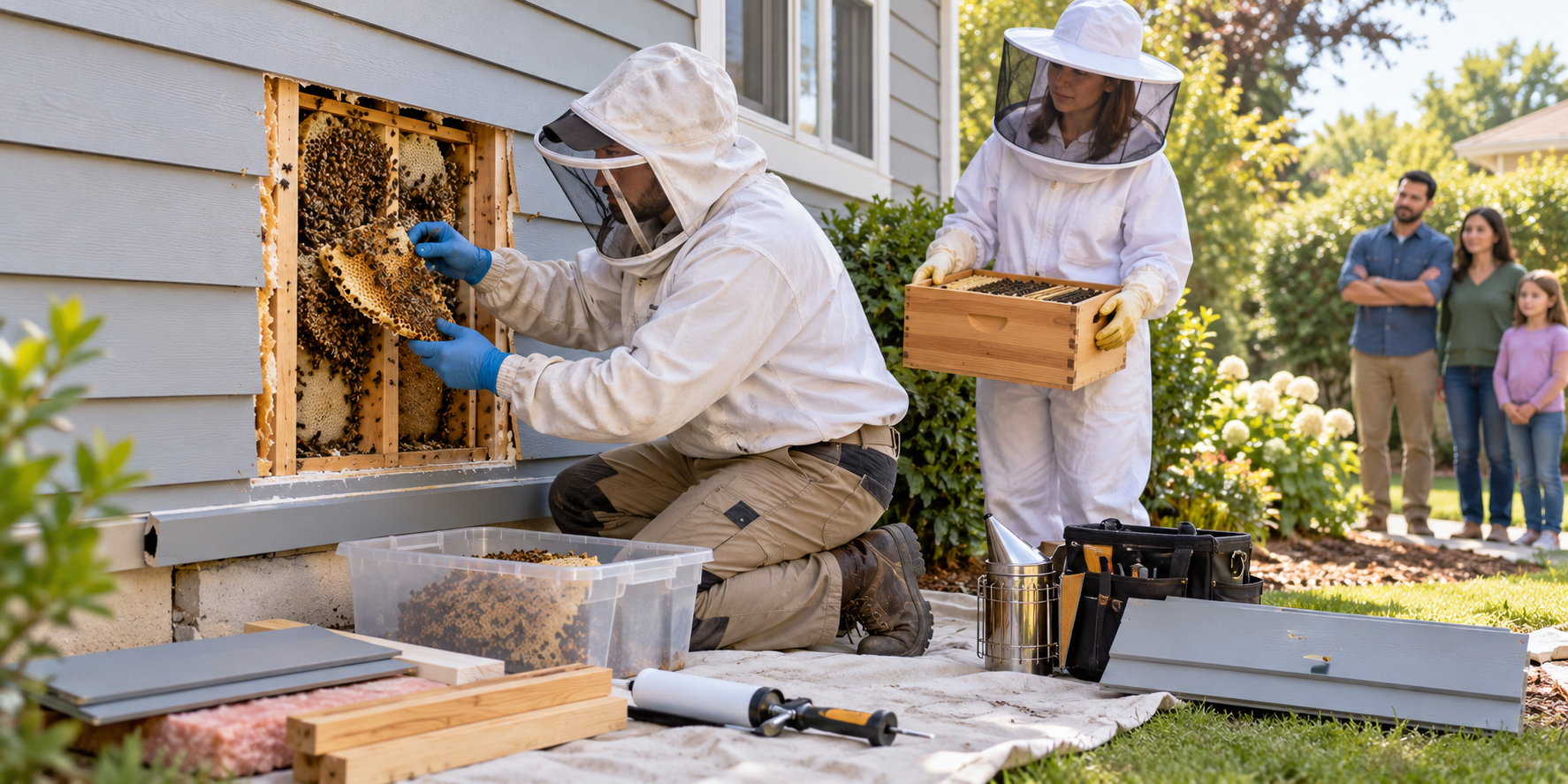
A bee colony inside a wall, roof, soffit, or chimney can turn a pest visit into a building-opening and restoration project. Broad U.S. wildlife-removal observations support a planning expectation of hundreds of dollars for limited access, while established colonies with opening, comb, residue, exclusion, and repair can reach the low thousands. Canadian availability and pricing vary sharply by region; obtain a local quote in CAD.
Confirm a colony before pricing removal
A swarm, a few foraging bees, a bumble-bee nest, and an established honey-bee colony do not create the same job. Ask the provider to identify what is present, whether a colony is established, where it is located, and whether live removal or relocation is available locally.
An exposed nest that can be handled without opening the building is a different scope from bees entering through a soffit or chimney and building comb inside. A photo from the ground may not reveal the cavity, colony size, residue, or condition of the assembly.
The full job has several scopes
| Scope | What can be included |
|---|---|
| Assessment | Species or colony confirmation, location, access, and safety review |
| Removal | Live-colony removal or another qualified method appropriate to the site |
| Building access | Opening siding, trim, soffit, roof edge, masonry, chimney, or drywall |
| Comb and residue | Removal of honeycomb, honey, debris, or material that could attract new pests |
| Exclusion | Closing the cavity and correcting the entry route |
| Restoration | Roofing, siding, masonry, drywall, paint, trim, or finish matching |
| Follow-up | Monitoring, reinspection, or confirmation of closure |
The pest or wildlife provider may own only the first and fifth scopes. Ask for a written handoff to the carpenter, roofer, mason, or finish contractor if the building must be opened or repaired.
What drives the price
The largest cost changes usually come from location and access rather than the number of bees seen. A high roofline, chimney chase, finished wall, narrow crawlspace, or fragile historic assembly requires more planning and restoration. A colony that has been present long enough to create significant comb or residue can add removal and cleaning time.
Travel, limited local availability, seasonal demand, safe staging, and whether a beekeeper or pest/wildlife contractor is needed can also affect price. Live removal may not be available for every species, location, or condition, so ask what the provider is actually offering rather than assuming “removal” means relocation.
Protect the building after the colony is gone
Closing only the visible hole can leave another route open. The contractor should identify how the insects entered and whether the cavity is dry, clean, and suitable for closure. If the opening involves roofing, siding, masonry, a flue, or ventilation, the repair must preserve the assembly’s intended function.
Do not block a suspected opening while bees remain inside. Do not inject a product into a wall or chimney based on a generic recommendation. Chemical use, if proposed, must follow the applicable label and qualified-provider requirements.
Compare a colony-removal proposal
Ask for the following in writing:
- what insect or colony condition was identified;
- whether the price covers inspection, removal, opening, comb, cleanup, closure, and repair;
- whether live removal or relocation is available and what it means in this market;
- how the provider will protect occupants during the work;
- who owns roof, siding, chimney, masonry, drywall, or finish restoration;
- what happens if a larger cavity or additional entry is found;
- whether follow-up and recurrence prevention are included.
If the quote is only for treatment, price the building repair separately. A low pest invoice can leave the largest economic exposure untouched when comb, moisture, openings, or finishes remain.
Low, typical, and complex colony scopes
A low-complexity project may involve an accessible swarm or a cavity that can be reached without opening a finished assembly. A typical building-colony project may require opening siding, trim, soffit, roof edge, or chimney material, removing comb and residue, closing the cavity, and arranging follow-up. A complex project may involve high access, historic fabric, extensive honey or contamination, multiple openings, or restoration by several trades.
Ask the provider which scenario the proposal assumes. “Bee removal” can mean an assessment, a live-colony service, or only a treatment. Those are not comparable deliverables. Ask whether a beekeeper, pest professional, wildlife contractor, roofer, mason, or carpenter owns each step.
Residue affects future risk and repair
An empty cavity can still contain comb, honey, moisture, or material that attracts other insects or creates odor. The provider should explain what is removed and what is left in place. If a wall, roof, or chimney cannot be opened safely, the proposal should say so and identify the remaining uncertainty.
Closure also needs to address the route, not only the hole where bees were first observed. A roof, vent, chimney, or siding repair must preserve weather protection and the function of the assembly. Do not fill a cavity with an unapproved material or block a functional opening.
Live removal is not a universal promise
Local availability, species, colony condition, access, and timing affect whether live removal or relocation is offered. Ask what “relocation” means, whether it is guaranteed, and what happens if the colony cannot be safely recovered. A transparent treatment or removal proposal is more useful than a promise that does not describe the method or restoration.
How to protect the rest of the property
Before work starts, ask how the contractor will protect occupied rooms, finishes, roofing, siding, chimney components, and landscaping. An opening may expose weather-sensitive material or allow residue to migrate. Temporary protection, debris handling, and finish matching should be visible in the proposal.
If a colony cannot be reached without substantial demolition, ask for an inspection-only phase and a written decision point. That can be more economical than authorizing a full opening based on an uncertain location. Keep structural, roof, masonry, and finish decisions with the appropriate professionals.
Use an inspection phase when the cavity is unknown
If the bees are entering a wall, roof, soffit, or chimney but the colony location is not visible, ask for an inspection and access plan before approving full removal. The inspection should identify the likely cavity, building material, safe opening, live-colony possibility, residue, and restoration path. This can prevent paying for an unnecessary opening or a treatment that leaves comb in place.
Ask whether the provider coordinates with a beekeeper or another contractor, how the property will be protected, and what happens if live removal is unavailable. Keep the cost of access, closure, weather protection, and finish matching separate from the biological service.
The restoration allowance should be explicit
Ask whether the price includes matching siding, trim, roofing, masonry, drywall, paint, or chimney material. If it does not, get a separate allowance from the responsible contractor. A colony project can be successful biologically while still leaving an open cavity or unfinished building surface.
Do not hide the cavity condition
Ask the contractor to document whether the cavity is dry, accessible, cleared of comb, and ready for closure. If it cannot answer one of those questions, keep that uncertainty in the budget and ask what later inspection or repair is needed. A finished surface does not prove that the former colony condition was resolved.
Confirm the colony’s endpoint
Ask whether the provider is removing live bees, comb, residue, or only treating an entry point. A cavity can remain attractive or require repair even after visible activity falls. The quote should identify access, temporary opening protection, disposal or handling, exclusion, and restoration, with each trade’s responsibility stated. If the species or colony status is uncertain, pause before sealing and obtain the appropriate identification or legal guidance. A clear endpoint protects both the building and the budget from a second opening after a partial removal.
Confirm the restoration handoff
Ask who removes comb and residue, who confirms the cavity is ready to close, and who repairs siding, masonry, roofing, drywall, or trim. Keep species identification and lawful handling visible when the colony is protected or the method is uncertain. A provider can document bee removal without certifying the cavity’s moisture, structural, or finish condition. The written handoff should state what remains open and who owns the next decision.
Bottom line
Think in hundreds to low thousands of U.S. dollars for planning, with wide uncertainty because a colony inside a building is not a standard service visit. Confirm the species and cavity, separate live removal from repair, and obtain local CAD pricing. The complete budget includes access, comb and residue, exclusion, and restoration—not just the insect-control step.