
Whole-home pest exclusion is priced by the amount of inspection, access, sealing, screening, minor carpentry, and repair—not by one universal “pest-proofing” rate. A short visit to correct a door gap is a different project from tracing wildlife entry along a roofline or repairing a crawlspace perimeter. In the U.S., general pest work may range from a few hundred dollars for routine service to much more when difficult access, attic work, or building repair is involved. Canadian homeowners should obtain a local CAD quote.
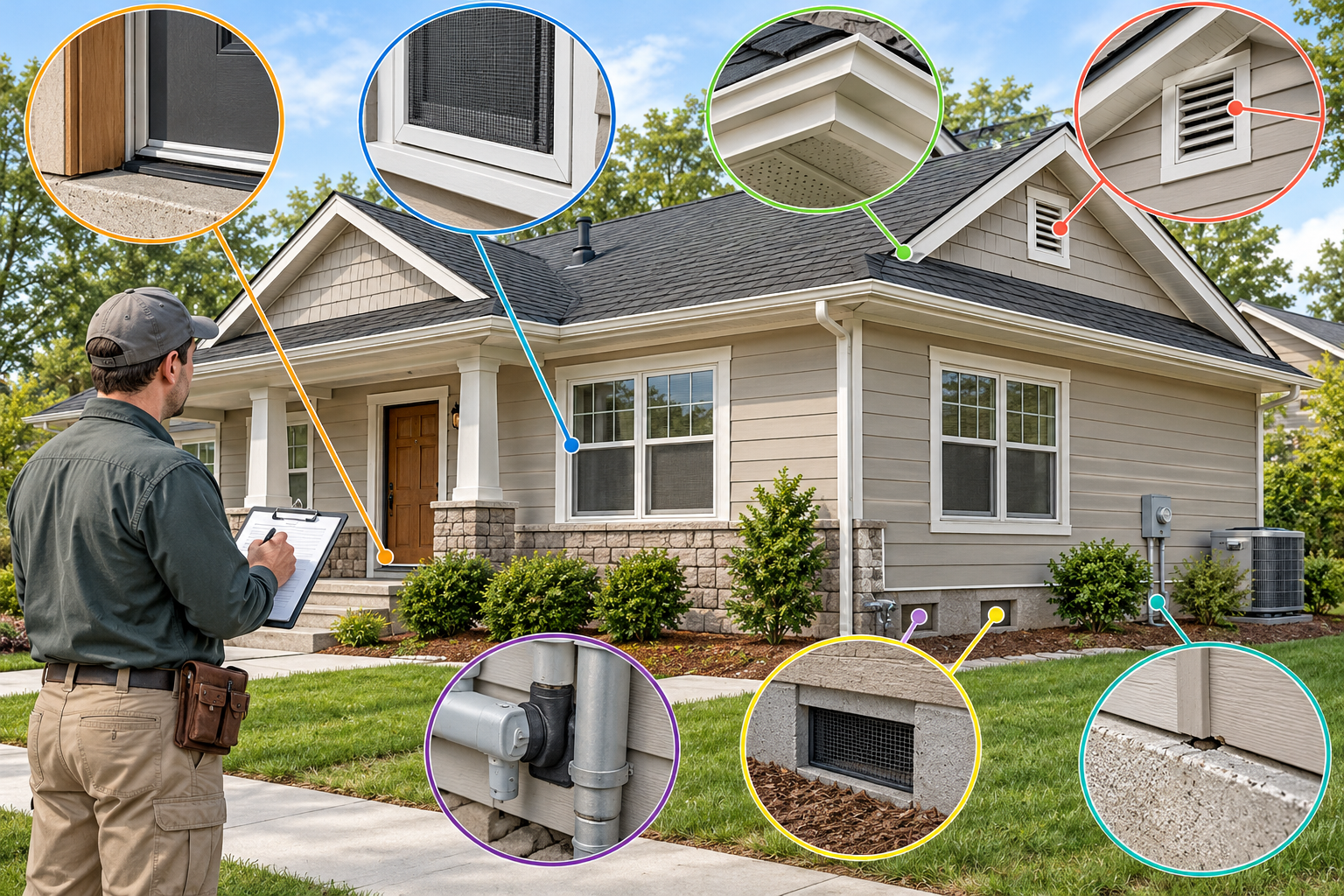
What a professional exclusion survey looks for
The survey should map likely access rather than simply apply sealant wherever a gap is visible. Typical areas include doors and thresholds, window and vent screens, utility penetrations, foundation openings, garage edges, crawlspace access, roof/eave/soffit transitions, chimneys, and damaged siding or trim. The provider may also identify food, water, shelter, branches, firewood, or moisture conditions that increase pressure.
EPA guidance identifies tight screens and openings, sanitation, removal of standing water, and correction of leaks as common prevention measures. Health Canada similarly connects rodent control with closing access points and removing food and shelter. Those sources support the prevention principle, not a universal construction detail or price.
A practical scope ladder
| Exclusion scope | Typical work | What can move the cost |
|---|---|---|
| Minor seal-up | Small cracks, door sweep, screen repair, limited penetrations | Number of locations and whether the surface is accessible |
| Room or foundation perimeter | Multiple openings, crawlspace access, utility entries, basic screening | Tight access, concrete or masonry, amount of inspection |
| Whole-home exclusion | Exterior survey, roofline, vents, doors, foundation, attic or crawlspace | Stories, perimeter length, number of openings, travel, follow-up |
| Wildlife exclusion | Confirm vacancy, coordinate timing, one-way or specialized barrier, repair | Species, den/nest status, height, legal requirements, repeat visits |
| Building repair | Roofing, siding, masonry, framing, drainage, or major carpentry | Material, concealed damage, permits, access equipment, finish restoration |
The boundary varies by provider. Ask the company to identify the exact opening, proposed material, expected service life, and what happens if the opening is larger or more damaged than it appeared from the ground.
Do not seal the wrong opening
An opening can be part of a building system. Vents may serve bathrooms, attics, crawlspaces, dryers, or combustion appliances; other gaps may allow drainage or drying. A suitable screen or guard is not automatically a solid plug. The provider should explain how the repair preserves the opening’s intended function and complies with the relevant product or building requirements.
Wildlife adds another boundary: make sure the animal, den, nest, eggs, or young are not inside before closure. Ontario guidance warns against sealing animals in and identifies autumn after young have left as a useful example, not a universal calendar. Local species, season, and law control.
Price the access, not only the material
Sealant, mesh, flashing, and a replacement sweep may be inexpensive. Labor can dominate when the provider must work at a roof edge, chimney, high soffit, crawlspace, or concealed wall. A wildlife provider may need several visits to confirm activity, remove an animal, install a barrier, and return to close or inspect the opening. Travel and limited local availability can matter in rural or seasonal properties.
Ask whether the price includes a written entry map, photographs, follow-up, cleanup, and a warranty. A “warranty” may cover the installed exclusion work but not new damage, a different entry path, a roof failure, a tree limb, or a building repair outside the provider’s scope.
Connect exclusion to the active problem
If animals or insects are present, exclusion may need to be sequenced after treatment or removal. Closing an occupied wildlife opening can trap an animal or separate a mother from young. For rodents, active control and exclusion may overlap, but the quote should say whether traps or monitoring remain after seal-up. For termites and carpenter ants, exclusion alone does not replace colony treatment or moisture correction.
The full budget may include:
- inspection and species identification;
- treatment, removal, or monitoring;
- exclusion materials and labor;
- moisture, plumbing, roof, or landscape correction;
- contaminated insulation, nest, droppings, or odor cleanup;
- drywall, siding, roofing, masonry, wiring, or structural repair.
Those follow-on scopes belong to the appropriate specialist, even when the pest company identifies the need.
How to compare proposals
Give each provider the same photos and access information, then ask for a line drawing or list of locations. Compare the number of openings, materials, height/access assumptions, interior or exterior work, animal-occupancy checks, follow-up, exclusions, and repair responsibility. Reject vague promises that the house will be “sealed completely” unless the provider defines what that means.
Match the work to the building
A small project may involve door sweeps, damaged screens, accessible utility gaps, or minor seal-up. A typical whole-home project may include a perimeter survey, attic and crawlspace access, roofline observations, vents, foundation openings, and follow-up. A complex project may become roofing, siding, masonry, carpentry, insulation, or structural work.
The scope should explain which condition is being corrected and why it is connected to the pest problem. A generic list of possible openings is not a diagnosis. Ask for photographs, a location map, inaccessible areas, material assumptions, access equipment, and the person responsible for each repair.
Quote scenarios and change orders
Ask whether the quote is a fixed scope, an allowance, or a time-and-materials inspection followed by work. Confirm how the price changes if a gap is hidden behind siding, a soffit is rotten, a roof edge is unsafe, or an opening serves ventilation or drainage. A clear change-order rule is more useful than an unrealistically low whole-home promise.
The warranty also needs a boundary. Some providers guarantee their installed seals for a period; others guarantee only that identified openings were addressed. Ask whether new damage, animal chewing, roof movement, inaccessible areas, or another species is excluded.
Prevention is not a substitute for treatment
Exclusion can reduce recurrence, but it does not necessarily remove an active animal, nest, colony, or contaminated material. Sequence control and closure so that an animal is not trapped inside. For bats, birds, raccoons, squirrels, and other wildlife, local species and timing rules can change the method.
A useful handoff document
Ask the exclusion contractor to provide photographs, a marked route map, materials, access assumptions, openings left untouched, warranty terms, and any work assigned to another trade. Give that document to the roofer, mason, carpenter, plumber, electrician, or building-envelope contractor who must complete the adjacent repair.
The handoff should say whether the animal or pest was controlled before closure and how the provider will confirm that. If the source is a protected animal, nest, or maternity roost, timing and lawful methods must be resolved before the building is sealed.
A low price can hide a narrow boundary
Ask whether the quote covers only visible gaps, a defined elevation, or all accessible routes. Ask how the provider treats new openings discovered during work and who decides whether a larger carpentry or envelope repair is necessary. These details determine whether the exclusion is a durable correction or a limited patch.
Check the finished opening
The handoff should identify what was sealed, what remains open, which materials were used, and whether the repair preserves ventilation, drainage, access, and other building functions. Ask for photographs before concealment and for a warranty that matches the actual area inspected. If the opening is near roofing, masonry, utilities, or a shared wall, assign the adjacent repair to the appropriate trade. A durable exclusion is not just a bead of sealant; it is a documented change that should remain compatible with the building and the pest-control sequence.
Confirm the building handoff
Ask for before-and-after photographs, a list of openings addressed, materials used, and any locations the contractor could not reach. Confirm that the work does not block required ventilation, drainage, or access and that another trade owns any roof, masonry, or utility repair. The completion note should also say whether active animals or insects were controlled before sealing. That information makes the exclusion useful to the next inspection and gives the warranty a defined boundary.
Bottom line
Home exclusion is worthwhile when it addresses a real access path while preserving required ventilation, drainage, and building functions. Start with an inspection and a location-specific scope. Use local CAD quotes in Canada and treat U.S. market observations as orientation only. The most useful quote shows how exclusion connects to treatment, source correction, cleanup, and repair.