
Professional treatment for ordinary household ants often falls in the low hundreds of U.S. dollars, with specialist market observations around $100–$500 for many routine pest projects. The range is only orientation. Species, colony location, season, access, follow-up, and whether entry-point correction is included can change the total. Canadian homeowners should obtain local CAD pricing rather than convert a U.S. estimate.
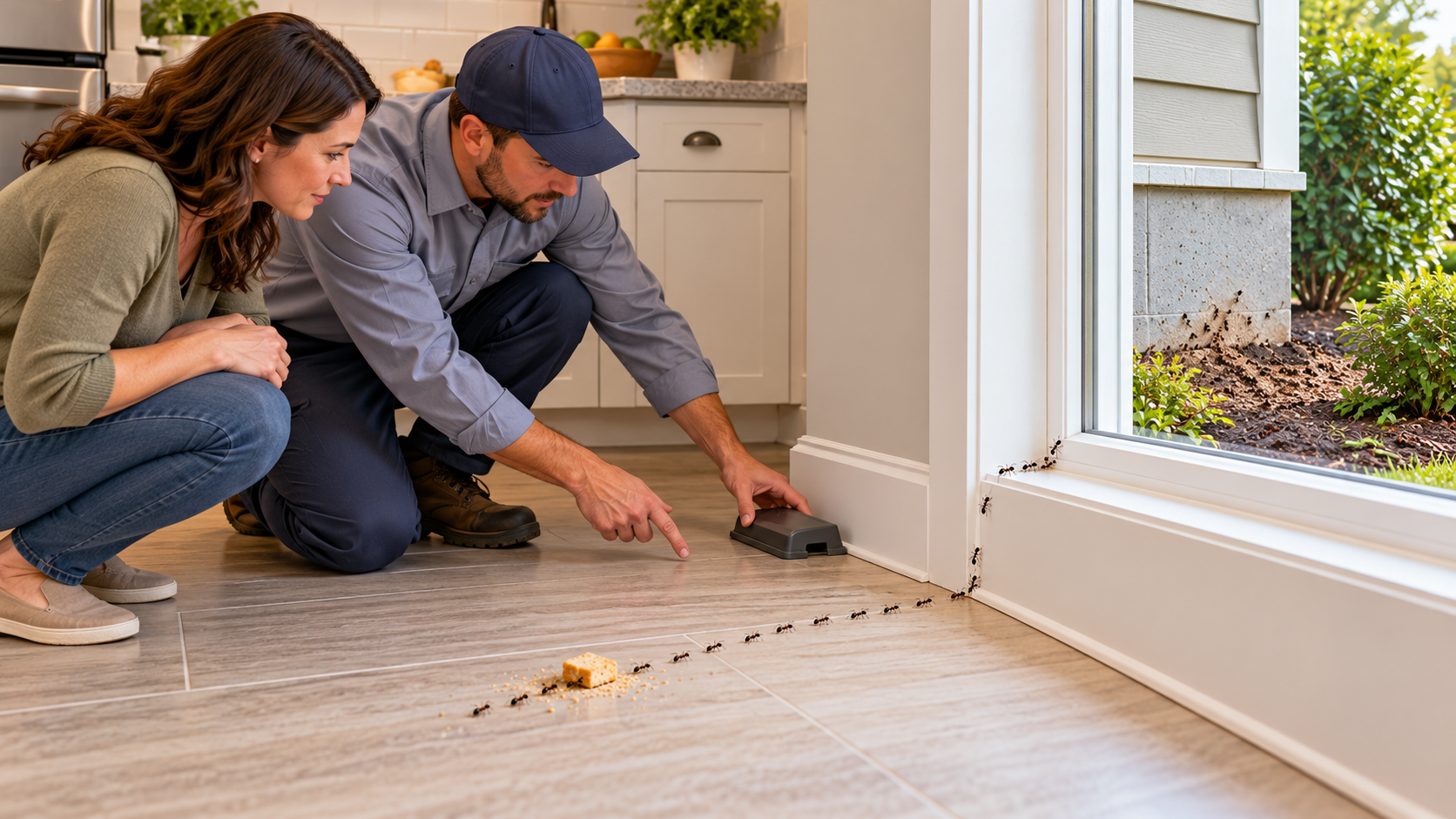
Identify the ant before choosing the service
Ordinary nuisance ants and carpenter ants do not represent the same building decision. Health Canada’s guidance treats carpenter ants as a wood-damaging concern that can be associated with moist or decayed wood, while many household ants are primarily a food, access, or seasonal nuisance. Fire ants, pharaoh ants, carpenter ants, and other species also differ in behavior and control requirements.
Visible workers do not tell you where the colony is. Ask whether the provider identified the species or is pricing a general service visit. If there is sawdust-like material, activity around damp wood, repeated emergence from a wall, or concern about structural material, use the carpenter-ant treatment guide rather than treating the problem as routine perimeter service.
What a household-ant quote may include
The proposed scope can combine:
- inspection and identification;
- targeted bait or other registered treatment;
- interior spot treatment where appropriate;
- exterior or perimeter work;
- food, water, and shelter corrections;
- sealing or repair of accessible entry points;
- a follow-up visit;
- seasonal or recurring service.
The provider should tell you whether the quote covers one room, the whole structure, the exterior perimeter, or a defined service period. A product or visit count without a treatment area is difficult to compare.
Why killing visible ants may not solve the problem
Ant activity can be supported by food residue, moisture, vegetation touching the building, cracks, utility penetrations, or an exterior colony. EPA integrated-pest-management guidance emphasizes reducing food, water, shelter, and access alongside appropriately selected controls. A treatment that reduces visible workers without correcting the route may lead to another call.
That does not mean every crack should be sealed immediately. Some openings serve ventilation, drainage, expansion, or other building functions. Ask whether the provider is identifying an entry path, and have the appropriate trade correct it when the work involves siding, roofing, masonry, plumbing, or structural material.
Baits, barriers, and recurring service
The right method depends on species, colony location, product label, and property conditions. Baits may be used as part of a targeted professional plan; perimeter work may be useful when exterior pressure is predictable; and a recurring plan may make sense for seasonal activity. Do not rank one approach as universally superior.
Compare the first visit with the full service period. Ask whether follow-up is included, what activity counts as a callback, whether a guarantee covers retreatment, and whether the plan excludes carpenter ants, termites, stinging insects, or wildlife. Product labels and local pesticide rules control actual use.
What changes the price
Expect a higher quote when the provider must locate activity in a wall, attic, crawlspace, or inaccessible exterior; inspect several rooms; work at height; return after monitoring; coordinate with a landlord or association; or separate ordinary ants from a wood-damaging species. A large house does not automatically need more treatment, but perimeter length and access can affect labor.
The cost can also rise when a homeowner wants a building correction rather than a treatment-only visit. Door and screen repair, siding or trim work, moisture correction, and vegetation management belong to separate scopes when they exceed minor pest-service work.
When professional service is worth pricing
A professional quote is especially useful when activity is persistent, the species is unclear, a nest may be concealed, the home contains sensitive occupants, or previous treatment did not solve the problem. Ask for an explanation of evidence, affected areas, method, preparation, follow-up, and exclusions.
Avoid improvising with multiple pesticides, foggers, or products from another jurisdiction. Use only products and methods that the provider or label says apply to the location and pest.
Three common service patterns
An isolated trail into a kitchen may need identification, a targeted treatment, and a check for food or water sources. Seasonal exterior pressure may lead to a perimeter or recurring proposal, but the provider should explain what evidence supports that schedule. Activity emerging from a wall, damp trim, attic, or subfloor warrants a more focused inspection because carpenter ants or another wood-destroying organism may change the project.
The service pattern affects cost more than the number of ants seen on a single day. Ask whether the price covers one room, the interior and exterior, a defined number of visits, or a continuing plan. Do not compare a one-time treatment with a seasonal program until the included follow-up and exclusions are clear.
Baits and barriers need a realistic expectation
A professional may select baiting, targeted treatment, perimeter work, or a combination based on species and colony location. The purpose is not simply to remove visible workers. The plan should explain what evidence will show that activity is declining and whether a return visit is included.
Product choice and use are controlled by the current label and local pesticide rules. The homeowner should not add a second product because the first visit did not produce an immediate visible change. Ask the provider how long the method is expected to take and what behavior or cleaning action could interfere with it.
When ordinary ant coverage is the wrong page
Carpenter ants can occupy or exploit moisture-damaged wood and may require a nest search, moisture investigation, or repair handoff. A general service quote that treats all ants as the same can understate the decision. Use carpenter-ant treatment cost when the evidence points to wood damage, concealed nesting, or recurring activity around damp material.
If the issue is a building opening, do not fill it without considering ventilation, drainage, siding, roofing, and structural functions. The appropriate trade may own the repair.
A simple quote comparison
Ask each provider to identify the ant if possible, state the indoor and exterior areas, explain the method, list follow-up, and identify whether exclusion or moisture work is included. Ask how the provider will handle activity that remains after the first visit and whether the guarantee covers only retreatment.
If the evidence points to a nest in a wall, damp wood, or recurring damage, do not force the project into ordinary seasonal service. A focused inspection may cost more up front but can avoid paying for repeated visits that do not address the colony or building condition.
Use monitoring when the diagnosis is uncertain
When activity is intermittent or the colony location is unclear, a focused inspection or monitoring period can be more useful than repeated broad treatments. Ask what observation will change the recommendation and how the provider will protect the building from recurrence.
Do not turn a seasonal observation into a whole-home claim
Ask whether the provider has evidence of an indoor colony, a recurring exterior route, or a one-time event. A targeted service may be enough when activity is bounded. A broader proposal should explain the area, method, follow-up, and why the added scope reduces recurrence.
Separate the first visit from the recurrence plan
Ask what the first visit is expected to accomplish, what evidence will be reviewed afterward, and what would justify another treatment. The price may cover an inspection, bait or targeted application, exterior correction, or a callback—not all of those at once. Ask whether food, moisture, vegetation, cracks, utility penetrations, or neighboring units are part of the recurrence discussion. If the provider recommends a broader program, request the reason, service frequency, renewal price, and stopping rule in writing. This keeps a routine ant issue from quietly becoming an open-ended contract.
Ask when the service is complete
The endpoint may be no observed activity for a stated period, a located colony, a corrected entry route, or a completed follow-up—not simply that an application occurred. Ask how the provider records that result and what the callback covers. If activity continues in another room or returns after weather changes, the next scope may be diagnosis or source correction. A written endpoint helps a homeowner compare a targeted visit with a recurring plan and keeps the price tied to the actual problem.
Bottom line
Use $100–$500 U.S. as a broad routine-service orientation, not a promise. The meaningful cost question is whether the proposal identifies the species, reaches the colony or route, includes follow-up, and addresses recurrence without absorbing unrelated structural or moisture work. Escalate carpenter-ant or wood-damage concerns to the appropriate inspection and repair scopes.