
Professional flea treatment for a home often sits in the low hundreds of U.S. dollars for a limited service area, with specialist market observations for routine pest work around $100–$500. A larger home, heavy activity, carpets and upholstery, outdoor sources, repeat visits, or extensive preparation can increase the total. Canadian homeowners should request a local CAD quote.
Treat the home and the source together
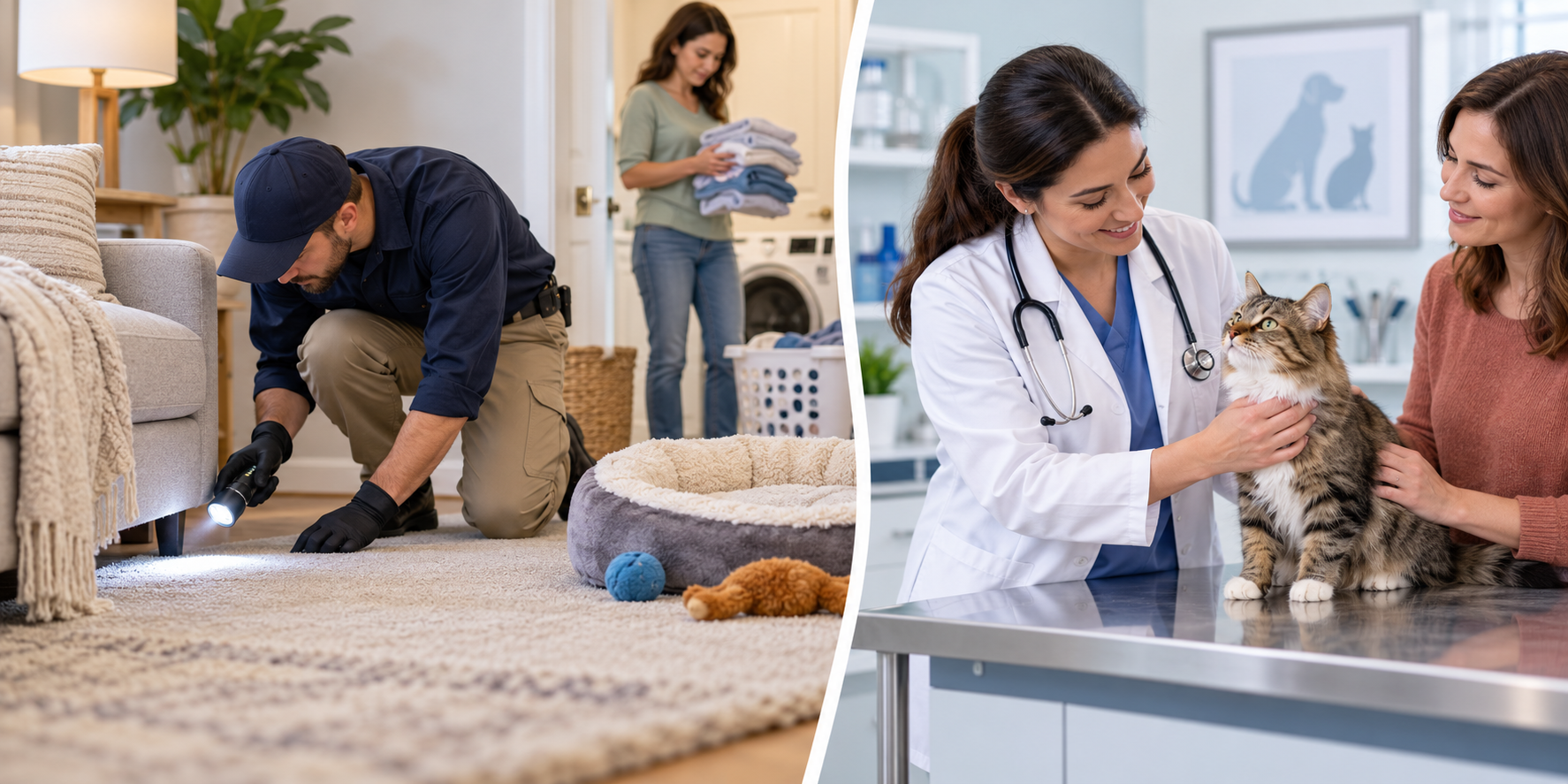
Flea control is not only a room-spray decision. The source may involve a pet, wildlife, an outdoor resting area, carpeting, upholstery, or a previous occupant. A pest professional can price the household treatment, but animal examination and medication belong to a veterinarian. Do not treat a pet with a household product or provide a pet-treatment budget as if it were part of the pest invoice.
Ask the provider to state what evidence supports a home infestation and which rooms or surfaces are included. Flea-like bites or an isolated insect may not establish the source. A correct identification can prevent paying for a broad treatment when the problem is elsewhere.
What the home-service scope may include
A proposal may cover:
- inspection and identification;
- treatment of carpets, flooring, upholstery, or other affected areas;
- preparation instructions;
- follow-up or a second visit;
- advice about pet and environmental coordination;
- limited exterior treatment where the source is demonstrated;
- reinspection or a callback condition.
EPA integrated-pest-management guidance supports removing food, water, shelter, and access opportunities while using products as directed. For fleas, that means the provider’s plan may involve cleaning and repeated attention to the life cycle rather than one isolated application.
Why repeat control may be part of the price
CDC advises coordinating household cleaning, veterinarian-directed treatment of every pet, and home treatment at the same time. Moderate-to-severe infestations may take months to control, and two or more follow-up treatments within 5–10 days after the first may be needed. This is U.S. consumer guidance, not a universal contractor schedule or product-label interval. Ask whether the quote includes those visits, what triggers another one, and keep veterinary care on a separate budget line.
Do not infer a failure from every later sighting, but do not accept an open-ended service plan without a defined decision rule. The useful question is how the provider will determine whether the home and source are moving toward control.
Preparation and household cost
Preparation can include vacuuming or cleaning as directed, moving furniture, giving access to baseboards and closets, laundering textiles, and arranging people or pets during the service. The exact steps depend on the product and method. Obtain written instructions and follow the current label and provider guidance rather than copying a generic online recipe.
The household may also pay for pet visits, approved pet products, cleaning supplies, temporary care, and follow-up. Those amounts vary too much for a universal estimate. Put them beside the pest-company price so that the total reflects the actual project.
Outdoor and building conditions
If activity is associated with a crawlspace, wildlife access, damaged screens, a porch, or an outdoor resting area, the quote may identify another scope. Exclusion, sanitation, landscape work, or finish repair may need separate contractors. A general flea treatment should not become an unsupported diagnosis of the building or pet condition.
Ask whether the proposal includes exterior areas and why. Treating a yard without a demonstrated source can add cost without improving the result. Conversely, ignoring a known source can make an interior-only plan incomplete.
Compare the proposal
| Quote question | Why it matters |
|---|---|
| What confirms fleas? | Bites and household observations can have other causes. |
| Which rooms and surfaces are treated? | The price depends on the actual area and furnishings. |
| How many visits are included? | Follow-up may be essential to the plan. |
| What preparation is required? | Household time, laundry, access, and pet arrangements are real costs. |
| Is pet or veterinary work included? | Usually it is a separate professional and invoice. |
| What is the callback rule? | It clarifies whether the plan addresses recurrence. |
Pesticides must be used by qualified providers according to applicable labels and jurisdictional rules. Do not add household foggers or combine products without professional direction.
Low, typical, and high-complexity cases
A low-complexity case may involve a confirmed home source, a small treated area, and one professional visit coordinated with the pet’s care. A typical case may include carpets, upholstery, preparation, and a return visit. A complex case may involve several rooms, repeated treatment, outdoor or wildlife sources, stored contents, or occupants who need a carefully planned re-entry period.
Ask the provider to explain which scenario the quote assumes. A broad service package can be wasteful if the source is not confirmed, while an interior-only treatment can be incomplete if an animal or outdoor condition continues to reintroduce fleas.
The pet and household must be coordinated
The home service cannot be judged separately from the animal-care plan. Ask the veterinarian which pet treatment is appropriate and when it should occur; do not use a household pesticide on an animal. Tell the pest provider about pets, children, aquariums, and sensitive occupants so the product and re-entry instructions are clear.
The cost of veterinary care, approved medication, boarding, bedding, laundry, and household preparation may exceed the pest invoice. Those amounts are variable and should be added as actual household lines rather than guessed from a generic flea-treatment average.
How to decide whether exterior work belongs
Exterior treatment can be reasonable when the provider has identified a relevant source or resting area. It may be unnecessary when the source is indoors or pet-related. Ask what evidence supports any yard, porch, crawlspace, or wildlife-related scope. If screens, doors, insulation, or building openings are involved, keep exclusion and repair as separate items.
How to compare treatment proposals
Ask each provider to identify the rooms, surfaces, preparation, products or method category, re-entry, follow-up, source assumptions, and exclusions. If one proposal includes pet coordination or exterior inspection and another does not, their totals are not directly comparable. Ask what happens when activity continues after the first visit and whether the callback depends on treating the pet or source.
Avoid paying for a broad treatment before the infestation and source are reasonably identified. At the same time, do not assume that an interior treatment solved the problem if a pet, wildlife source, or outdoor condition remains. The useful budget follows the source evidence.
A household decision checklist
Before approving, confirm what proves fleas are present, what rooms are treated, what preparation is required, what the provider expects from pet care, how many visits are planned, and what evidence triggers a callback. Put veterinary, laundry, boarding, and household labor in separate lines. Ask what happens if the source is wildlife or an outdoor condition rather than the pet or carpet.
The goal is not the cheapest spray. It is a bounded plan that addresses the home, the source, follow-up, and safe re-entry without adding unsupported products or unnecessary exterior work.
Treat the estimate as a coordinated household budget
The correct comparison includes the home service, pet care, preparation, follow-up, and source correction. A treatment-only price is not a complete answer when the source remains unresolved.
Review the source after treatment
If activity continues, ask whether the provider has evidence of a home residue, a pet or wildlife source, or a new introduction. That review is more useful than automatically buying another treatment. The next step may be veterinary care, source correction, cleaning, or a revised pest scope.
Clarify the follow-up test
Ask what the provider expects to see after treatment and how it will distinguish surviving activity from newly introduced fleas or an unresolved pet or wildlife source. The plan should identify preparation, re-entry, repeat visits, and any product restrictions for people and animals. If the source is outside the treatment area, the household may spend more without changing the result. Price the source investigation and pet or veterinary advice separately so the pest-service invoice does not imply that every cause has been addressed.
Bottom line
Use a broad U.S. planning band of $100–$500 for simpler home treatment, understanding that repeat visits and source correction can increase it. Budget veterinary and household preparation separately. The best proposal explains the home area, source assumptions, follow-up, safety instructions, and what another professional must handle.