
Angi’s current pest-control cost page shows a one-time visit for a 1,500-square-foot home at $108–$261 in Cost Insights and $300–$550 in a later national table. The page also reports a $172 average and $50–$500 broad range, without explaining how these displays relate, so they do not support one reliable typical price. Other recurring-service estimates give about $40–$70 monthly, $100–$300 quarterly, or $300–$550 annually; local scope and contract terms determine the usable comparison.
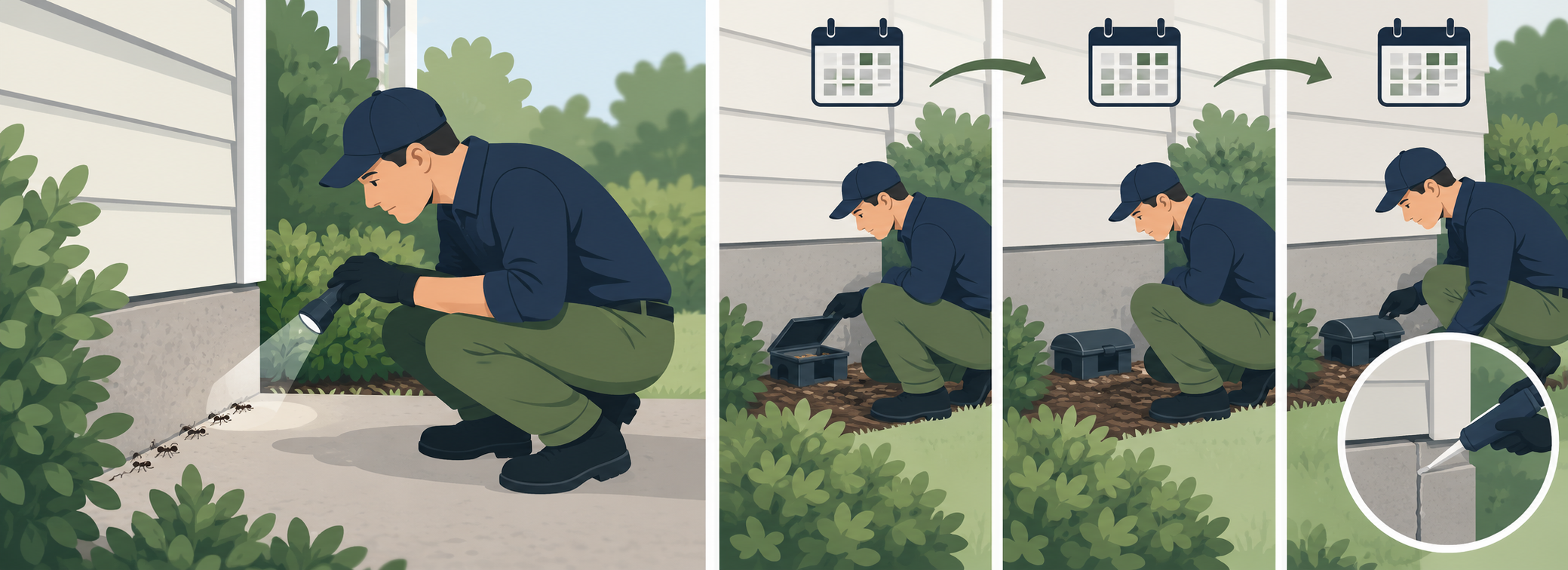
First decide what is recurring
Recurring service can make sense when pest pressure returns predictably, the property has conditions that cannot be corrected quickly, or monitoring is part of the control strategy. Seasonal ants, recurring stinging-insect activity, or a property with difficult access may justify scheduled inspections or preventive service.
It is a weaker fit when a single nest, isolated entry point, or short-lived event is the whole problem. Termites, bed bugs, wildlife, and contaminated spaces commonly require specialty programs rather than a generic monthly spray. The contract should identify those exclusions instead of implying that a general plan covers every pest.
What the first visit really includes
The initial recurring-service visit may cost more than later visits because it can include inspection, identification, initial treatment, documentation, and a starting service charge. A one-time treatment may also include only the immediate intervention. Compare the components, not just the first invoice.
| Cost component | One-time service | Recurring plan |
|---|---|---|
| Initial inspection | Free, bundled, or separately priced | Often part of the first visit, but confirm |
| Immediate control | Usually central to the visit | Usually included in the starting service |
| Preventive inspection | May be limited | May recur at the stated interval |
| Follow-up/callback | May be a limited guarantee or extra | May be included, excluded, or subject to conditions |
| Exclusion or building repair | Often excluded | Usually still a separate scope |
| Specialty pests | Often separately quoted | Frequently excluded or governed by an add-on |
EPA consumer guidance recommends asking what pests, locations, timing, preparation, re-entry precautions, follow-up, guarantees, and structural damage responsibilities are covered. That list is more important than the word “maintenance” in the sales description.
Do the break-even math
Use the actual contract rather than a generic monthly price. A simple comparison is:
Recurring total for one year = initial visit + scheduled visits + covered add-ons − credits.
Compare that number with the one-time service plus any likely follow-up visit and the cost of correcting the entry, food, water, shelter, or moisture condition. Repeat the exercise for two and three years. A plan with a low per-visit price can cost more if you rarely use the visits or if it does not address the reason pests return.
For example, a seasonal exterior service may be sensible if activity is reliably seasonal and the provider explains the covered perimeter and callback terms. It may be poor value if the actual problem is a leaking pipe, unsealed utility penetration, damp wood, or an occupied wildlife cavity. In those cases, the service plan may suppress symptoms while the building condition continues to generate cost.
Read the guarantee carefully
“Free retreatment” does not necessarily mean a refund, exclusion work, damage repair, or unlimited visits. Ask:
- Which pest and areas are covered?
- Is a callback limited to a time window or number of visits?
- Must the homeowner complete sanitation, repairs, or preparation?
- Is the plan void if another product or provider is used?
- Are termites, bed bugs, wildlife, and structural damage excluded?
- What happens when the plan is canceled, renewed, or transferred?
EPA guidance also warns that routine pesticide applications around a home are not automatically appropriate when pests are absent. A recurring plan should explain its inspection and prevention logic, not only promise a chemical application on every calendar date. Product labels and applicable state, provincial, territorial, and municipal rules control how products may be used.
The building may be the better investment
Integrated pest management combines prevention with appropriately selected treatment. Depending on the pest, useful corrections can include better food and garbage storage, leak repair, removal of shelter, improved screens, and carefully scoped exclusion. Do not seal a vent, drainage opening, or wildlife entry while an animal is inside or where doing so conflicts with the building’s intended function.
Separate treatment from exclusion, sanitation/source correction, and repair; price work owned by another trade separately. This shows whether a recurring plan includes the building changes that could stop pests from returning.
Compare the first year with the next two
Ask the provider to itemize active control, monitoring, exclusion, source correction, and repairs, then compare the initial inspection and treatment in year one with scheduled visits, callbacks, cancellation, and renewal in years two and three. A three-year view makes a one-time intervention plus durable repair comparable to a plan that may or may not address why pests return.
Use the same service definition for every provider. “Quarterly service” might mean an inspection, a perimeter visit, a retreatment only when activity is found, or a routine pesticide application. Those are different economic products. Ask how the plan handles specialty pests and whether the provider will price termites, bed bugs, rodents, wildlife, or structural repair separately.
Scenarios where recurring service can fit
Recurring service may be reasonable when pest pressure is seasonal and predictable, when the property has a persistent condition that cannot be corrected quickly, or when monitoring provides meaningful early warning. It can also be useful for a larger or attached property where routine inspection is part of a coordinated program.
It is a weaker fit for a single nest, a confirmed isolated entry point, a one-time wildlife event, or a problem caused by a repair that has not yet been made. A subscription should not conceal that the building remains open to pests.
Read the service promise
Ask who owns inspection, treatment, exclusion, sanitation, repair, and callback work. Confirm the covered pests, treated areas, visit frequency, guarantee, preparation, re-entry, cancellation, price changes, and transfer terms. EPA guidance cautions against routine pesticide use when pests are absent; a responsible plan should explain its inspection and prevention logic.
A decision rule for the homeowner
Choose a one-time service when the pest, area, and cause are genuinely bounded and the quote includes the needed follow-up. Consider a recurring program when the risk is demonstrably seasonal, persistent, or monitoring-dependent and the contract describes what each visit accomplishes. If the plan does not address a known entry, moisture, food, or shelter condition, price that correction before committing to multiple years of service.
Keep the decision reversible where possible. Ask about cancellation, renewal, price increases, transfer, and what happens if the pest changes. A plan that is affordable in the first year may not be the right long-term purchase if it does not reduce the underlying risk.
Recheck the decision after the first visit
The first inspection may show that a recurring plan is unnecessary, or that a durable exclusion or source correction is more valuable. Ask the provider to revisit the service recommendation after the initial evidence is collected rather than treating the introductory plan as a permanent commitment.
Reprice after the evidence improves
Ask for a first-year total that includes the initial inspection, visits, follow-up, materials, and any required preparation. Then ask what renewal costs and what would end the program. If the first visit identifies a bounded problem or a durable entry correction, the recurring recommendation may change. If it identifies shared walls, seasonal exposure, or a source that needs monitoring, the longer plan may be more reasonable. Revisit that decision with actual service records instead of allowing an introductory price to set the entire ownership commitment.
Use the first visit as a decision point
Confirm what the initial visit will establish and what information will be available before renewal. A one-time scope may be enough when the pest, area, and cause are bounded; a monitoring plan may be useful when seasonality or shared-building exposure is documented. Keep preparation and follow-up responsibilities in the written scope so the choice responds to evidence rather than an introductory offer.
Bottom line
Choose one-time service when the problem is genuinely isolated and the quote includes the needed follow-up. Consider recurring service when the risk is demonstrably seasonal, persistent, or monitoring-dependent and the contract has a defined scope. Treat the first year and later years separately, and request Canadian pricing in CAD rather than converting U.S. observations.